On this page
Yes, and by a lot. Drop a freezer-cold tennis ball next to a warm one and the cold one bounces far lower. Here are real measurements, the two reasons for the gap, and a plan to test it with a phone camera.
What is the coefficient of restitution?
The coefficient of restitution, e, is the ratio of a ball's vertical speed just after a bounce to its speed just before it (Allen and Allen, arXiv). Bounce height depends on speed squared, so e also equals the square root of bounce height divided by drop height: e = √(h_after ÷ h_before).
The International Tennis Federation keeps balls for 24 hours at 20 ± 2 °C before testing, noting that high temperatures can affect the ball rubber and increase bounce height (ITF ball approval tests). Its test drops the ball from 254 cm, and a Type 2 (medium) ball must rebound 135 to 147 cm (ITF Rules of Tennis, Appendix I).
How much lower does a cold tennis ball bounce?
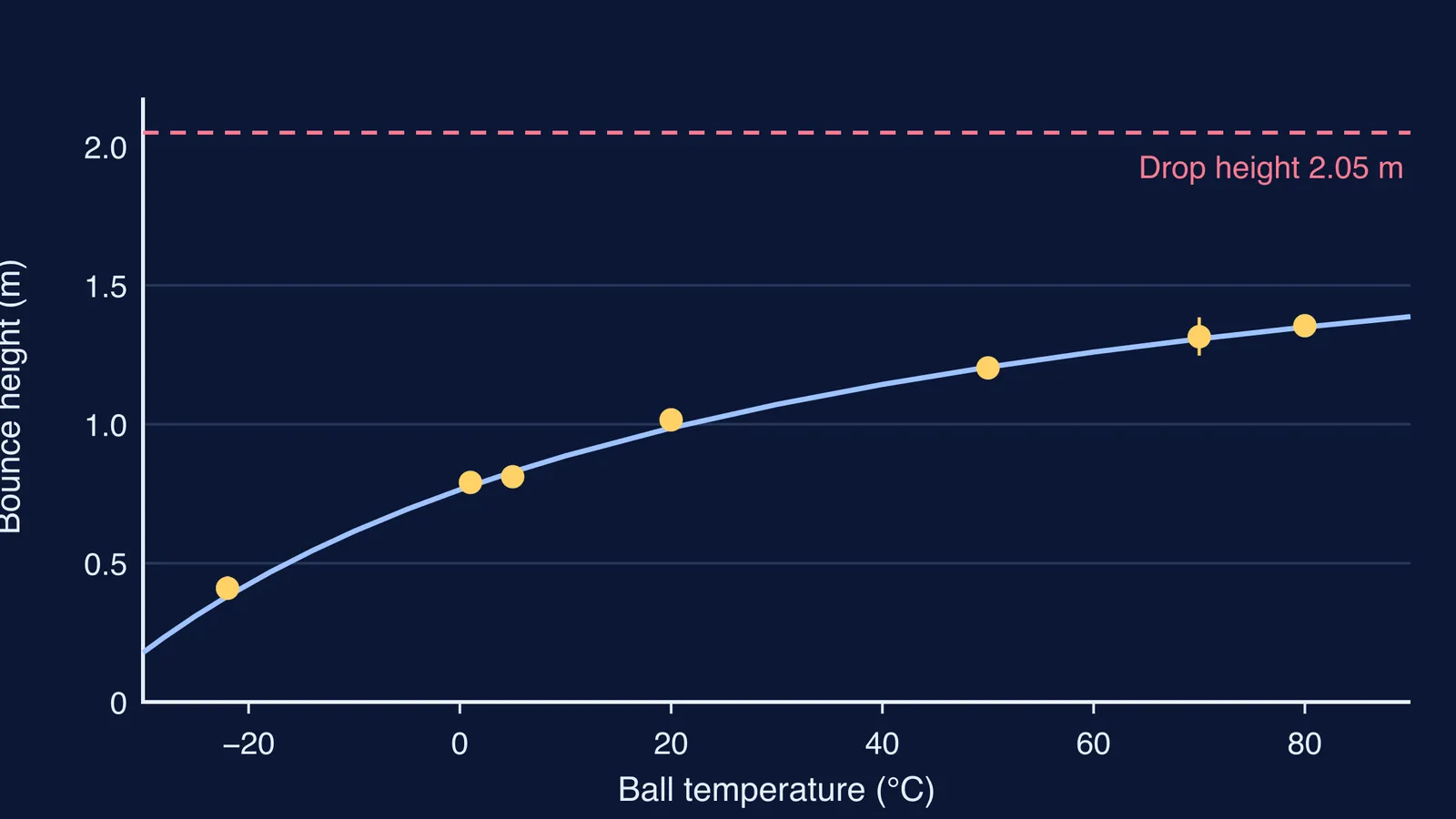
In Modeling the bounce of a gas-filled ball, Martin Allen and Bruce Allen dropped a tennis ball from the top of a door, 2.05 m up, at seven temperatures from −22 °C to 80 °C, filming each bounce on a phone, three drops per temperature. We converted their measured e values into bounce heights using h = 2.05 × e²:
−22 °C: e = 0.447, bounce about 0.41 m
1 °C: e = 0.621, bounce about 0.79 m
5 °C: e = 0.629, bounce about 0.81 m
20 °C: e = 0.704, bounce about 1.02 m
50 °C: e = 0.766, bounce about 1.20 m
70 °C: e = 0.801, bounce about 1.32 m
80 °C: e = 0.813, bounce about 1.36 m
The frozen ball reached about 40% of the room-temperature height (0.41 ÷ 1.02). One limit: the authors used a single old, "dead" ball and expect a fresh ball, with higher internal pressure, to differ.
Why does a cold ball bounce lower?
First, the gas inside pushes back less. The pressure of a fixed amount of gas is proportional to its absolute temperature, and the Allen model is built on that ideal gas law (arXiv). Worked example: 5 °C is 278 K, 40 °C is 313 K, and 313 ÷ 278 ≈ 1.13, so the warm ball's absolute pressure is about 13% higher. What pushes a squashed ball back out is the excess over outside air, the gauge pressure, which changes by a bigger fraction; see gauge pressure vs absolute pressure.
Pressure matters a lot: the same paper's basketball, at equal inside and outside pressure, had e = 0.407 and bounced only 34 cm, 17% of its drop height; at 27.7 psi absolute, e reached 0.869.
Second, the rubber may stiffen and waste more energy. After drilling a 4 mm hole to release the pressure, the Allens found their ball still bounced, so the rubber stores energy too, and they note earlier studies found tennis-ball rubber properties change significantly with temperature. A University of Illinois physics Q&A explains that flexing rubber heats up and makes noise, losing energy, and predicts that even a solid rubber ball will be less bouncy when cold (Ask the Van).
How do you work out the coefficient of restitution from your own drops?
A ball dropped from 254 cm (ITF ball approval tests) that rebounds 141 cm, the middle of the allowed Type 2 range, has e = √(141 ÷ 254) = √0.555 ≈ 0.75 (ITF Rules of Tennis). A made-up home result: dropped from 2.00 m, a fridge ball rises 0.80 m, so e = √0.40 ≈ 0.63. If e stays the same at lower speeds, as the Allen model assumes, each later bounce reaches e² times the height of the one before, as our test of bounce height after each bounce shows.
How to run the cold vs warm ball test at home
Use one pressurised tennis ball for every temperature, so ball age is not a hidden variable.
Cool it in the fridge or freezer for a few hours; warm it in warm tap water inside a sealed bag, then dry it. Those are the temperatures a University of Illinois physics Q&A suggests for this project (Ask the Van).
Tape a measuring tape to a wall and fix one drop height, such as 2.00 m, to the bottom of the ball.
Write your prediction before each set of drops.
Film in slow motion and read the highest point of the ball's bottom.
Drop three times per temperature, quickly, since your hand changes the ball's temperature. Average.
List drop height, bounce height and e for each temperature.
If the ideal gas law feels shaky, the Fermi Concept Library has a lesson for every concept in physics and chemistry. For ideas easier to see than read, the Fermi Simulation Lab has interactive simulations to explore alongside your drops. Then stack a tennis ball on a basketball and see why the top ball can bounce far higher.