On this page
Suppose you ask an AI to solve cos²x = sin x cos x and it answers x = nπ + π/4. That answer misses a whole family. A trig solution can look complete and still drop answers, or include ones that never worked. Two common steps cause these errors, and both are quick to test.
Why does AI lose solutions when it divides by cos x?
You can only divide by cos x when cos x is not zero. A LibreTexts precalculus chapter on trigonometric equations says that when you divide both sides by a variable expression, you are assuming the expression you are dividing by is nonzero. If cos x = 0 also satisfies the equation, those values silently drop out of the answer.
Take cos²x = sin x cos x, a practice problem in a Rochester Institute of Technology handout on solving trigonometric equations. If you divide by cos x, you get tan x = 1, so x = nπ + π/4. If you factor instead, you get cos x (cos x − sin x) = 0, which gives two families:
cos x = 0, so x = nπ + π/2
cos x = sin x, so x = nπ + π/4
The handout's answer key lists π/2 and 3π/2 next to π/4 and 5π/4 between 0 and 2π. Dividing by cos x loses half of them.
The quick test: whenever the working divides by something with x in it, set that to zero and try those values in the original equation. At x = π/2 both sides equal 0, so a family is missing.
Why does squaring both sides add solutions that don't work?
Squaring keeps every true solution but can add new ones, because a = b and a = −b both turn into a² = b². The LibreTexts chapter names three cases where you must check solutions: a function with a restricted domain, multiplying both sides by a variable expression, and applying an even power (such as a square) to both sides. It also works an example where x = π comes out of the squared equation but fails in the original.
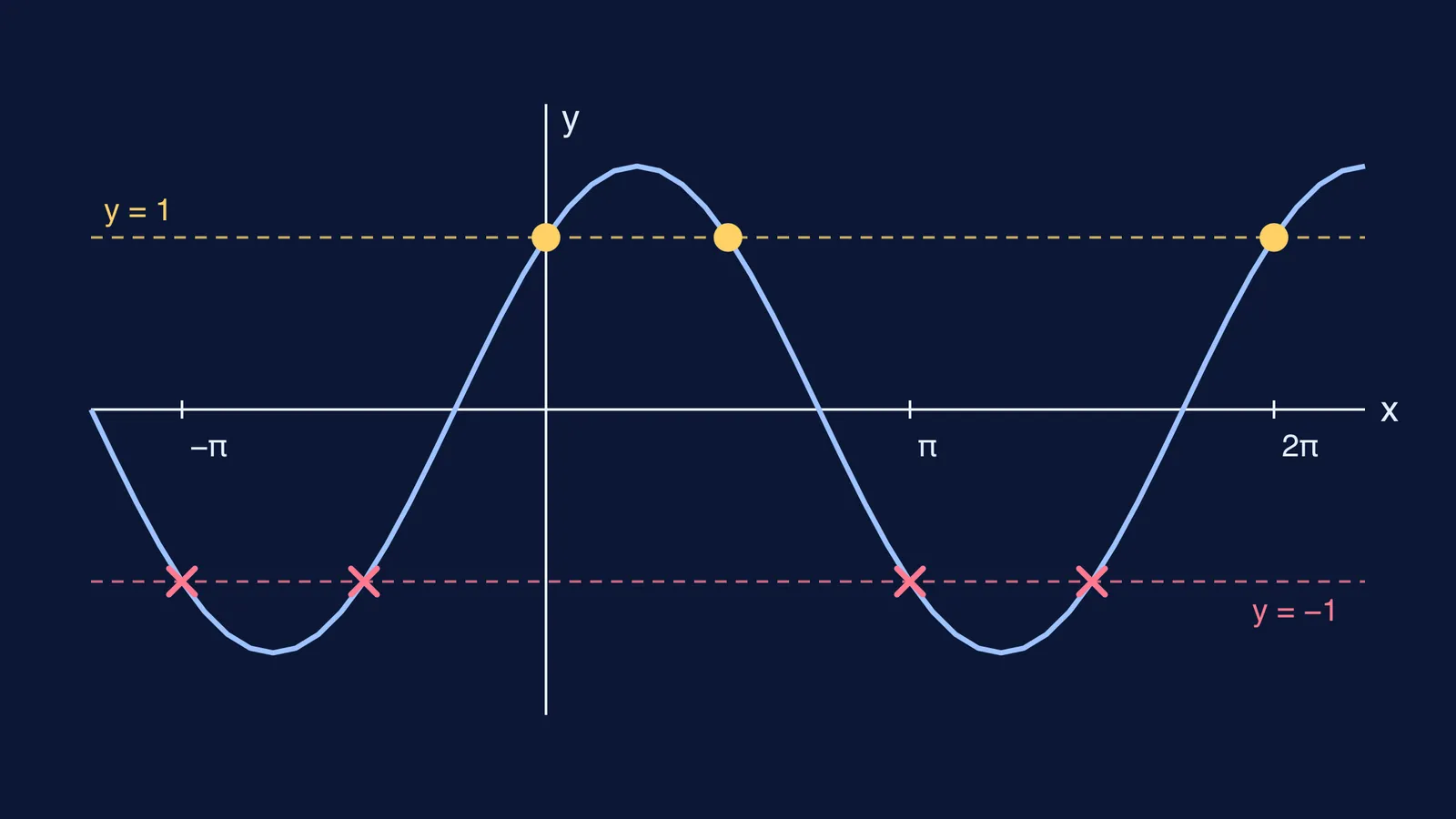
Try sin x + cos x = 1. Squaring gives sin²x + 2 sin x cos x + cos²x = 1, so sin 2x = 0 and x = nπ/2. If an AI stops there, its answer is only half true. Put in n = −1, 0, 1:
n = −1, x = −π/2: sin x + cos x = −1 + 0 = −1. Fails.
n = 0, x = 0: 0 + 1 = 1. Works.
n = 1, x = π/2: 1 + 0 = 1. Works.
One failure proves x = nπ/2 is wrong as written. The squared equation also accepts sin x + cos x = −1, which is where the fake values come from. The correct answer is x = 2nπ or x = 2nπ + π/2. See why squaring both sides gives extra roots for the same effect in algebra, and why squared trig equations give nπ ± α for equations like tan²x = 3.
How do you check an AI's trig solution step by step?
Write down the original equation, before any working.
Scan the AI's steps for two moves: dividing by an expression containing x, and squaring both sides.
For each division, set the divisor to zero, solve, and test those values in the original. If any work, a family is missing.
For each family the AI gives, put in n = −1, 0, 1 and test every value in the original equation. Use exact values such as sin(π/2) = 1, not calculator decimals.
If a family's values are closer together than the original equation's period, test more n until you cover one full period.
Count the solutions between 0 and 2π and compare with a graph of both sides. Our guide to checking an AI's graph claims by plotting the function shows how.
What should you tell the AI after the check?
Give it the exact value that broke its answer, and ask it to name the step. For example:
For a lost family: x = π/2 satisfies the original equation but is not in your answer x = nπ + π/4. Solve again by factoring instead of dividing, and list every family.
For a fake family: x = −π/2 is in your family x = nπ/2 but gives sin x + cos x = −1. Which step added it, and what is the correct general solution?
Work out your own corrected answer before you read the reply, so you are checking the AI rather than swapping one answer for another.
The Fermi Problem Library has worked problems with a step-by-step solver that explains the reasoning rather than printing an answer, so you can spot where a factor should have been kept. If general solutions still feel shaky, the Fermi Concept Library gives every concept in mathematics its own lesson.
Next time an AI hands you a general solution, test the divisors and three values of n before you copy it down.