On this page
To solve tan²x = 3 you need every angle, not just the one your calculator shows. The answer is x = nπ ± π/3, where n is any integer. The more useful part is why the same shape also solves sin²x = sin²α and cos²x = cos²α.
How do you solve tan²x = 3 for all solutions?
Write the right side as the square of a known tan value: 3 = (√3)² = tan²(π/3).
Take square roots and keep both signs: tan x = √3 or tan x = −√3.
Solve each one. As OpenStax Precalculus on solving trigonometric equations puts it, "the period of tangent is π, not 2π," so tan x = √3 gives x = nπ + π/3, and tan x = −√3 = tan(−π/3) gives x = nπ − π/3.
Merge the two families: x = nπ ± π/3, with n any integer.
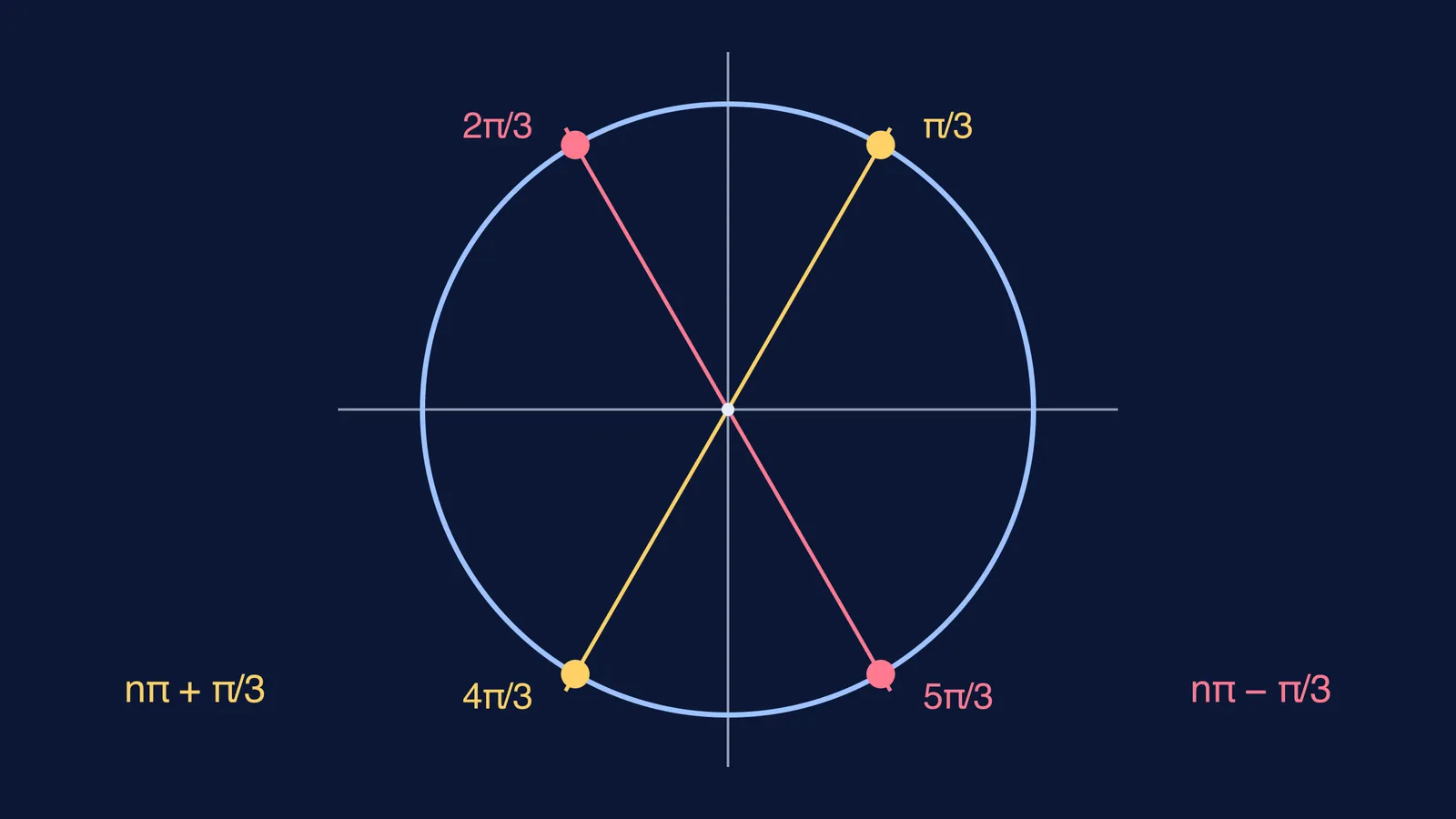
Check by listing the answers from 0 up to 2π. n = 0 gives π/3; n = 1 gives 2π/3 and 4π/3; n = 2 gives 5π/3. That is four angles, one in each quadrant, and the diagram at the top shows them on the unit circle.
Why do sin², cos² and tan² equations share the nπ ± α form?
The reason is the double angle. The reduction formulas in OpenStax Precalculus write all three squares through cos 2x:
sin²x = (1 − cos 2x)/2
cos²x = (1 + cos 2x)/2
tan²x = (1 − cos 2x)/(1 + cos 2x)
Each square is a one-to-one function of cos 2x. For sine and cosine this is plain: sin²x = sin²α means (1 − cos 2x)/2 = (1 − cos 2α)/2, so cos 2x = cos 2α. For tan, write c = cos 2x and d = cos 2α. Cross-multiplying (1 − c)/(1 + c) = (1 − d)/(1 + d) gives 1 + d − c − cd = 1 + c − d − cd, which leaves c = d.
So all three equations turn into the same one: cos 2x = cos 2α. Cosine is even and repeats every 2π, so the angles with equal cosine are 2x = 2nπ ± 2α. Halve both sides and you get x = nπ ± α. The cosine rule itself, cos x = cos α giving x = 2nπ ± α, sits alongside the sine and tan rules in our post on how to find the general solution of trigonometric equations.
On the unit circle, α, π − α, π + α and 2π − α are mirror images across both axes and share the same sin², cos² and tan². Squaring throws away the quadrant, and nπ ± α lists exactly those four angles, every turn.
How do you solve sin²x and cos²x equations the same way?
Find an acute angle α with the same square, then write nπ ± α.
4 sin²x = 3: sin²x = 3/4 = sin²(π/3), so x = nπ ± π/3.
2 sin²x − 1 = 0: sin²x = 1/2 = sin²(π/4), so x = nπ ± π/4.
4 cos²x = 1: cos²x = 1/4 = cos²(π/3), so x = nπ ± π/3.
3 tan²x = 1: tan²x = 1/3 = tan²(π/6), so x = nπ ± π/6.
The second one is a good cross-check. OpenStax Example 4 solves 2 sin²θ − 1 = 0 for 0 ≤ θ < 2π and lists π/4, 3π/4, 5π/4 and 7π/4. Put n = 0, 1 and 2 into nπ ± π/4 and you get the same four angles.
Remember sin²x means (sin x)², not sin(x²); our explainer on the difference between sin²x and sin x² covers it.
Which mistakes cost marks on squared trig equations?
Run this checklist before you box the answer.
Did you keep both signs? Writing only nπ + π/3 for tan²x = 3 loses half the solutions.
Did you write nπ, not 2nπ? The cosine pattern 2nπ ± π/3 gives π/3 and 5π/3 but misses 2π/3 and 4π/3.
Are all answers allowed? For tan equations, x cannot be an odd multiple of π/2, where tan is undefined.
Does the count fit? For α between 0 and π/2, expect exactly four answers from 0 up to 2π, one per quadrant.
For messier equations, count the solutions on a graph before you solve; our guide to finding the number of solutions of a trigonometric equation by graph shows how.
If you keep landing on half the answer set, the Fermi Problem Library has worked problems with a step-by-step solver that explains the reasoning rather than printing an answer, so you can find the step where the minus root went missing. To go back over general solutions from the start, the Fermi Concept Library covers every concept in mathematics, each with its own lesson.
Next time you meet a squared trig equation, reduce it to one acute angle, write nπ ± α, and expect four answers per turn.