

On this page
Type sin x = 1/2 into a calculator and you get one answer, π/6. Your exam wants all of them. Because sine, cosine and tangent repeat forever, one solution usually means infinitely many, and the general solution is a single formula in an integer n that lists every one. Getting there takes three steps: know the standard forms, reduce to them, then check for lost or extra roots.
What is the general solution of a trigonometric equation?
OpenStax's Algebra and Trigonometry gives the reason plainly: "as trigonometric functions are periodic, solutions are repeated within each period." The principal solutions are those in one cycle, usually 0 ≤ x < 2π. The general solution writes all of them at once, with n any integer.
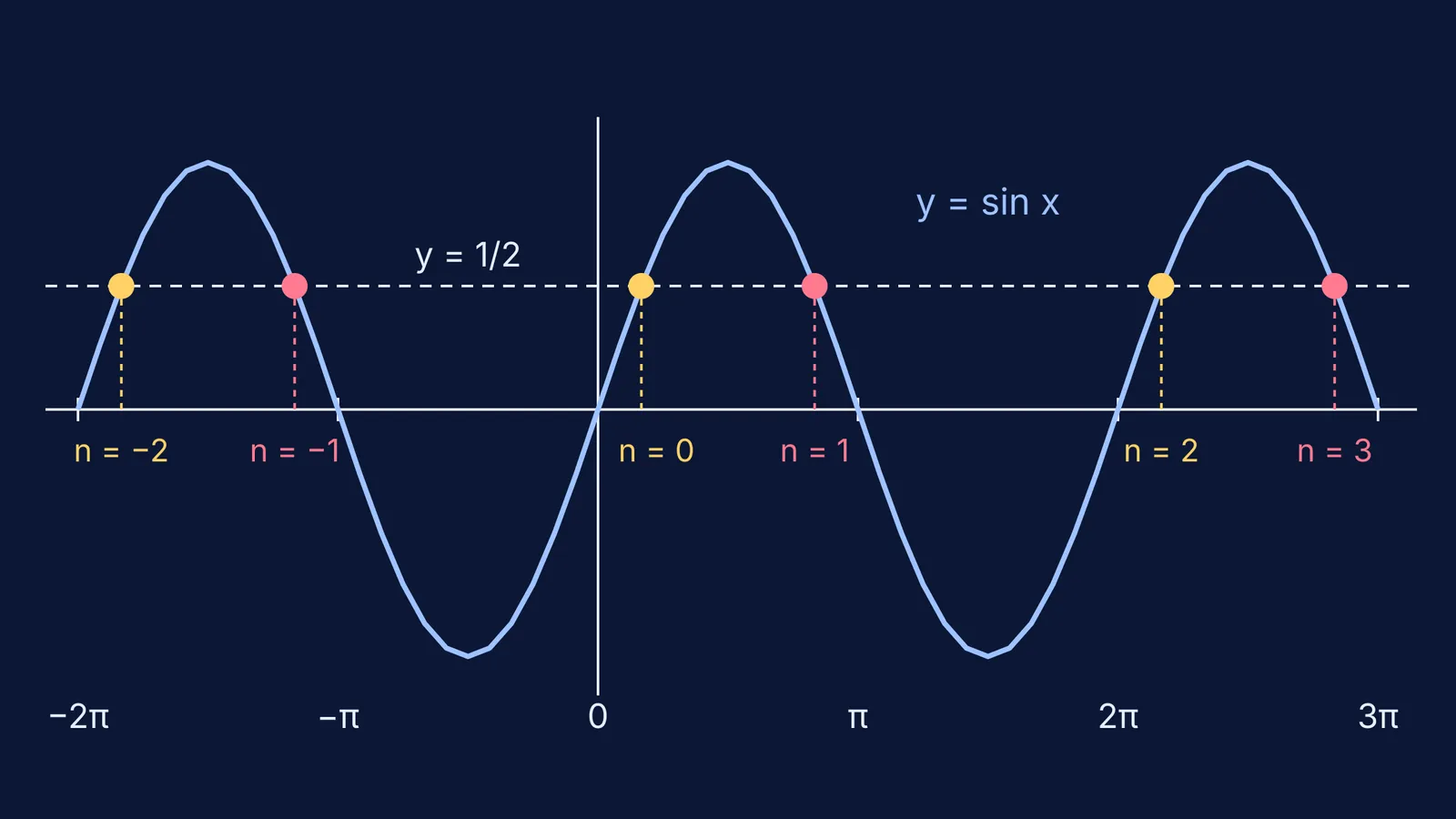
So π/6 is a principal solution of sin x = 1/2, and x = nπ + (−1)ⁿ π/6 is the general solution: π/6, 5π/6, 13π/6, 17π/6 and so on.
What are the three standard forms for sin, cos and tan?
As stated on ProofWiki, with n any integer:
Sine: if sin x = sin α, then x = nπ + (−1)ⁿα (proof).
Cosine: if cos x = cos α, then x = 2nπ ± α (proof).
Tangent: if tan x = tan α, then x = nπ + α (proof).
Sine takes each value twice per cycle, at α and π − α, and the (−1)ⁿ switches between them. Cosine is symmetric about 0, so its pair is α and −α. Tangent needs only one family because, as OpenStax notes, "the period of tangent is π, not 2π."
To see these roots as crossing points, read our guide to counting the solutions of a trigonometric equation by graph.
How do you reduce a harder equation to a standard form?
Most exam equations are one of the three forms in disguise. Try these moves in order:
Move everything to one side and factor. Each factor equal to zero is a simpler equation.
For a quadratic in one function, such as 2sin²x − 3sin x + 1 = 0, put t = sin x, solve, and reject any t outside −1 ≤ t ≤ 1.
For a sin x + b cos x = c, divide by √(a² + b²) to get a single sine or cosine.
Use double-angle or sum-to-product identities to make products, then return to move 1.
Write the right-hand side as a function of a known angle and apply the formula.
Where do lost roots come from?
Take 2 sin x cos x = cos x. Dividing by cos x gives sin x = 1/2, so x = nπ + (−1)ⁿ π/6. That is incomplete. Paul Dawkins's Lamar University notes on trig equations make the same point about cancelling an x from both sides of an equation: it "WILL cause us to lose a solution here."
Factor instead: cos x (2 sin x − 1) = 0. So cos x = 0, giving x = (2n + 1)π/2, or sin x = 1/2 as before. At x = π/2 both sides are 0: a real root the division threw away.
Where do extra roots come from?
Take sin x + cos x = 1. Squaring gives 1 + 2 sin x cos x = 1, so sin 2x = 0 and x = nπ/2. Test one cycle in the original: x = 0 and x = π/2 work, but x = π and x = 3π/2 give −1. Squaring cannot tell 1 from −1. The same notes warn that solving equations with square roots, which usually means squaring, "can lead to values that are not, in fact, solutions to the equation."
Move 3 avoids this. Divide by √2: sin(x + π/4) = sin(π/4), so x + π/4 = nπ + (−1)ⁿ π/4. Even n gives x = 2kπ; odd n gives x = 2kπ + π/2. Exactly what survived the check.
If you can follow these lines but cannot see where your own attempt went wrong, the Fermi Problem Library has a step-by-step solver that explains the reasoning rather than printing an answer.
How do you check a trigonometric equation for lost or extra roots?
Before the final line, ask:
Did I divide by anything that can be zero? Solve that factor = 0 separately.
Did I square? Substitute every candidate from one cycle into the original.
Is anything undefined? OpenStax: "the domain of the function must be considered before we assume that any solution is valid." Drop values where tan x or a denominator breaks.
Did I reject impossible values, such as sin x = 2?
Does my count of roots in 0 ≤ x < 2π match the graph?
Does my answer differ from the book's? Try n = 0, 1, 2, 3 in both; one set can have several forms.
The same trap appears in triangles: see the ambiguous case of the sine rule.
If the formulas still feel shaky, revise periodic functions in the Fermi Concept Library, then solve 2sin²x − 3sin x + 1 = 0 with this checklist beside you.


