On this page
Say you ask an AI tutor for the moment of inertia of a disc about a tangent, and it replies in clean steps: 3MR²/2. Your book says 5MR²/4. Both are real moments of inertia of a disc, about different axes. The AI solved a different problem from the one you set.
So when you check AI answers in rotational motion, look at the axis before the algebra.
Why does AI get the axis wrong in moment of inertia answers?
Moment of inertia is not a property of a body alone. OpenStax University Physics defines it for a point mass as mr², "with r being the distance from the point particle to the axis of rotation" (OpenStax, section 10.4). Change the axis and r changes, so I changes.
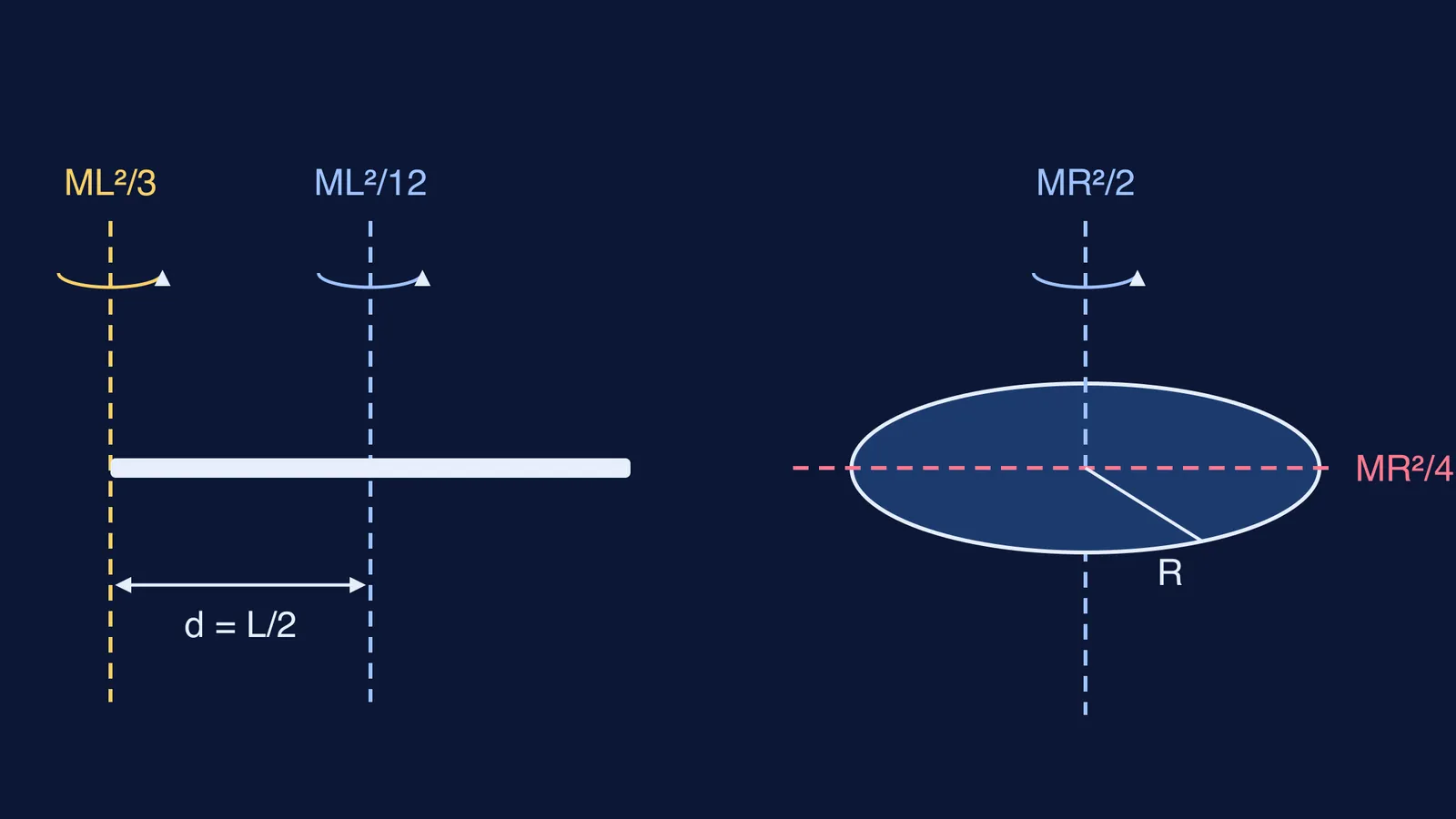
The same textbook shows the size of the effect: a uniform thin rod has I = ML²/12 about its centre and I = ML²/3 about one end, a factor of four (OpenStax, section 10.5).
A chatbot predicts likely text, so it can attach a right-looking formula, such as MR²/2 for a disc, to the wrong axis. Physics education researchers Giulia Polverini and Bor Gregorcic give a basic account of how large language models work, and discuss their strengths and limitations, in a 2024 European Journal of Physics paper on ChatGPT in physics education (Polverini and Gregorcic, 2024). For you, a fluent answer is a draft to check.
How do you check an AI's moment of inertia answer?
Run these three checks in order.
Name the axis. Write one sentence: "axis through ___, parallel to ___." Ask the AI to state its axis the same way. If the two differ, stop there.
Test the theorem step. The parallel axis theorem is I = I_cm + Md², and it only works from an axis through the centre of mass, with d the perpendicular distance between the two parallel axes (OpenStax, section 10.5). The perpendicular axis theorem applies only to a planar (flat) object, and the three axes must meet at one point (HyperPhysics, Georgia State University). Did the AI start from the centre of mass and use the right d?
Compare with the known results. Rod: ML²/12 about the centre, ML²/3 about an end. Thin disc: MR²/2 about the axis perpendicular to its face, MR²/4 about a diameter. Ring: MR² about its central axis, MR²/2 about a diameter (list of standard results). Any shifted answer must be bigger than the centre-of-mass value about a parallel axis, never smaller.
What does a wrong axis look like in a worked example?
Take the disc about a tangent. A tangent can lie in the plane of the disc, or be perpendicular to it, and the two give different answers.
Tangent in the plane of the disc:
The parallel axis through the centre of mass is a diameter, so start from I_cm = MR²/4.
The distance between the diameter and the tangent is d = R.
I = MR²/4 + MR² = 5MR²/4.
Tangent perpendicular to the plane (an axis through the rim, parallel to the central axis):
Start from the central perpendicular axis, I_cm = MR²/2.
d = R again, so I = MR²/2 + MR² = 3MR²/2.
So the AI's 3MR²/2 was not an algebra slip. It picked the wrong tangent, and check 1 catches it.
Another slip lives in the theorem step. For a rod about one end, an AI might write ML²/12 + ML² = 13ML²/12, using d = L instead of L/2. Check 3 catches it: the known answer is ML²/3, which d = L/2 gives.
For the ring version of this trap, see our explainer on the moment of inertia of a ring about a tangent.
Which results should you know by heart?
Six anchors are enough: rod about centre and end, disc and ring each about their axis and a diameter. If an AI answer cannot be traced back to one of them with a theorem step, ask it to show that step.
The same habit works beyond this chapter. Our guide to testing an AI formula with special values shows how to plug in cases you already know, and which axis to take torque about applies the axis question to torque problems.
If the axis idea itself feels shaky, the Fermi Concept Library has a lesson for every concept in physics. To practise the theorem step, the Fermi Problem Library has worked problems with a step-by-step solver that explains the reasoning rather than printing an answer, so you can see where the axis is chosen.
Next time an AI hands you a moment of inertia, write the axis sentence first. It takes one line and catches the mistake that algebra checks miss.