On this page
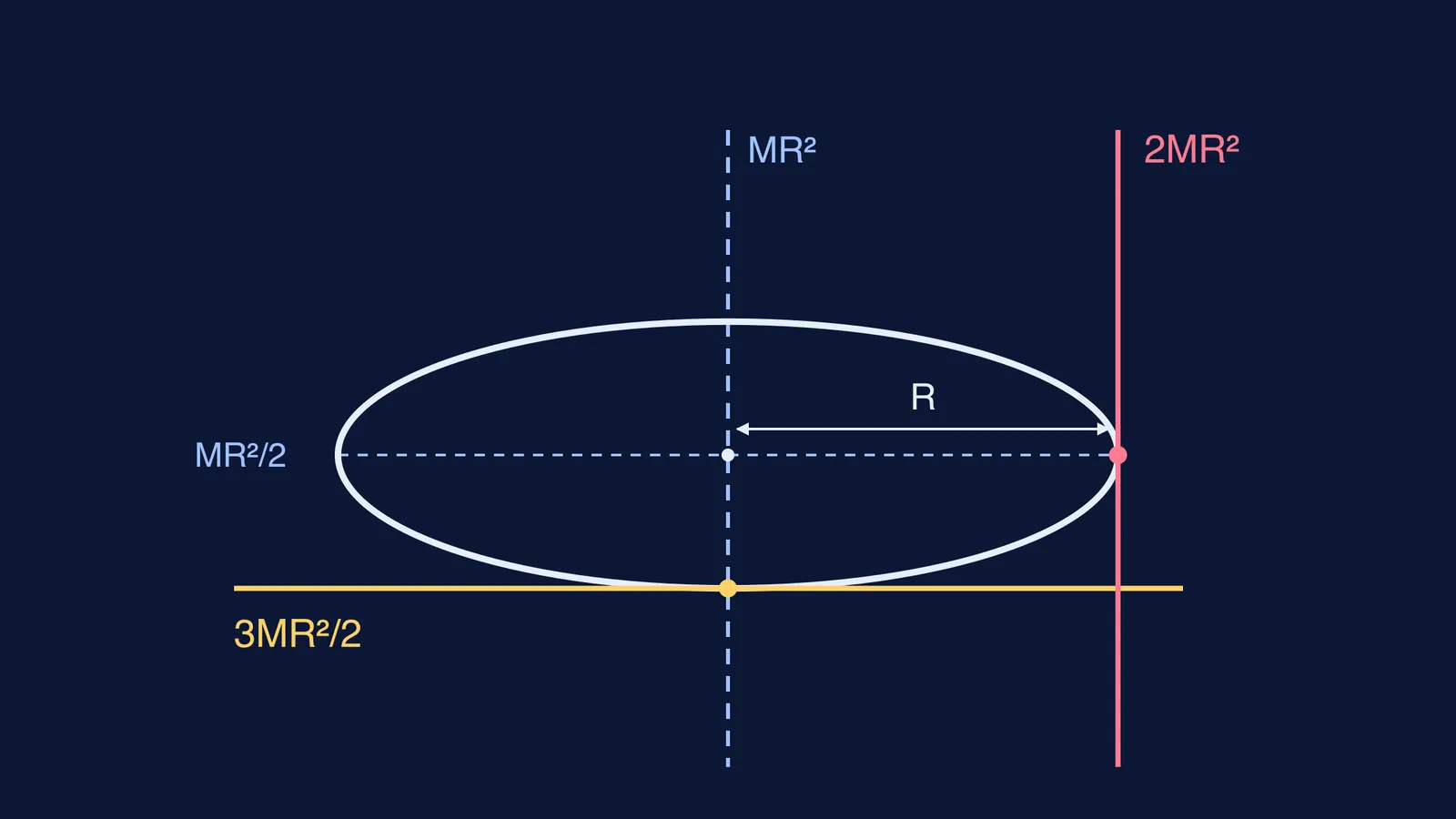
The question "moment of inertia of a ring about a tangent" hides two different axes. One tangent lies in the plane of the ring. The other touches the ring at one point and stands perpendicular to its plane. The first gives 3MR²/2, the second 2MR², and both come from the same theorem used with a different starting axis.
What are the two starting values for a ring?
Every tangent calculation starts from an axis through the centre. The NCERT Class 11 chapter on rotational motion lists both in Table 6.1 (NCERT Physics Part I, Chapter 6):
About the axis through the centre, perpendicular to the plane: I = MR², because every bit of mass sits at distance R.
About a diameter: I = MR²/2.
The same chapter says the derivations of its table values are beyond the scope of the textbook, so here is where MR²/2 comes from. For a flat object, the moment of inertia about an axis perpendicular to the plane equals the sum of the moments about two perpendicular axes in the plane through the same point (HyperPhysics, perpendicular axis theorem). Two perpendicular diameters of a ring are identical by symmetry, so 2I = MR² and the diameter value is MR²/2.
What does the parallel axis theorem say?
The parallel axis theorem is I = I_cm + Md², where d is the distance from an axis through the centre of mass to the parallel axis you want (OpenStax University Physics, section 10.6/Book%3A_University_Physics_I_-_Mechanics_Sound_Oscillations_and_Waves_(OpenStax)/10%3A_Fixed-Axis_Rotation__Introduction/10.06%3A_Calculating_Moments_of_Inertia)). HyperPhysics puts it in words: the new moment is the centre-of-mass moment plus that of the whole object treated as a point mass at the centre of mass (HyperPhysics, parallel axis theorem).
Notice the condition. One of the two axes must pass through the centre of mass. You cannot jump from one off-centre axis to another by adding Md².
For a ring, the centre of mass is the geometric centre, and every tangent is at distance d = R from a parallel axis through it. So the whole job is choosing which central axis is parallel to your tangent.
What is the moment of inertia of a ring about a tangent in its plane?
A tangent in the plane touches the ring at one point and runs parallel to a diameter. Start from that diameter:
I_cm = MR²/2, about the diameter parallel to the tangent.
d = R.
I = MR²/2 + MR² = 3MR²/2.
The radius of gyration is k = R√(3/2), about 1.22R.
What is the moment of inertia of a ring about a tangent perpendicular to its plane?
This axis passes through a point on the rim, perpendicular to the plane. Picture a bangle hung on a nail, swinging flat against the wall: the nail is the axis. It is parallel to the central axis, so:
I_cm = MR², about the central axis.
d = R.
I = MR² + MR² = 2MR².
The radius of gyration is k = √2 R, about 1.41R.
A worked example with numbers
Take a thin ring of mass 0.4 kg and radius 0.25 m. Then MR² = 0.4 × 0.0625 = 0.025 kg m², in the SI unit NCERT gives for moment of inertia (NCERT Chapter 6); our explainer on SI units of moment of inertia and torque covers why.
Central axis, perpendicular to the plane: 0.025 kg m².
Any diameter: 0.0125 kg m².
Tangent in the plane: 0.0125 + 0.025 = 0.0375 kg m².
Tangent perpendicular to the plane: 0.025 + 0.025 = 0.050 kg m².
The ring is hardest to turn about the perpendicular tangent and easiest about a diameter. That ordering is a quick sanity check on any answer you write.
Where do students lose marks on this question?
Reading "tangent" without checking the plane. Sketch the axis first, then ask which central axis is parallel to it.
Adding MR² to the wrong base. Starting from MR² for the in-plane tangent gives 2MR², which answers the other question.
Using the parallel axis theorem between two axes, neither of which passes through the centre.
Using the perpendicular axis theorem on a three-dimensional body. It holds for flat objects only.
Mixing up a ring and a disc. A disc has MR²/2 about its central axis and MR²/4 about a diameter (NCERT Table 6.1), so its tangents give 3MR²/2 (perpendicular to the plane) and 5MR²/4 (in the plane). The disc's perpendicular tangent and the ring's in-plane tangent share the value 3MR²/2, so check which body the question names.
The same two-step method gives the moment of inertia of a cube about an edge, and the ring's large moment of inertia is why it loses the rolling race against a disc and a sphere.
If you get the right number but cannot say which axis you started from, try a few more. The Fermi Problem Library has worked problems with a step-by-step solver that explains the reasoning rather than printing an answer, and the Fermi Concept Library gives every physics concept its own lesson.