

On this page
If a JEE question asks for the moment of inertia of a solid cube about one of its edges, you do not need a triple integral. You need one value you can look up, one distance you can see, and one theorem. Below: where each piece comes from, two checks, and the wrong distances that cost marks.
What is the moment of inertia of a cube about its centre?
For a uniform solid cube of mass M and side a, the moment of inertia about an axis through its centre, parallel to an edge, is Ma²/6, as listed in the list of moments of inertia on Wikipedia.
That value comes from the cuboid formula on the same page. For a cuboid with sides w and h perpendicular to the axis, I = M(w² + h²)/12. Put w = h = a and you get M(2a²)/12 = Ma²/6.
How does the parallel axis theorem move the axis to an edge?
The parallel axis theorem states I = I_cm + Md², where d is the distance between an axis through the centre of mass and a parallel axis, as given in OpenStax University Physics, Volume 1. The only real work is finding d.
Here is the worked example, step by step:
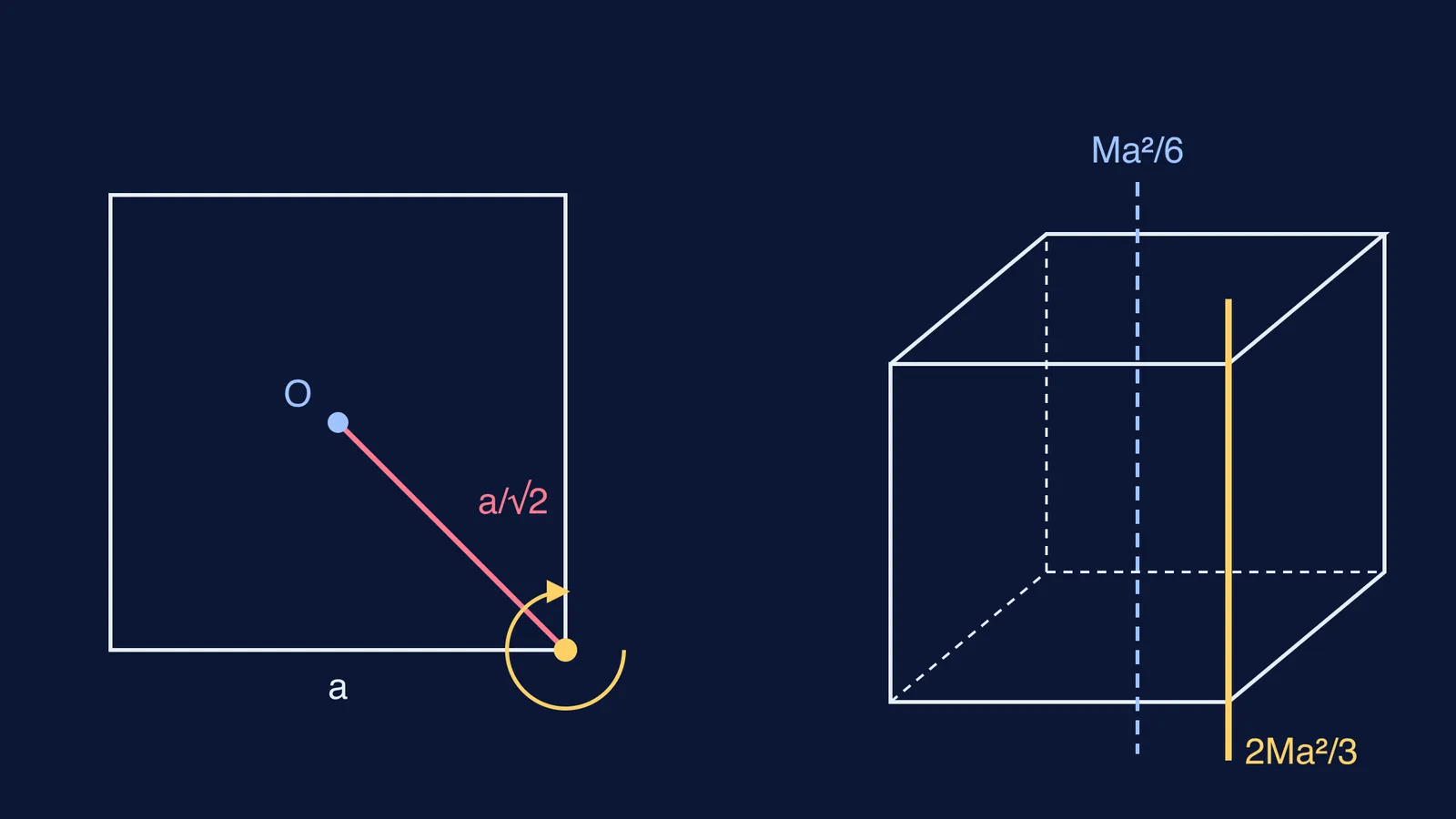
Put the origin at the centre of the cube and let the central axis be the z-axis.
Pick a vertical edge. Every point on it has x = a/2 and y = a/2, so the edge is the line through (a/2, a/2) parallel to z.
The distance between the two parallel lines is d = √((a/2)² + (a/2)²) = a/√2, which is half the diagonal of a face.
So d² = a²/2.
I_edge = Ma²/6 + M(a²/2) = Ma²/6 + 3Ma²/6 = 4Ma²/6 = 2Ma²/3.
The same value, 2Ma²/3 for a cube about any edge, is used in a University of Maryland Physics 410 solution set on a cube that tips over an edge.
Can you check 2Ma²/3 without the theorem?
Yes, and doing it once makes the answer stick.
Direct integral. Put the edge on the z-axis, with the cube filling 0 to a in x, y and z. Then I = ∫(x² + y²) dm. The average of x² over 0 to a is a²/3, so ∫x² dm = Ma²/3, and the same for y. Adding them gives 2Ma²/3.
Slice into plates. Cut the cube into thin square slices perpendicular to the edge. Each slice turns about an axis perpendicular to its plane, through one corner. A square plate about a perpendicular axis through its centre has m(a² + a²)/12 = ma²/6 (the thin rectangular plate entry in the same Wikipedia list). Shift to the corner by a/√2 and each slice gives ma²/6 + ma²/2 = 2ma²/3. Add the slices and you get 2Ma²/3.
Which mistakes give the wrong answer?
Most wrong answers come from the wrong d. Run your answer against this list:
d = a/2 gives Ma²/6 + Ma²/4 = 5Ma²/12. That is right for an axis through the centre of a face, parallel to an edge, but not for the edge itself.
d = a gives 7Ma²/6. You used the full side instead of the distance from the centre.
d = a√3/2 gives 11Ma²/12. That is half the body diagonal: the distance to a corner point, not to an edge line.
Ma²/3 is a square plate about an edge in its own plane. It is a different body and a different axis; compare it with our post on the moment of inertia of a square plate about its diagonal.
Applying I_cm + Md² between two axes that are both off-centre. The theorem only works when one of the two axes passes through the centre of mass.
If a question asks for the radius of gyration about the edge, use I = Mk²: k² = 2a²/3, so k = a√(2/3), about 0.816a. Our guide to radius of gyration with quick Class 11 problems has more of these.
How should you practise this before an exam?
A 20-minute plan for one sitting:
From memory, write the cuboid formula and reduce it to Ma²/6 for the cube.
Draw the top view of the cube. Mark the centre and the edge you want, and draw d.
Solve the face-centre axis (5Ma²/12) and the edge axis (2Ma²/3) one after the other, so you feel the difference between a/2 and a/√2.
Do the direct integral once, to see the same 2Ma²/3 appear.
Finish with one mixed question that needs both the parallel and perpendicular axis theorems; our explainer on parallel and perpendicular axis theorems sets out when each applies.
If you keep reaching the wrong d, the Fermi Problem Library has worked problems with a step-by-step solver that explains the reasoning rather than printing an answer, so you can follow how each step, including the choice of distance, is reasoned out.
Next time you see a cube and an edge, say it in one breath: Ma²/6, plus M times half of a², equals 2Ma²/3.


