

On this page
When you first encounter the mechanics of a square plate, a surprising result appears: the moment of inertia about its diagonal is identical to its moment of inertia about an axis passing through its centre and parallel to a side. Both evaluate to ML²/12. This symmetry trick is a staple in physics exams, showing how the perpendicular axis theorem can bypass complex calculus.
What is the moment of inertia of a square plate about its diagonal?
The moment of inertia of a uniform square plate of mass M and side L about its diagonal is ML²/12.
This is exactly the same as the moment of inertia about an axis passing through its centre and parallel to one of its sides.
How do you derive the moment of inertia about the diagonal?
We do not need to integrate over the triangular halves of the plate to find this. Instead, we use two powerful tools: the perpendicular axis theorem and the symmetry of the square.
The perpendicular axis theorem states that for any flat, two-dimensional object, the moment of inertia about an axis perpendicular to the plane (Iz) equals the sum of the moments of inertia about two mutually perpendicular axes (Ix and Iy) that lie in the plane and cross at the same point: Iz = Ix + Iy.
Step 1: Find the moment of inertia about the central perpendicular axis
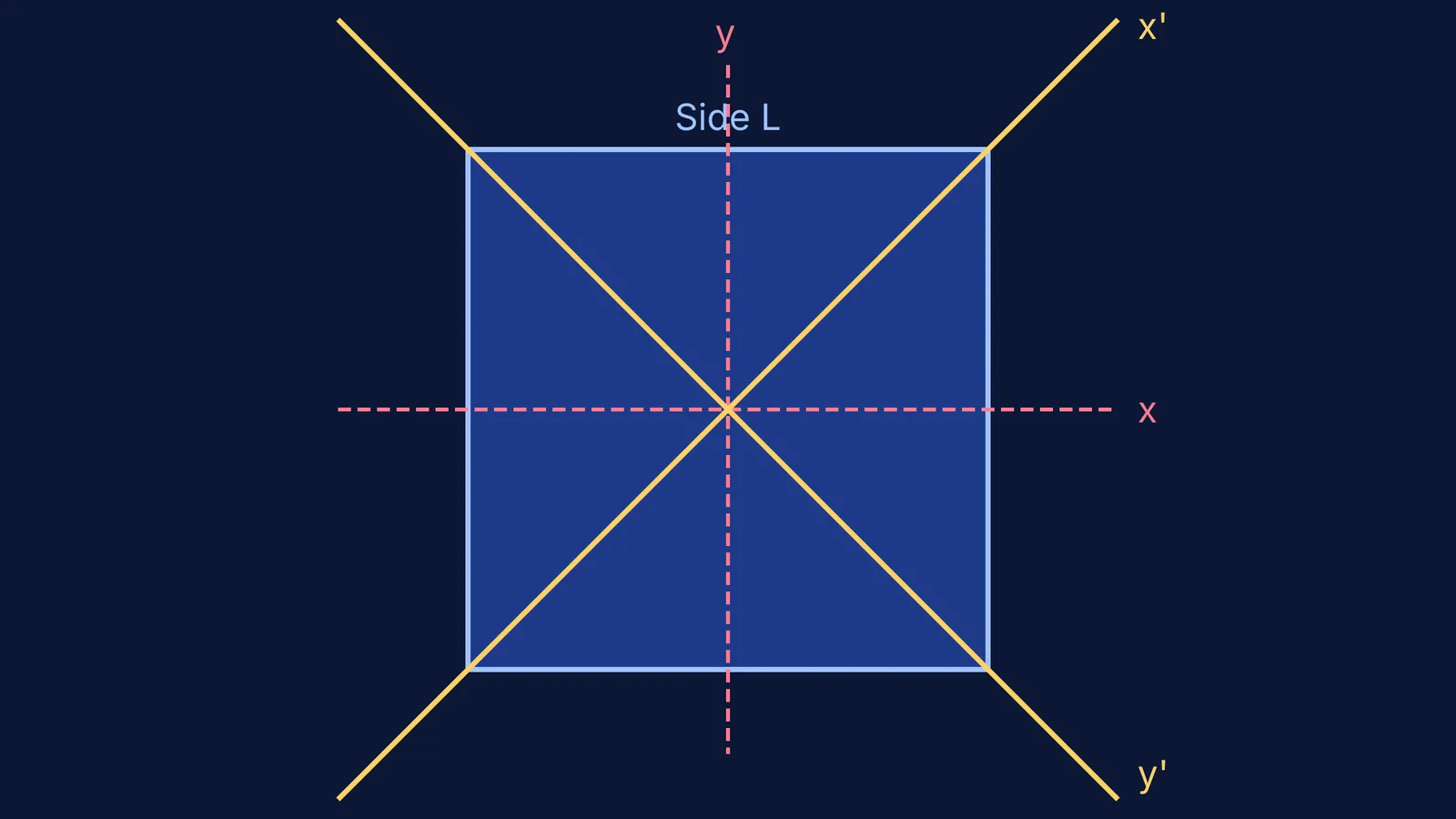
First, consider the axes parallel to the sides of the square. Let the x-axis and y-axis pass through the centre of the square plate, parallel to its edges.
The moment of inertia of a square plate about an axis parallel to its side is ML²/12. Because the square is symmetric, the moment of inertia about the x-axis and the y-axis are the same: Ix = ML²/12 Iy = ML²/12
Using the perpendicular axis theorem, the moment of inertia about the z-axis (which points straight out of the plate's centre) is the sum of these two: Iz = Ix + Iy = ML²/12 + ML²/12 = ML²/6.
Step 2: Apply the perpendicular axis theorem to the diagonals
Now, let us rotate our chosen in-plane axes by 45 degrees so that they lie exactly along the two diagonals of the square. Let us call them the x'-axis and the y'-axis.
The diagonals of a square cross at 90 degrees, so they are mutually perpendicular. Because the square is perfectly symmetric around both diagonals, the mass is distributed identically around each one. Therefore, the moment of inertia about both diagonals must be equal: Ix' = Iy'
The perpendicular axis theorem applies to any pair of perpendicular axes in the plane that meet at the centre. So, the sum of the moments of inertia about the diagonals must still equal the moment of inertia about the z-axis: Iz = Ix' + Iy'
Since Ix' and Iy' are equal, we can write: Iz = 2 × Ix'
We already know that Iz = ML²/6. Substituting this in gives: ML²/6 = 2 × Ix' Ix' = ML²/12
The moment of inertia about the diagonal is ML²/12.
Why do the diagonals give the same result as the sides?
In rotational motion, students often memorise standard formulas but freeze when an axis is shifted or rotated. If you try to guess the diagonal's moment of inertia by thinking of it as two triangles, you might incorrectly assume it should be different from the axis parallel to the side. The square's perfect 90-degree symmetry ensures the mass distribution averages out to the same resistance to rotation regardless of how you spin it in that plane.
If you struggle to know when to apply these rules, the Fermi Problem Library has worked problems with a step-by-step solver that explains the reasoning rather than printing an answer. If you are missing the underlying idea of how mass distribution affects rotation, the Fermi Concept Library contains every concept in physics, chemistry, biology, mathematics and computing, each with its own lesson and its place in the map.
How do you use this in exam problems?
When solving rotational mechanics problems for a uniform square plate of mass M and side L, remember these quick reference values:
Through the centre, parallel to a side: ML²/12
Through the centre, along a diagonal: ML²/12
Through the centre, perpendicular to the plate: ML²/6
Along one of the outer edges: ML²/3
If you need to find the radius of gyration for any of these axes, equate the moment of inertia to MK² and solve for K. When forces are applied to the plate during rotation, you might also need to calculate the torque about a point with vectors to find the resulting angular acceleration. Mastering these derivations means you will not have to rely on rote memorisation when an exam question twists the axis of rotation by an unfamiliar angle.