On this page
Turn a bicycle upside down, press the dynamo against the tyre and turn the pedal slowly. The lamp glows dull and wavers. Spin the wheel hard and the light turns bright and steady. Both changes come from the AC generator equation you meet in Class 12.
Why does a bicycle dynamo light get brighter when you go faster?
A bicycle dynamo is a small AC generator. A detailed bench-test page on bicycle electronics describes them as alternators with permanent magnets: a magnet spins next to a fixed coil, so the magnetic flux through the coil keeps reversing.
By Faraday's law, the emf depends on how fast the flux changes. Spin faster and the emf is bigger, which pushes more current through the filament. The bulb's power goes up with the square of the current, so at walking pace a little extra speed makes a noticeable difference.
What does the AC generator equation say?
For a coil of N turns and area A turning at angular speed ω in a field B, the emf is ε = NBAω sin(ωt), as set out in OpenStax University Physics, section 13.6.
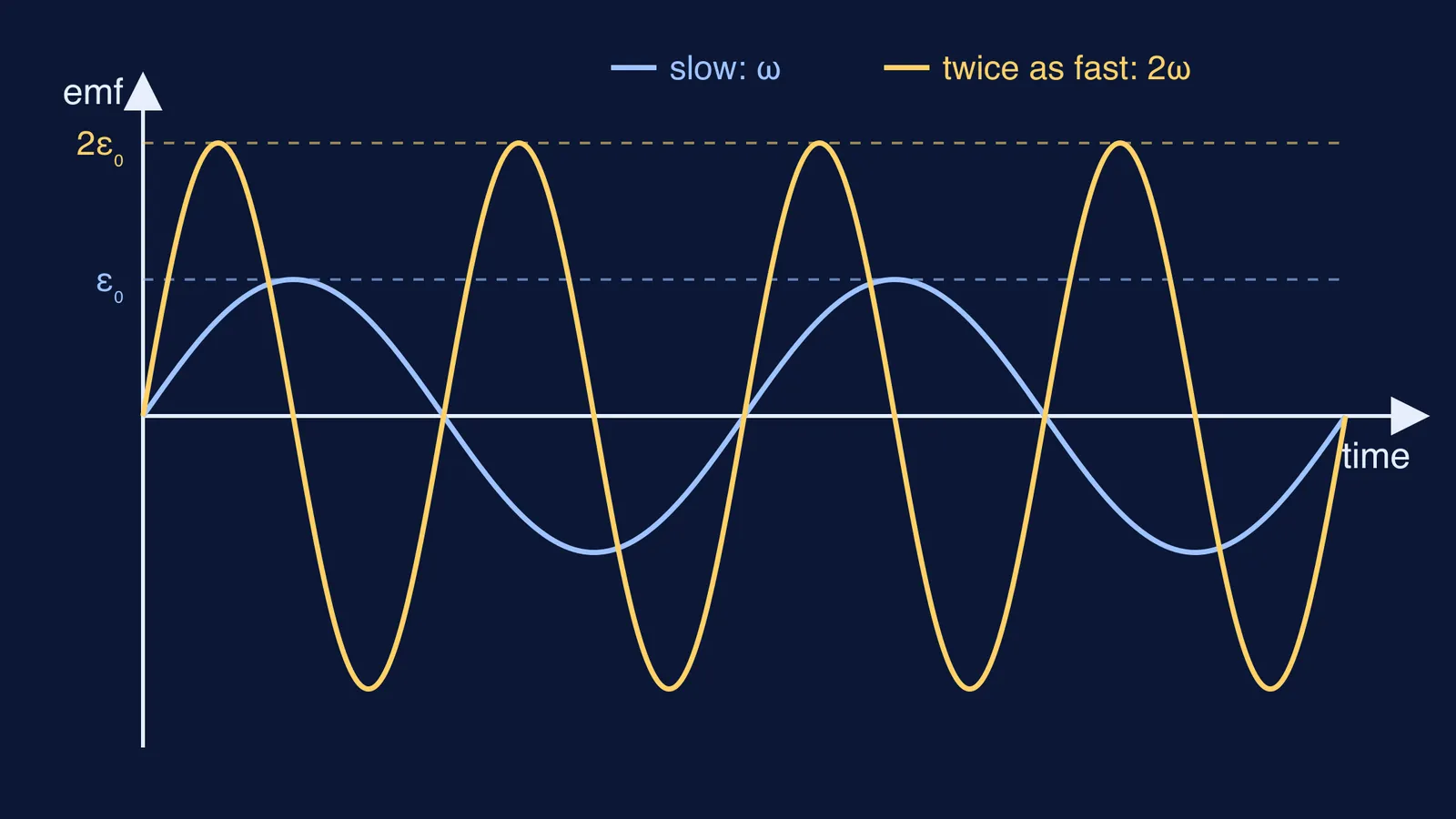
The peak emf is ε₀ = NBAω, so spinning twice as fast doubles the peak emf.
The output frequency is f = ω/2π, so the same doubling also doubles the cycles per second.
Ride faster and you get taller waves packed closer together. For the steps behind the formula, see our step-by-step derivation of emf in an AC generator, or read how Hippolyte Pixii's early dynamo made AC from a turning magnet.
Why does a dynamo light flicker at low speed?
A real dynamo has many magnet poles. Each north-south pair gives one cycle per revolution, so f = (number of poles ÷ 2) × revolutions per second.
The bench tests on this hub dynamo page give real numbers. At 15 km/h, a Busch & Müller Dymotec6 bottle dynamo with 8 poles put out 168 Hz, while a Shimano DH-3D71 hub dynamo with 28 poles put out only 28 Hz. At 8 km/h the 28-pole hub was down to 15 Hz, which the same page says causes visible flicker of the light.
The bulb's power follows sin², so it peaks twice per cycle and dips to zero in between. At low frequency the filament cools a little in each dip and you see the pulsing; at higher frequency the dips come too fast to notice. Compare how mains AC frequency works in India.
Why doesn't the bulb keep getting brighter forever?
According to the bottle dynamo bench tests, most European dynamos are rated 3 W (500 mA at 6 V), and in a standard light system the power is zero at standstill, 3 W at moderate speed and only a little more than 3 W at very high speed. The same page sums it up: a dynamo is a current source.
The reason is the coil's own inductance L. Its opposition to AC, the inductive reactance, is X = ωL, and it rises in direct proportion to frequency (OpenStax University Physics, section 15.2). With a bulb of resistance R, the peak current is:
I₀ = NBAω ÷ √(R² + ω²L²)
At low speed ωL is much smaller than R, so the current rises with ω and the light brightens quickly. At high speed ωL dominates and the current tends to NBA ÷ L.
If inductive reactance is the shaky part, the Fermi Concept Library has a lesson on every concept in physics, so you can go back to the idea this rests on.
Try it: a 10-minute dynamo experiment
You need a bike with a dynamo light, a tape measure, a stopwatch and a friend.
Turn the bike upside down on a mat. Keep fingers, hair and loose clothes away from the spokes and chain.
Measure the wheel's circumference: mark the tyre and floor, roll one full turn, measure.
Spin the wheel by hand slow, medium and fast.
At each speed, have your friend count wheel turns for 10 seconds, then divide by 10.
Note how bright the lamp looks and whether it flickers.
Work out speed (turns per second × circumference) and, for a hub dynamo, frequency (poles ÷ 2 × turns per second).
Worked example: suppose your wheel measures 2.1 m round and your hub dynamo has 28 poles (14 pole pairs). At 15 km/h, or 4.17 m/s, the wheel makes 4.17 ÷ 2.1 = 1.98 turns per second, giving 14 × 1.98 ≈ 28 Hz. At 8 km/h, or 2.22 m/s, it makes 1.06 turns per second, giving about 15 Hz. Both match the measured hub dynamo figures. A bottle dynamo's small roller turns many times per wheel turn, so its frequency is much higher.
To see ideas like this in motion, try the interactive simulations in the Fermi Simulation Lab, built for ideas that are easier to see than to read.