On this page
In August 1831, Michael Faraday showed that a changing magnetic field can push a current through a wire. Within a year, a young instrument maker in Paris had turned that laboratory effect into a machine you could crank by hand. Hippolyte Pixii's 1832 generator is an early ancestor of the AC generator in your Class 12 textbook, and it explains a puzzle many students meet: why early machines went to the trouble of turning their alternating output into one-way current.
Who was Hippolyte Pixii and what did he build in 1832?
Hippolyte Pixii (1808–1835) was an instrument maker from Paris, according to his Wikipedia biography. His machine came right after Faraday's discovery: the Royal Institution's page on Faraday's induction ring says Faraday "achieved success" with it on 29 August 1831. We tell that story in how Michael Faraday discovered electromagnetic induction in 1831.
The US National High Magnetic Field Laboratory calls the Pixii machine "the first practical mechanical generator of electrical current". The Museo Galileo in Florence holds an example dated around 1832, built from mahogany, brass, iron and steel, and describes it as a landmark in turning mechanical energy into electricity.
The design was simple. A horseshoe-shaped permanent magnet was turned by a geared hand crank beneath a suspended electromagnet, as the Museo Galileo catalogue describes; the MagLab's tutorial shows two wire coils above the magnet's upturned poles. Note the choice: the magnet moved and the coils stayed still.
How did Pixii's generator make alternating current?
Trace one coil through one turn of the crank.
The north pole swings under the coil. The magnetic flux through the coil rises, then falls as the pole moves away. By Faraday's law, a current flows while the flux changes.
Half a turn later, the south pole arrives. The field now points the other way through the coil, so the change in flux has the opposite sign.
The current therefore flows the other way.
The north pole comes back, and the cycle repeats.
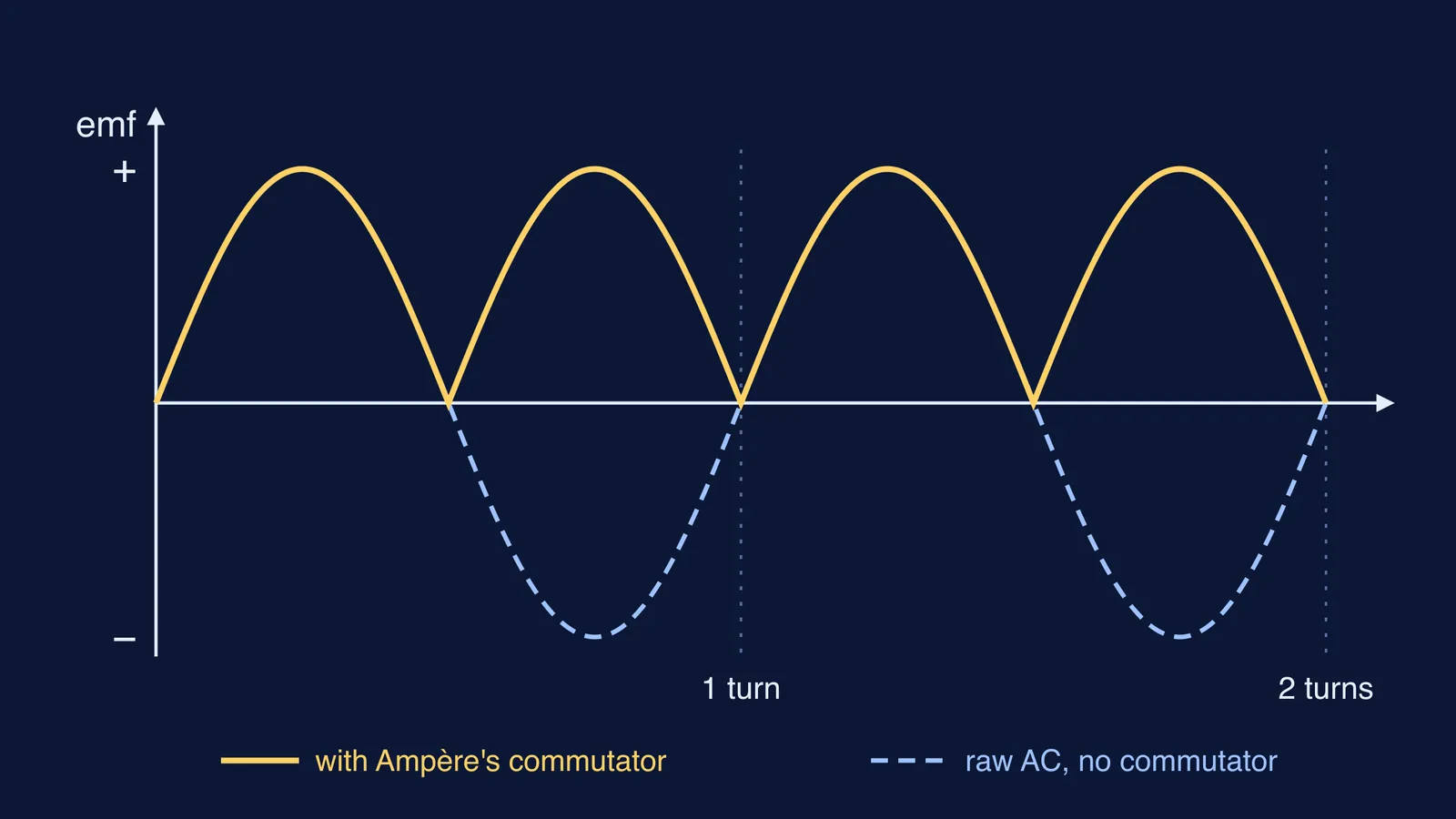
The MagLab's description matches this: the current "flows for a moment in one direction, then reverses course," and the machine gives two surges of current for every full revolution of the magnet. The Engineering and Technology History Wiki puts it plainly: Pixii's machine generated what would today be called an alternating current.
Why did Pixii add a commutator?
Current that kept changing direction was not what people wanted. As Pixii's Wikipedia biography puts it, at that time direct current was preferable to alternating current.
The fix was a switch that flips the coil's connections at just the right moment, so the reversed half of each cycle comes out the same way as the first half. The Museo Galileo says its machine has "Ampère's rocking commutator, actuated by a cam on the axis", which rectifies the alternating current, and Wikipedia says the commutator was introduced on a suggestion by André-Marie Ampère. The result was a pulsing but one-way current. The hero diagram above shows both outputs: the raw alternating wave, and the same wave with every negative half flipped up.
Later dynamos smoothed those pulses out. To see how, read how Zénobe Gramme's ring armature gave smooth direct current.
How does Pixii's machine connect to the AC generator in Class 12?
Your textbook generator turns a coil inside a magnet's field instead of turning the magnet near the coils. The physics is the same: what matters is the relative motion. For a coil of N turns and area A spinning at angular speed ω in a field B, the emf is e = NBAω sin ωt.
Here is a worked example with made-up but realistic numbers, the kind of numerical you will meet in board exams and JEE Main:
Coil: N = 100 turns, A = 0.01 m², B = 0.2 T.
You crank at 5 turns per second, so ω = 2π × 5 ≈ 31.4 rad/s and the frequency is 5 Hz.
Peak emf = NBAω = 100 × 0.2 × 0.01 × 31.4 ≈ 6.3 V.
Crank twice as fast and both the peak emf and the frequency double. With a hand-cranked machine like Pixii's, a bigger voltage meant faster reversals too.
When you study induction, use this four-step check on any generator question:
Find what is moving relative to what.
Ask when the flux through the coil is largest, and when it is changing fastest.
Mark where the emf changes sign. That is where the current reverses.
Ask whether a commutator or slip rings connect the coil to the outside circuit. A commutator gives one-way pulses; slip rings pass on the alternating current.
If a rotating coil is hard to picture from a flat diagram, the Fermi Simulation Lab has interactive simulations for ideas that are easier to see than to read. For more on why faster spinning raises both voltage and frequency, see our explainer on the emf in a rotating coil.
When you get stuck on a generator numerical, the Fermi Problem Library has worked problems with a step-by-step solver that explains the reasoning rather than printing an answer.