On this page
Point a hair dryer, on cool, at the ceiling and drop a ping pong ball into the air. It hovers and wobbles but stays put. Tilt the dryer and it still hangs there, off to one side. Before you read on, guess: what holds it?
The ball has two problems: it must be held up and held in.
Why does a ping pong ball float in hair dryer air?
The holding-up part is drag. A regulation table tennis ball is 40 mm across and weighs 2.7 g, according to the ITTF Laws of Table Tennis. That works out to a weight of about 0.026 N.
Moving air pushes on the ball with a drag force set by the air's density, the ball's cross-section, the square of the air speed and a drag coefficient, as NASA's guide to the drag equation defines it. The same NASA page gives a sphere's drag coefficient as anywhere from 0.07 to 0.5, depending on the flow.
The air is fastest close to the dryer, as the UC Santa Barbara physics circus notes, and it slows as the jet spreads. So the ball settles at the height where drag exactly equals its weight.
What pulls the ball back into the jet?
The usual answer is "fast air has low pressure", but NASA's page on Bernoulli's equation notes that the total pressure is constant along a streamline and may vary from one streamline to the next. The jet and the room's still air are not on one streamline. For a case where Bernoulli applies cleanly, see our narrowing pipe simulation post or how Giovanni Venturi found fluid speeds up in a narrow pipe.
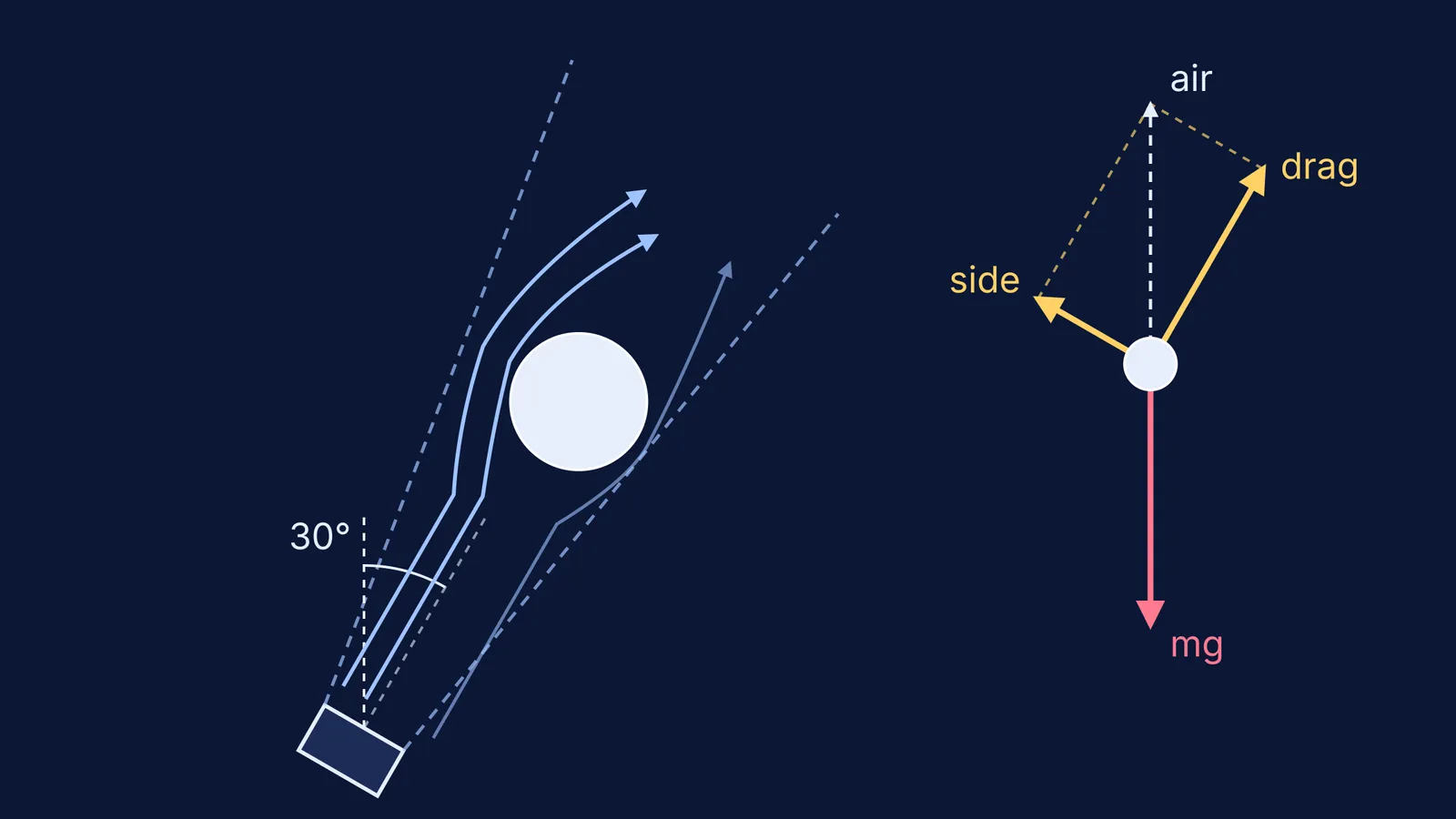
At the ball, air follows its curved surface instead of carrying straight on. When the ball drifts to one side, more air clings to the side still in the jet. As The Naked Scientists explain, this is Newton's third law: the ball pulls the air one way, so the air pulls the ball back the other way.
Physicist Rod Cross states the general rule in the American Journal of Physics: if a ball deflects air downwards, the air pushes the ball upwards with an equal and opposite force. So the low pressure that matters is where the air wraps over the ball and gets turned, not everywhere in the jet.
What happens when you tilt the jet?
Tilt the dryer and gravity still pulls straight down. That weight now splits into two parts: one along the jet, which drag has to balance, and one across the jet, which the curving air has to balance.
Here is a worked example for a 30 degree tilt. It uses the ITTF ball, sea-level air density of 1.229 kg/m3 from NASA's table of air properties, and a drag coefficient of 0.5, the top of NASA's range for a sphere:
Weight: 0.0027 kg x 9.81 m/s2 = 0.026 N.
Cross-section: pi x (0.020 m)2 = 0.00126 m2.
Vertical jet: setting drag equal to weight gives an air speed of about 8.3 m/s, roughly 30 km/h, at the ball.
Tilt 30 degrees: the part along the jet is 0.026 x cos 30 = 0.023 N, so the ball floats where the air is about 7.7 m/s.
The part across the jet is 0.026 x sin 30 = 0.013 N, half the ball's weight, and the curving air must supply all of it.
At 45 degrees the sideways job grows to about 0.019 N, which is why a steep jet eventually drops the ball. Treat the speeds as estimates: a drag coefficient below 0.5 means a faster jet.
How do you test it at home?
In a study in the American Journal of Physics, Catherine Crouch, Eric Mazur and colleagues found that students who only watched a demonstration understood the underlying concepts no better than students who never saw it, while students who predicted the outcome first showed significantly greater understanding.
So write each prediction down before you try it:
Speed: switch from low to high. Does the ball rise, fall or stay?
Tilt: tilt to roughly 15, 30 and 45 degrees. At which angle does it fall out? Does it sit above or below the jet's centre line?
Tap: nudge it gently down, then sideways. Which direction recovers faster?
Swap: try a slightly heavier ball of similar size. Does it float lower or higher?
For each test, write one sentence saying which force changed. Our guide on using an AI tutor alongside a physics simulation shows how to turn a wrong guess into a better explanation.
The Fermi Simulation Lab has interactive simulations for the ideas that are easier to see than to read, and Fermi's AI tutor checks understanding as it goes, deciding whether to explain, ask or show.
Grab the dryer, write your four predictions, and find the angle where your ball lets go.