On this page
In CBSE Class 10 mathematics, questions about the surface area of combined solids test whether you can picture a 3D object in your mind. However, many students lose marks on these problems because of a simple conceptual trap: they treat surface area the same way they treat volume.
Why do students get the surface area of joined solids wrong?
When you join two wooden blocks together, their combined volume is simply the volume of the first block plus the volume of the second block. You never lose any wood.
Because of this, the most common mistake is the "hidden face" error, where students calculate the total surface area (TSA) of a combined solid by adding the TSA of its individual parts.
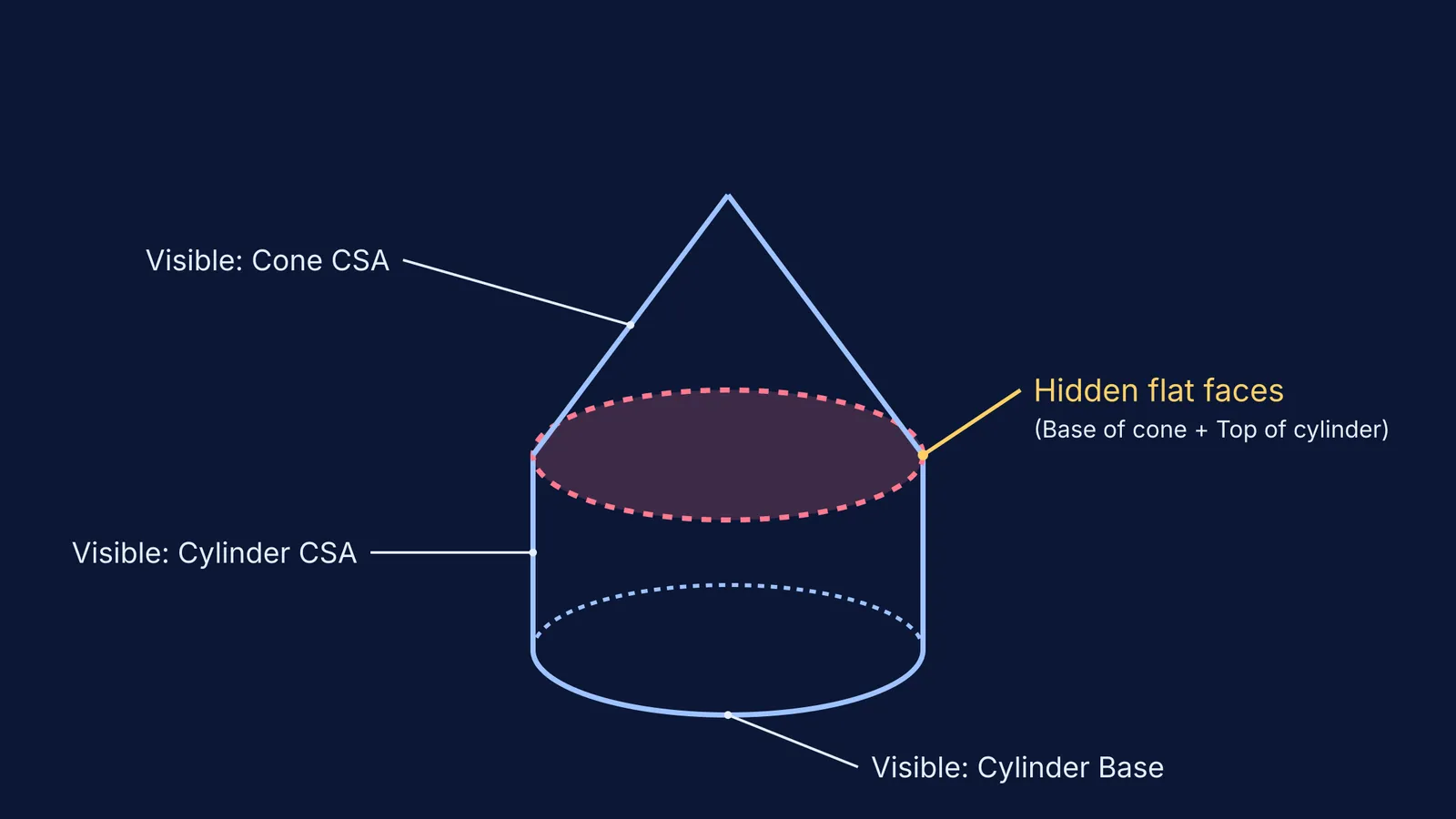
When two or more basic solids are joined, the faces that touch each other disappear from the outside. The total surface area of a combined solid is the sum of its visible curved and flat surfaces [[1]](https://ncert.nic.in/textbook/pdf/jemh112.pdf). To find the correct area, you must only add the curved surface areas (CSA) of the faces you can still touch, and completely ignore the flat surfaces that are glued together inside the object.
For example, if a wooden toy is made by mounting a cone on top of a cylinder, the flat circular base of the cone and the flat top of the cylinder are glued together. Neither is visible on the outside of the toy. If you blindly add the formula for the TSA of a cone to the TSA of a cylinder, you will be counting those hidden faces and getting the wrong answer. The correct surface area of the toy is just the CSA of the cone plus the CSA of the cylinder plus the area of the cylinder's base.
How can you ask AI which faces are hidden when two solids are joined?
Before you start writing down formulas, it helps to build a strong habit of listing what is visible. If you are not sure you have pictured it correctly, you can ask an AI tutor to check your reasoning.
For instance, using Fermi's AI tutor, you can describe the shape and ask: "I have a solid made of a cylinder with a hemisphere attached to one end. Which faces are hidden, and which are visible?"
The tutor will not just print the final answer for you to copy. It will confirm that the flat top of the cylinder and the flat base of the hemisphere are now hidden inside the joint. It will then prompt you to build the total area from the remaining visible parts: the curved surface of the cylinder, the flat bottom of the cylinder, and the curved surface of the hemisphere. By working out what you know and building a plan for the session, the AI tutor teaches you how to think through the geometry rather than just handing you a formula.
What happens to the surface area when a solid is scooped out?
The rule of counting visible faces also protects you from the second most common exam mistake: scooped-out solids.
If a question says a hemisphere is hollowed out from a solid wooden cube, students often subtract the surface area of the hemisphere. However, while scooping out wood obviously decreases the volume, it creates a new bowl-shaped surface inside the block. This actually increases the overall surface area.
To find the surface area of the new solid, you start with the total surface area of the cube, subtract the circular area of the top opening (because that flat part is gone), and then add the curved surface area of the hemisphere (because you can now touch the inside of the bowl).
By asking which faces are hidden before you write down a single number, you stop relying on memorised formulas and start calculating what is actually there.