On this page
Most students ask an AI for one explanation and stop when it sounds clear. A better habit takes two minutes more: ask for the same idea at two depths, put them side by side, and list exactly what the simple version leaves out. That list is your study plan for the topic.
Here is the method with electric potential, which NCERT teaches in both Class 10 and Class 12, so you can check every claim against the textbook.
Why ask AI to explain at two levels instead of one?
A simple explanation is not wrong. It has parts removed, and you usually cannot see which. Next to a deeper version, the missing pieces show up as differences you can name.
Naming the gap is a form of self-explanation: putting into your own words how new information connects to what you already know. In a 1994 study in Cognitive Science, Michelene Chi and colleagues asked 14 eighth-grade students to self-explain after each line of a passage on the circulatory system, while 10 students simply read it twice; the prompted group gained more from pretest to posttest. A 2013 review of ten study techniques by John Dunlosky and colleagues rated self-explanation as moderate utility, partly because it had not been tested enough in real classrooms. Treat it as a useful habit, not a magic trick.
What prompts should you use?
Use three messages, in this order:
"Explain electric potential the way the Class 10 CBSE book would. Keep it under 120 words."
"Now explain electric potential at Class 12 level. Keep the same order of ideas so I can compare."
"Do not tell me the differences yet. I will list what the Class 10 version leaves out, and you tell me what I missed or got wrong."
The third message matters most: if the AI writes the gap list, you are back to reading.
What does the Class 10 explanation of electric potential leave out?
Here is the comparison, checked against the NCERT books rather than against the AI.
The Class 10 NCERT Science chapter on Electricity defines electric potential difference as the work done to move a unit charge from one point to another in a circuit carrying current, so V = W/Q. One volt is one joule of work per coulomb of charge. It introduces the idea with water flowing because of a pressure difference, and calls the potential difference a difference of "electric pressure".
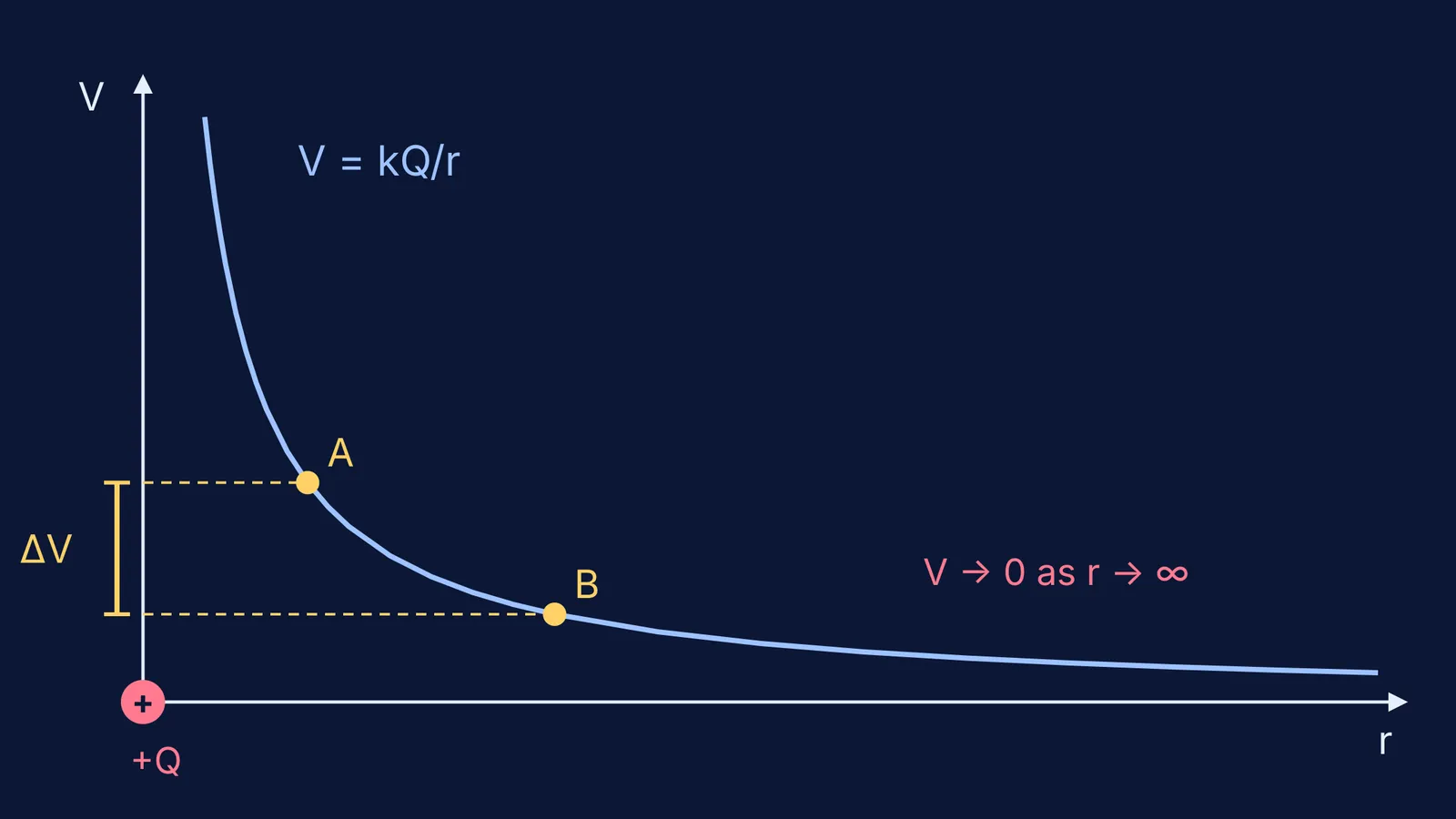
The Class 12 NCERT chapter on Electrostatic Potential and Capacitance defines the electrostatic potential at a point as the work done in bringing a unit positive charge, without acceleration, from infinity to that point.
Your gap list should look something like this:
Potential at a point. Class 10 only talks about a difference between two points. Class 12 gives every single point its own value.
A zero you choose. Class 12 says only the difference in potential is physically significant, and takes zero at infinity as a convenient choice.
No current needed. Class 10 defines it in a circuit carrying current. Class 12 defines it for any static arrangement of charges.
A formula with a shape. For a point charge, V = Q/(4πε₀r), so potential falls as 1/r while the field falls as 1/r².
Signs. Near a negative charge, the potential is negative.
A new picture. Equipotential surfaces, which are always at right angles to the field, add a second way to picture potential alongside field lines.
Now notice what survives. V = W/Q is still true at Class 12: it is the potential difference V_P − V_R, the work per unit charge between two points. The Class 10 idea was not thrown away; it became one piece of a bigger picture.
If a gap is about the bigger idea rather than one formula, the Fermi Concept Library gives each concept its own lesson and its place in the map. Equipotential surfaces are easier to see than to read, which is what the Fermi Simulation Lab is for; our post on three predictions to test with equipotential lines gives you something to try.
How do you check that the AI got both levels right?
A "Class 12" answer may borrow JEE-level ideas, or a "Class 10" answer may slip in a wrong analogy. Three checks:
Match each definition to the NCERT wording, as above.
For every gap, ask: "Is the Class 10 version a simplification here, or is it wrong?" A simplification is fine; a wrong statement needs fixing in your notes.
Watch the zero point. If the AI says potential "is" zero somewhere without saying who chose that, ask why. Our explainer on why the zero of potential energy can go anywhere covers the same idea for energy.
For more warning signs, read how to tell if an AI explanation is oversimplified.
If you want help working through your list, Fermi's AI tutor notices where you are stuck, decides whether to explain, ask or show, and checks understanding as it goes.