On this page
You draw the bisector of angle A in triangle ABC, and it meets BC at a point D. A common first guess is that D is the midpoint of BC. It usually isn't. Make a guess, then test it on one worked example and a triangle you can drag.
What does the angle bisector theorem say?
The angle bisector of an angle in a triangle divides the opposite side in the same ratio as the two sides next to that angle (Wolfram MathWorld). In symbols, if AD bisects angle A, then BD : DC = AB : AC.
Euclid proved this, and its converse, as Proposition 3 of Book VI of the Elements: if a line from the vertex cuts the base in the ratio of the other two sides, that line bisects the angle (Euclid's Elements, Book VI, Proposition 3).
Call the sides a = BC, b = CA and c = AB. Splitting a in the ratio c : b gives two formulas worth remembering:
BD = a × c / (b + c)
DC = a × b / (b + c)
Where will the bisector cut? Predict before you calculate
Take a triangle with AB = 8, AC = 4 and BC = 9. Before reading on, write down three things:
Is D the midpoint of BC?
If not, is D nearer to B or to C?
Roughly how long is BD?
Writing a prediction is not busywork. Catherine Crouch, Eric Mazur and colleagues compared different ways of presenting classroom demonstrations and found that students who only watched understood the underlying concepts no better than students who did not see the demonstration at all, while students who predicted the outcome first showed significantly greater understanding (Crouch et al., American Journal of Physics, 2004). A wrong guess on paper is something you can fix.
Worked example: AB = 8, AC = 4, BC = 9
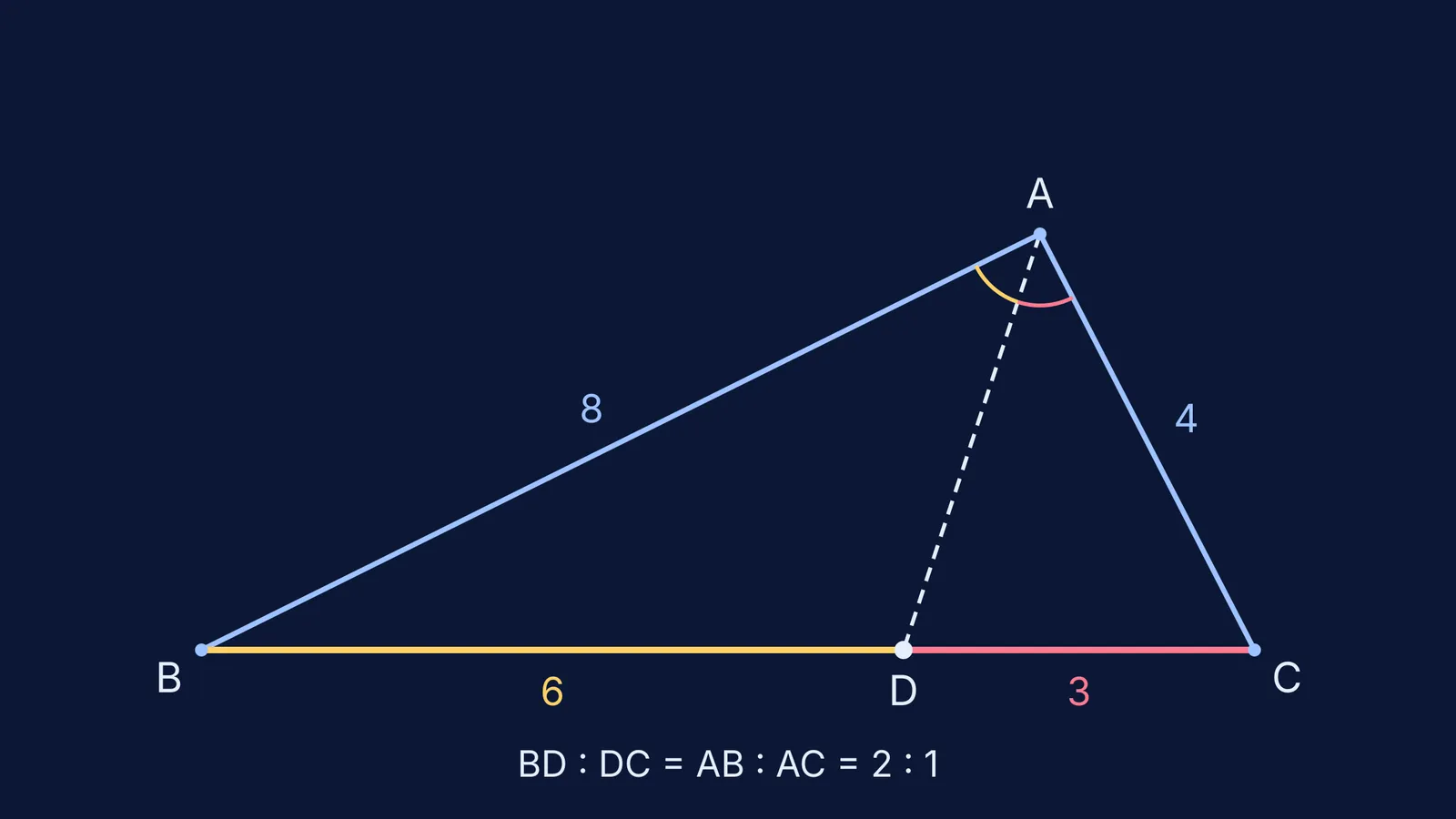
Write the ratio from the theorem: BD : DC = AB : AC = 8 : 4 = 2 : 1.
BC has 2 + 1 = 3 equal parts, so each part is 9 ÷ 3 = 3.
BD = 2 × 3 = 6 and DC = 1 × 3 = 3.
Check: 6 + 3 = 9, and 6 : 3 = 8 : 4.
So D is not the midpoint, which would be 4.5 from B. It sits closer to C, the end of the shorter side. The diagram at the top of this post is this exact triangle, drawn to scale.
What happens to the ratio when you drag the triangle?
Dragging shows which changes matter. Use any dynamic geometry tool or the Fermi Simulation Lab, which has interactive simulations for ideas that are easier to see than to read. For each move, predict BD : DC first, then read off both ratios.
Drag A until AB = AC. Prediction: BD : DC becomes 1 : 1 and D lands on the midpoint.
Drag A towards C so that AC shrinks. Prediction: BD : DC grows and D slides towards C.
Keep AB = 8 and AC = 4 but open or close angle A. BC gets longer or shorter, and so do BD and DC, yet BD : DC stays at 2 : 1. Only the two adjacent sides decide the ratio.
Scale the whole triangle up or down. Every length changes; the ratio does not.
Why is the ratio AB : AC?
Euclid's proof needs one extra line (Book VI, Proposition 3).
Through C, draw a line parallel to AD. Extend BA beyond A to meet it at E.
Angle AEC equals angle BAD (corresponding angles), and angle ACE equals angle DAC (alternate angles).
Angles BAD and DAC are equal, so angles AEC and ACE are equal, and triangle ACE is isosceles with AE = AC.
In triangle BCE, AD is parallel to EC, so BD : DC = BA : AE = AB : AC.
A quicker area argument: triangles ABD and ADC share a height from A, so their areas are in the ratio BD : DC. D is equally far from AB and AC, so the same areas are also in the ratio AB : AC.
Where does the theorem show up in exam problems?
Step 4 rests on proportional sides in similar triangles; our post on the area ratio of similar triangles shows that family of ideas visually. Once you know the ratio c : b, the section formula for dividing a segment in a ratio gives the coordinates of D directly. And the three bisectors of a triangle meet at one point, which you can check with Ceva's theorem for concurrent lines: the three ratios are c/b, a/c and b/a, and their product is 1.
If a bisector problem still stalls you, the Fermi Problem Library has worked problems with a step-by-step solver that explains the reasoning rather than printing an answer.