

On this page
What is Ceva's theorem?
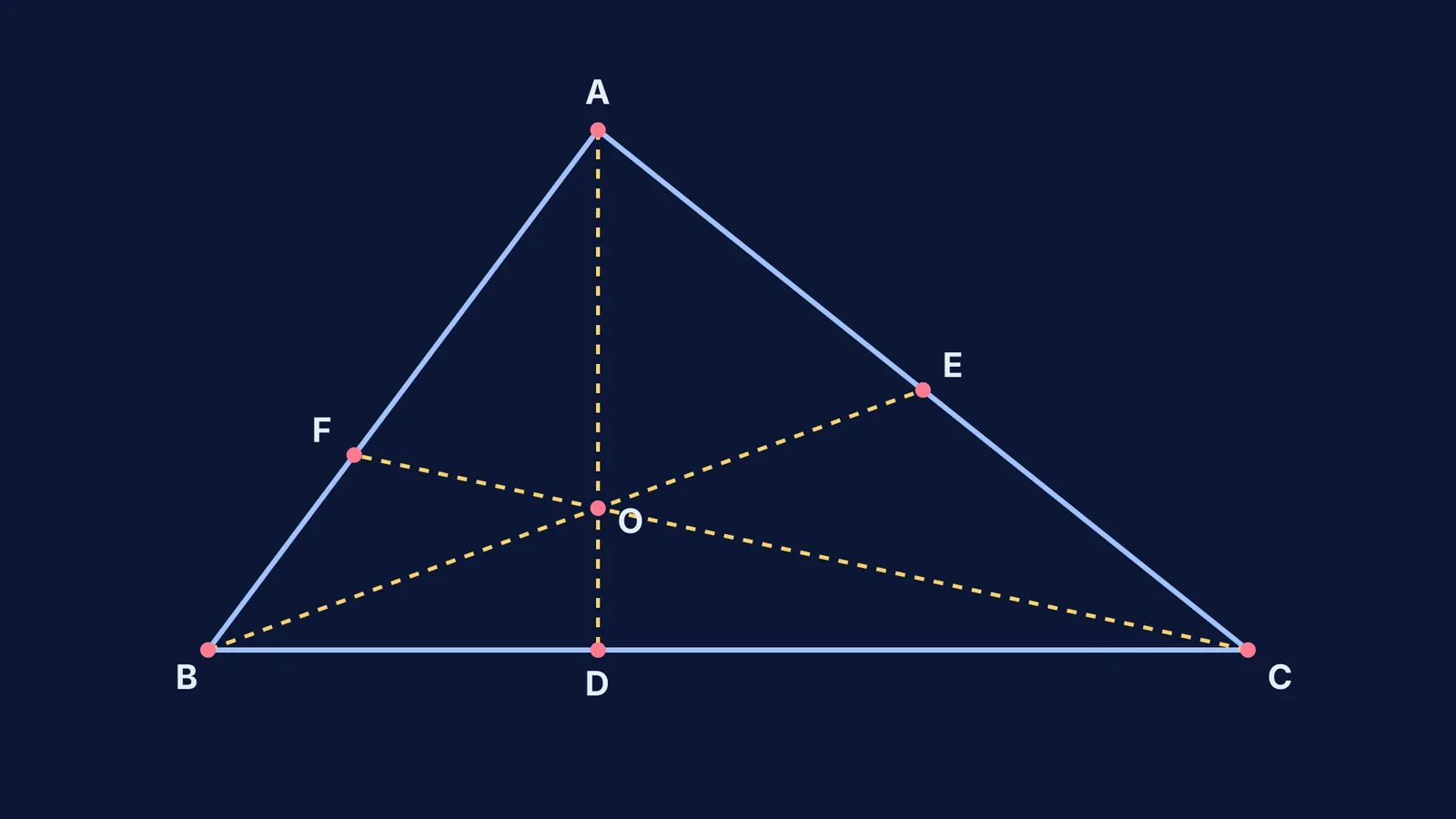
In any triangle ABC, you can draw a line from each corner (vertex) to the opposite side. These lines are called cevians. Ceva's theorem states that three lines drawn from the vertices of a triangle to the opposite sides meet at a single point if and only if the product of the ratios of the divided sides is exactly 1 [[1]](https://en.wikipedia.org/wiki/Ceva%27s_theorem).
Written mathematically for cevians AD, BE, and CF, they are concurrent when:
(AF/FB) × (BD/DC) × (CE/EA) = 1
This single equation lets you prove that a triangle's medians, altitudes, and angle bisectors each meet at a perfect central point. If you want to see how this fits into other coordinate geometry checks, such as the Condition for three lines to be concurrent, worked, Ceva's theorem gives you a fast route without needing Cartesian coordinates.
Who discovered Ceva's theorem?
Although it carries the name of Italian mathematician Giovanni Ceva, who published it in his 1678 work *De lineis rectis*, he was not the first to find the rule. The theorem was originally discovered in the 11th century by Yusuf Al-Mu'taman ibn Hűd, a mathematician and King of Zaragoza [[1]](https://en.wikipedia.org/wiki/Ceva%27s_theorem). His work contained the proof but fell out of common knowledge until it was rediscovered in 1985.
Why does it matter for Olympiad geometry?
Geometry problems in exams like the IMO often ask you to prove that three lines are concurrent. Doing this with angles or coordinates can be long and prone to errors. Ceva's theorem reduces a complex drawing problem into a single multiplication check. If you can show the lengths multiply to 1, the proof is done.
To master these proofs without staring at a blank page, Fermi's AI tutor works out what you already know, builds a plan for the session, and teaches through it—drawing the figure and checking understanding as it goes.
How do you prove Ceva's theorem using areas?
The most elegant way to prove Ceva's theorem relies on the areas of triangles. When two triangles share the same height, the ratio of their areas is exactly the same as the ratio of their bases.
Look at the bases BD and DC on the bottom of the triangle. The large triangles ABD and ADC share the same height from vertex A. Therefore, the ratio of their areas is BD/DC.
The smaller triangles OBD and ODC at the bottom also share a height from the central point O. Their area ratio is also BD/DC.
If you subtract the small triangles from the large ones, the remaining triangles ABO and ACO must also have the area ratio BD/DC.
By rotating the triangle and applying the exact same logic to the other two sides, you find:
Area(ABO) / Area(ACO) = BD / DC
Area(BCO) / Area(ABO) = CE / EA
Area(ACO) / Area(BCO) = AF / FB
When you multiply these three area ratios together, every area cancels out with one on the opposite side of the fraction. The result is exactly 1. Because the area ratios equal the side ratios, the product of the side ratios must also be 1.
Are the medians concurrent?
A median is a line drawn from a triangle's corner to the exact midpoint of the opposite side. Do all three medians meet in the middle? Let's check with Ceva's theorem.
Let D be the midpoint of BC. Therefore, BD = DC, so the ratio BD/DC = 1.
Let E be the midpoint of AC. Therefore, CE = EA, so the ratio CE/EA = 1.
Let F be the midpoint of AB. Therefore, AF = FB, so the ratio AF/FB = 1.
Multiply them together:
1 × 1 × 1 = 1
Because the product is exactly 1, Ceva's theorem guarantees the three medians must meet at a single point, known as the centroid. You can use similar logic to prove that the three altitudes meet at the orthocenter. For more ways to handle triangle geometry, such as finding the Area of a triangle using determinants, and the collinearity test, breaking the shapes into ratios is a powerful tool. Once you find the vertices or intersections, you might also want to draw a Circle through three given points: finding its centre and radius.
For more complex applications, the Fermi Problem Library has worked problems with a step-by-step solver that explains the reasoning rather than printing an answer.


