On this page
In match-the-column questions, one wrong line costs you the whole question, and that is where an AI chatbot tends to trip. Ask it to solve the full grid at once and an early slip can drag the other matches with it. The fix: give the AI one pair at a time, then check each match on its own.
How do match-the-column questions work in JEE Advanced?
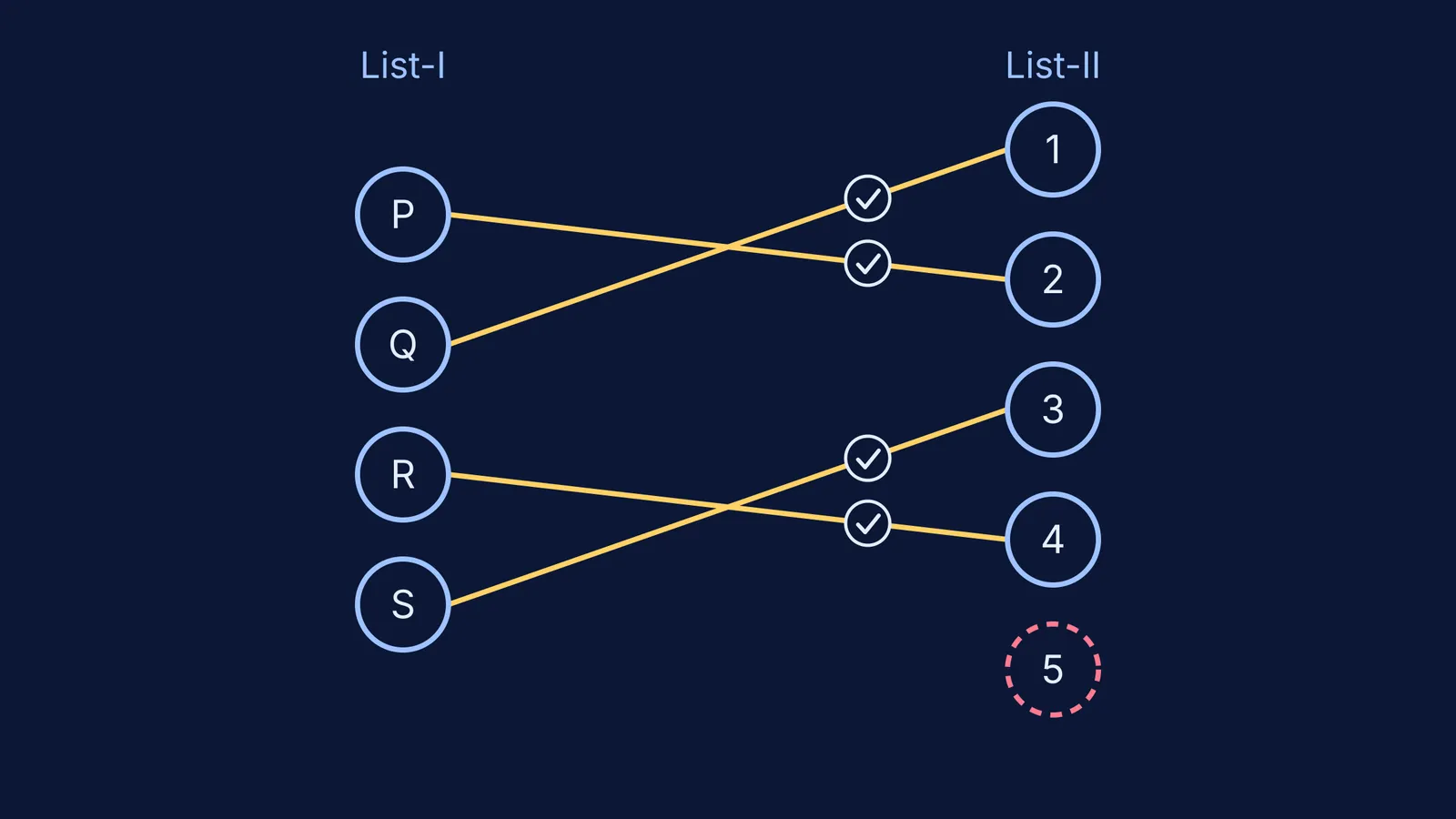
In the official JEE Advanced 2025 Paper 1 answer-key paper, the mathematics section had three Matching List Sets, each with a List-I of four entries (P, Q, R, S) and a List-II of five entries (1 to 5). You choose one of four options, and each option is a full combination such as P→2, Q→1, R→4, S→3. The marking was +4 only if the correct combination was chosen, 0 if left blank, and −1 in all other cases.
So three right pairs out of four earn nothing, and because List-II has a spare entry, you cannot find the last match by elimination. Formats can change from year to year, so read the instructions on the paper you sit.
Why does AI get match the following questions wrong?
A chatbot writes step by step, and each step leans on the last. In a 2023 study, Muru Zhang and colleagues built three question sets on which ChatGPT and GPT-4 often gave a wrong answer and backed it with at least one false claim. Checked separately, ChatGPT could identify 67% of its own mistakes and GPT-4 87%. The authors call this hallucination snowballing: the model over-commits to an early mistake and makes more mistakes it would not otherwise make.
A matching grid invites that snowball: if the AI decides P→5 first, it looks for options starting P→5 and builds reasons for the rest.
The options add their own noise. A 2023 study by Pouya Pezeshkpour and Estevam Hruschka found that shuffling the order of answer options opened a performance gap of roughly 13% to 75% for large language models on multiple-choice benchmarks. So keep the four combination options away from the AI until the very end.
How do you use AI for match the following questions, one pair at a time?
Splitting a hard problem into simpler subproblems is a known way to help these models; least-to-most prompting by Denny Zhou and colleagues (ICLR 2023) is built on it. For matching questions, also keep the pieces independent, so no answer leans on another.
Cover the options. Copy only List-I and List-II.
Send one List-I entry per message with the whole of List-II, and ask the AI to work it out from a formula or definition before picking a number.
Write each pair down yourself before you look at the options.
Check each pair in a fresh chat, phrased as a claim to test.
Only then open the options. If none contains all four pairs, one is wrong: redo the two you were least sure of.
What to type for step 2: "Here is one item: Planck's constant. Derive its dimensions from a formula you know. Then tell me which of these it matches: (1) MLT⁻¹, (2) ML²T⁻¹, (3) MT⁻², (4) ML⁻¹T⁻², (5) ML²T⁻². Ignore every other item."
What to type for step 4: "Check this single claim: surface tension has dimensions MT⁻². Say true or false and show the formula you used. If false, give the correct dimensions."
A worked example
Say List-I is (P) Planck's constant, (Q) impulse, (R) pressure and (S) surface tension, with List-II as in the script above.
P: E = hf, so h = energy × time = ML²T⁻² × T = ML²T⁻¹, which is (2).
Q: impulse = force × time = MLT⁻² × T = MLT⁻¹, which is (1).
R: pressure = force ÷ area = MLT⁻² ÷ L² = ML⁻¹T⁻², which is (4).
S: surface tension = force ÷ length = MT⁻², which is (3).
Entry (5), ML²T⁻², is the trap: those are the dimensions of energy. An AI that grabs (5) for Planck's constant may then defend an option starting P→5. Checked alone, the slip shows up in the first line of working.
What should you check before trusting the final option?
Every pair has its own line of working.
No pair was chosen because it was the only number left.
You can say why the spare List-II entry fits nothing.
Any pair the AI changed between steps 2 and 4 gets solved again by hand.
If the AI's working uses the wrong method, not just a wrong number, compare it with a worked problem in the Fermi Problem Library, where a step-by-step solver explains the reasoning rather than printing an answer. The same habit works for other formats: see our guides to practising true or false with reason questions, using AI for odd one out questions and reviewing mistakes after timed practice.
We built Fermi's AI tutor to teach rather than answer: it notices where you are stuck and checks understanding as it goes, so you leave a matching question able to explain all four pairs, not just the letter you ticked.