

On this page
Asking an AI for a true-or-false statement and explaining your reasoning is one of the fastest ways to find out what you do not know.
When you read a textbook, everything feels familiar. You follow the derivation, understand the examples, and move on. But exam questions, especially Assertion-Reason types in JEE and NEET, twist the wording to test your exact understanding. Often, students can solve a numerical problem but stumble on a theoretical true-or-false statement because they rely on pattern matching instead of first principles.
How do you get true or false with reason questions from AI?
Instead of asking an AI to explain a topic to you, you flip the script. You ask the AI to give you a statement. You then reply with "True" or "False", and critically, you write out exactly why you chose that answer.
The AI then grades your reason, not just your final answer. If your logic is sound, it confirms your understanding and moves on. If your logic is flawed or incomplete, it points out the specific gap in your reasoning.
To get the most out of this, you need a prompt that stops the AI from simply lecturing you or giving away the answer immediately.
When the AI replies with a statement, do not just guess. Type out your logic as if you were explaining it to a classmate. For example, if the statement is "A body in uniform circular motion has constant acceleration", your answer should be "False, because the direction of the velocity is constantly changing, which means the direction of the centripetal acceleration is also changing."
Why practice true or false with reason questions from AI?
This method forces you to do two things that are proven to build durable memory: practice testing and self-explaining.
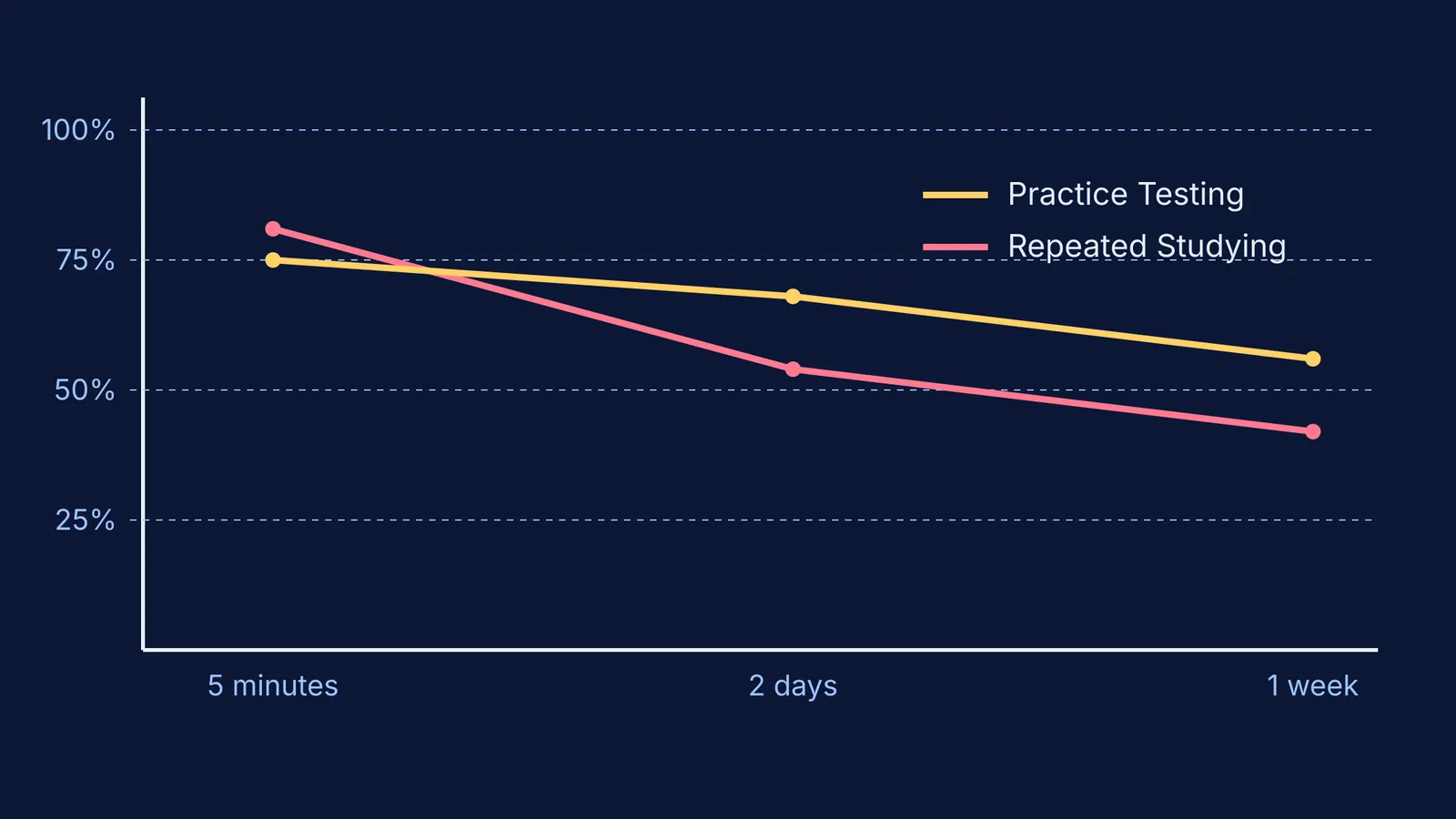
First, taking tests is not just for assessment; it actively changes your memory. A 2006 study by Roediger and Karpicke found that taking a memory test improves long-term retention far more than simply restudying the same material. In their experiment, students either studied passages repeatedly or took tests on them without feedback. When tested five minutes later, the students who simply restudied did slightly better and felt much more confident. But when tested a week later, the students who took practice tests retained significantly more information. The sheer effort of retrieving an answer builds a stronger, more lasting memory trace.
Second, explaining why something is true is the key to deep understanding. A 1989 study on self-explanations found that "Good" students naturally generate more explanations that relate actions to principles, while "Poor" students do not generate sufficient self-explanations and rely heavily on examples. When you type out your reason for a true-or-false statement, you are actively linking the specific question back to the underlying physical or mathematical principle.
By asking the AI to check your reason, you are doing active recall safely. If you prefer not to manage prompts yourself, Fermi's AI tutor does this automatically. It works out what you already know, builds a plan for the session, and teaches through it, deciding whether to explain, ask, or show the next step.
What does a good AI response look like?
When you answer a true-or-false statement, the AI should do more than just say "Correct" or "Incorrect". It should validate the specific principle you used or catch any partial misunderstandings.
If you are partially right, it should highlight the gap. For instance, if you identify a physics formula correctly but miss a negative sign convention, the AI should prompt you to think about direction before simply giving you the corrected formula.
You can mix these true-or-false sessions with numerical problems. This approach is a form of interleaved practice, which forces your brain to constantly switch gears and decide which concept applies. Instead of passively memorising physics formulas and hoping they stick, you are actively using AI to understand mistakes, not just get answers. Make it a habit: before finishing your study session, ask the AI for three true-or-false statements on the topic you just covered, and refuse to close the book until you can explain the reasons clearly.


