On this page
You ask a chatbot for "a quote by Einstein about not giving up" for your assembly speech, and it hands you a neat line with a famous name attached. It might be real. It might also be a line Einstein never said, or one nobody can trace at all. Every quote from AI needs a quick check before it goes into an essay or speech.
Why does AI make up quotes of famous people?
A chatbot writes its reply by predicting likely next words. It does not open a book and copy a sentence. A 2025 paper by Adam Tauman Kalai and colleagues, Why Language Models Hallucinate, describes the result: "Like students facing hard exam questions, large language models sometimes guess when uncertain, producing plausible yet incorrect statements instead of admitting uncertainty." The authors argue that the way models are trained and evaluated rewards guessing over admitting uncertainty. A famous name plus an uplifting theme is an easy pattern to guess.
Researchers have measured the same habit with references. William Walters and Esther Isabelle Wilder asked ChatGPT to write short literature reviews on 42 topics and checked every citation (Scientific Reports, 2023). In that study, 55% of the GPT-3.5 citations and 18% of the GPT-4 citations were fabricated. Citations are not quotes, but the lesson carries over: a confident answer with a name and a source attached is not proof.
Which famous quotes are often misattributed?
The internet is full of wrong attributions, and a chatbot can repeat them. Here are two well-known examples.
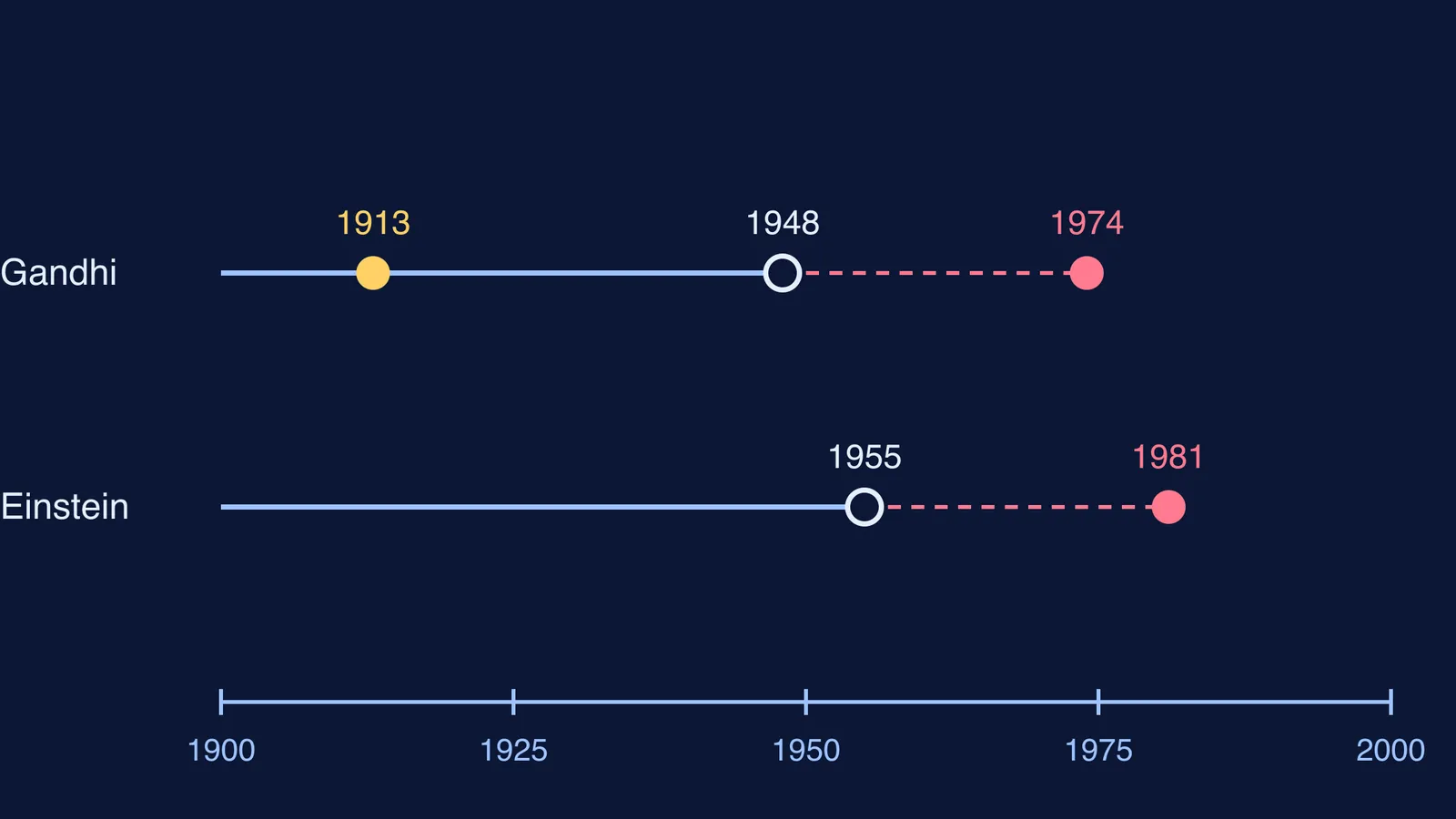
"Insanity is doing the same thing over and over again and expecting different results" is usually credited to Albert Einstein. Quote Investigator found its earliest strong match in an October 1981 newspaper report of an Al-Anon meeting, and concluded that the link to Einstein "occurred many years after his death and is unsupported."
"Be the change you wish to see in the world" is credited to Gandhi. What Quote Investigator traced back to Gandhi is a 1913 passage in Indian Opinion, which reads in English: "If we could change ourselves, the tendencies in the world would also change." It gives credit for the short slogan to the educator Arleen Lorrance, who wrote "be the change you want to see happen" in 1974.
How do you check if a quote is real?
Use three steps, in this order. None of them takes long.
Search the exact phrase. Put the quote inside quotation marks in Google; Google's search help says this finds an exact match. If sites credit different people, or the only hits are quote images and social posts, treat it as unverified. Add "Quote Investigator" or "Wikiquote" to the search to find people who have already researched it.
Find the original source. A real quote has a home: a book with a page, a speech with a date, a letter, an interview. If you cannot see the words there, you do not have a quote yet.
Check the date. The source has to come from the person's own lifetime or their published work. A line that first appears in print decades after the person died fails, however famous it is.
If a quote passes all three, use it and name the source. If it fails any step, drop it or present it honestly as a popular saying.
A worked example for an assembly speech
Say a chatbot gives you: "Insanity is doing the same thing over and over again and expecting different results. (Albert Einstein)"
Step 1, exact phrase. Searching it in quotation marks plus "Quote Investigator" brings up the page above, which calls the Einstein link unsupported.
Step 2, original source. Quote Investigator found no substantive evidence that Einstein wrote or spoke it. The earliest strong match it found is an October 1981 newspaper report (Quote Investigator).
Step 3, date. Einstein died on 18 April 1955, 26 years before that report. Fail.
What you can say on stage instead: "There's a saying, often wrongly credited to Einstein, that insanity is doing the same thing again and expecting a different result."
You can also ask the chatbot for the book or speech, page and date, then open what it names. Chatbots invent sources too, for the same reason AI tutors invent fake NCERT page numbers.
What else should you check in AI-written work?
The same habit works for statistics: here is how to check every number in AI-made project data. If you are still writing, see how to prepare a two-minute assembly speech built around your own words.
In a science essay, getting the idea right matters more than the quote. The Fermi Concept Library has a lesson for every concept in physics, chemistry, biology, mathematics and computing, so you can explain it in your own words before you reach for someone else's.