On this page
Your teacher has put your name down for Monday's assembly: a thought for the day, a news round-up or a talk for a special day. Two minutes sounds short until the whole school is looking at you. But a two-minute speech is a small job you can plan: one idea, about one page of writing and three timed rehearsals.
How do you choose a topic for a school assembly speech?
Pick one idea that means something to everyone in the hall, from the youngest class to the seniors, and that gives them something to think about or do that day. Test it by writing your point as one sentence a Class 6 student would understand. "Climate change" is too big; "why switching off the fan when you leave a room matters" fits in two minutes.
Topics that work well:
A day the school is marking that week, tied to one action students can take
The science behind something everyone saw recently, such as the first monsoon rain
A short true story with one lesson
One habit, such as asking a question in class
If you choose a science topic, read its lesson in the Fermi Concept Library first, so you can explain it in your own words rather than recite a paragraph.
How many words is a two-minute speech?
Measure your own pace instead of guessing, because people speak at very different speeds. Researchers at the University of Pennsylvania measured speaking rate in 2,438 recorded phone conversations and found an overall average of 196 words per minute, with individual conversations ranging from 111 to 291. They also found that people speak more slowly with strangers. On a microphone in a big hall, slow down further so the back rows can follow.
A worked example:
Write a rough draft.
Read the first 100 words aloud at your slow stage pace and time it. Meera takes 45 seconds.
100 divided by 45, times 60, gives about 133 words per minute.
Two minutes is about 266 words; cut 10% for pauses and aim for 240.
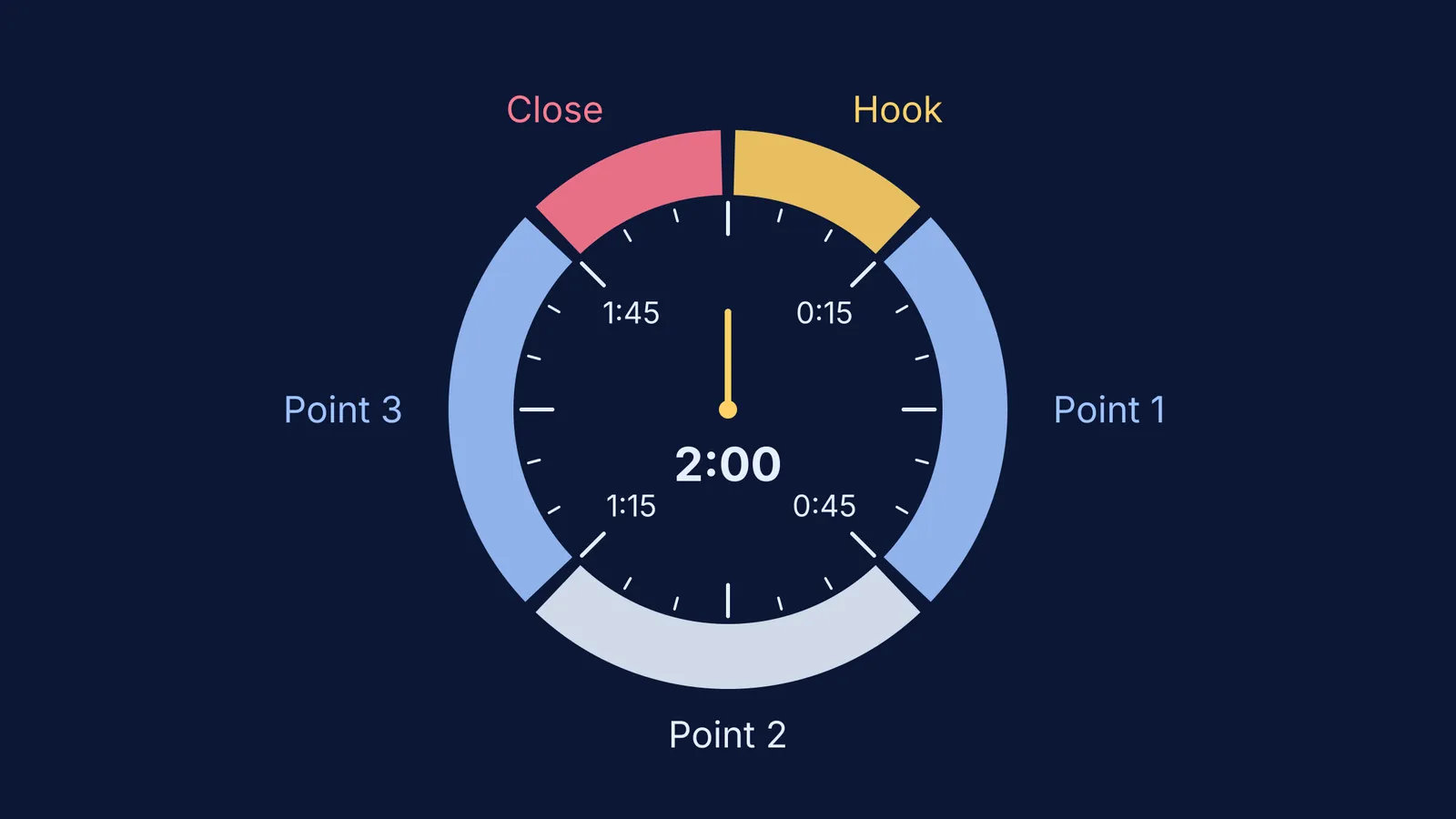
Split the budget like the timer dial at the top of this post: a hook of about 30 words (15 seconds), three points of about 60 words each (30 seconds each) and a close of about 30 words (15 seconds).
What should a two-minute assembly speech sound like?
Here is a shortened sample on asking questions in class:
Hook (0:00 to 0:15): "Good morning. Raise your hand in your head if you have ever sat in class confused and said nothing. I have, many times."
Point 1 (0:15 to 0:45): Why we stay quiet: we assume everyone else understands.
Point 2 (0:45 to 1:15): The day you finally asked, and found others had the same doubt.
Point 3 (1:15 to 1:45): A challenge: one question a day, in any subject.
Close (1:45 to 2:00): "This week, ask one question. Someone in your class will be glad you did. Thank you."
It has no long list of facts, no quote you cannot check, and it ends with one clear action.
How do you practise a speech with a timer?
Use your phone's stopwatch for three runs, ideally on different days.
From the page. Read the script aloud with the timer running, and rewrite any sentence you stumble over.
From a cue card. Write one keyword per part, stand up and speak from the card.
Full rehearsal. Speak loudly enough for the back of the room, to a parent or sibling, and finish between 1:50 and 2:00.
Saying it aloud matters for memory, not just for your voice. In eight experiments by Colin MacLeod and colleagues, when some words in a study list were said aloud and others read silently, people recognised the spoken words better later, and even mouthing them helped. So rehearse out loud, not only in your head.
If your talk explains a science idea and you are unsure it holds up, Fermi's AI tutor can ask you questions and check your understanding as it goes. For longer talks with slides, see how to practise a science presentation with AI feedback.
What if you get nervous before speaking?
You are not alone. In a survey of 1,135 students at a Brazilian university, 63.9% reported fear of public speaking, and those who rarely spoke to groups were more likely to feel it. Every small chance to speak, assembly included, is practice.
On the day, arrive early, check the microphone height and know your first sentence by heart. Pause and take a breath between parts; a short silence gives listeners time to catch up. For more, read our guide to getting better at public speaking in school; parents can follow this guide to helping a child with stage fear at school events.
If worry about speaking feels overwhelming or lasts for weeks, talk to your school counsellor or a doctor, or call Tele MANAS, India's free 24x7 mental-health helpline, on 14416.
Tonight, write your one-sentence point and time your first 100 words.