

On this page
You asked a chatbot for numbers for your school project. It gave you a neat percentage, a survey name and a year. Then you searched for the survey and found nothing.
Can AI really make up statistics and survey data?
Yes. Large language models "sometimes guess when uncertain, producing plausible yet incorrect statements instead of admitting uncertainty", in the words of a 2025 paper on why language models hallucinate by researchers at OpenAI and Georgia Tech. They argue that the way models are trained and scored rewards a confident guess over "I don't know".
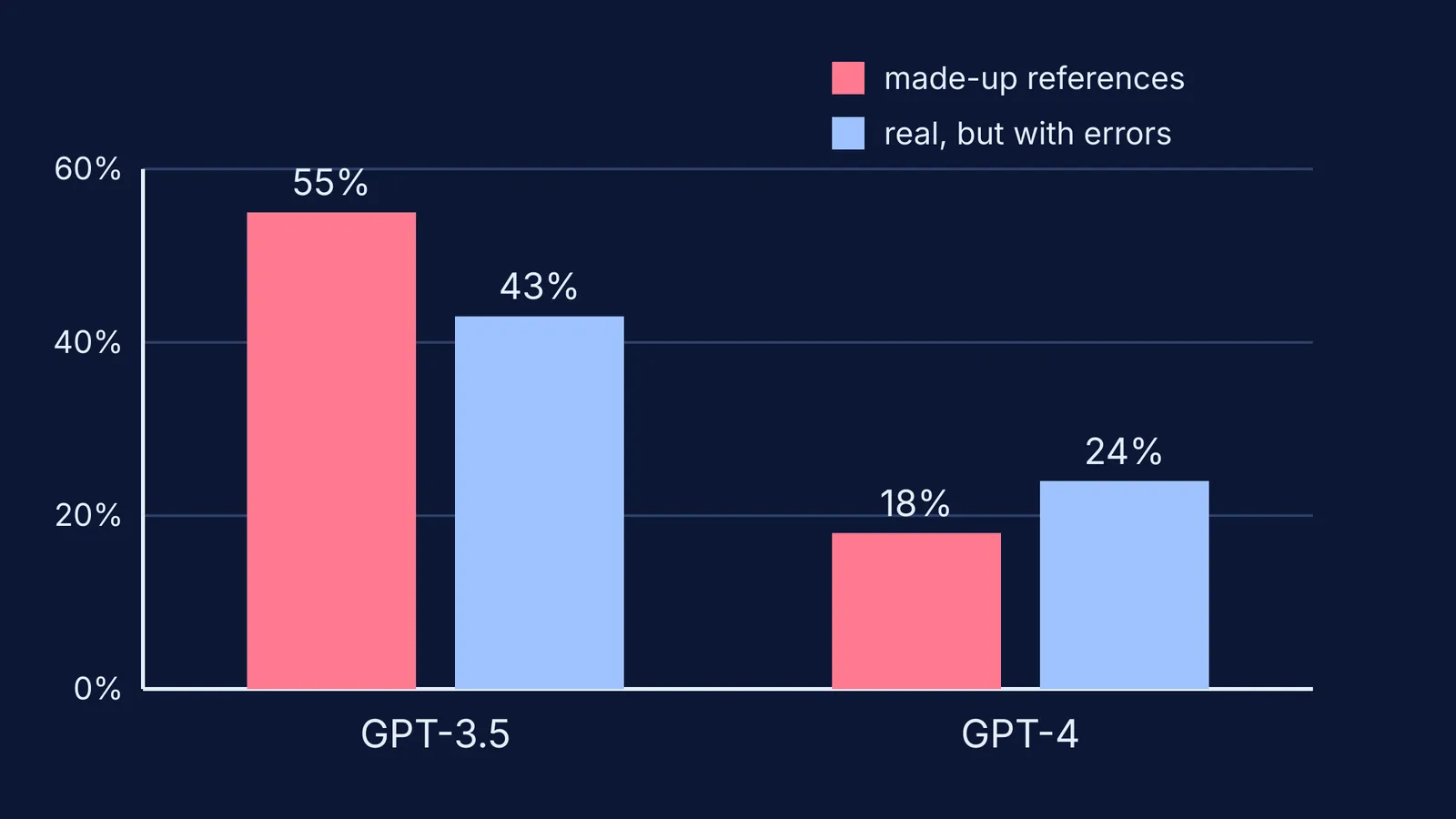
For references, the problem has been measured. In a 2023 study in Scientific Reports, William Walters and Esther Isabelle Wilder checked 636 citations that ChatGPT wrote for short literature reviews on 42 topics. 55% of GPT-3.5's citations were fabricated, against 18% of GPT-4's. Even among the real ones, 43% of GPT-3.5's and 24% of GPT-4's had substantive errors.
Whole datasets can be faked too. In a 2023 paper in JAMA Ophthalmology, Andrea Taloni and colleagues asked GPT-4's data-analysis tool to fabricate records for 300 eyes of 250 patients and to make one eye operation look better than another. It produced a dataset showing exactly that. The authors did it on purpose, to show how the tool could be misused. A chatbot will not warn you: a made-up number sounds as confident as a real one.
How do you spot a made-up number?
None of these proves a number is fake, but each is a reason to check:
A round, tidy figure with no table, page or link attached.
A survey or report you cannot find on the organisation's own website.
A link that is broken or lands on a general homepage.
A different figure when you ask the same question again in a new chat.
Vague details: "a recent study of Indian students", with no year, place or sample.
If the chatbot also gave you references, our guide to checking references and citations that AI made up shows how to test each one.
Where can you find real data for a school project?
Go to whoever did the counting. Good places to start:
eSankhyiki, the data portal of India's Ministry of Statistics and Programme Implementation, where official statistics can be searched and downloaded.
UDISE+, the government's data system on schools; our explainer on what UDISE+ 2025-26 data shows about India's schools shows the kind of figures it holds.
The World Bank's India data page, with more than 1,000 time series indicators you can download as CSV or Excel.
Our World in Data, where each chart has a "Learn more about this data" section with citation instructions.
You can also collect your own. A small, honest survey of your class, with your questions and tally shown, beats a big number nobody can find.
How do you say where every number came from?
Use a simple routine we call trace it or drop it:
Ask the chatbot for the exact source, then step away from the chat.
Open the organisation's own website and find the report or dataset.
Find the number itself in a table or on a page. Check the year, the place, who was asked and the exact wording.
Decide. If it matches, use it. If the real report says something different, use the real figure. If it is nowhere, delete it.
Write a source line beside the number.
A source line has six parts: organisation, report or dataset name, year, table or page, link, and the date you opened it.
Suppose a chatbot tells you what share of Indian students have a computer at school, "from a 2023 government survey". You search UDISE+ and find the report, but its table counts schools, not students, and the year is different. So you replace the chatbot's figure with the real one, rewrite your sentence to say "schools", and add the source line. If you had found nothing, the sentence would go.
If the hard part is the maths behind the data, such as percentages, averages or reading a graph, Fermi's AI tutor works out what you already know, builds a plan for the session and checks your understanding as it goes, so you can explain your own numbers in a viva.
What should you tell your teacher if AI gave you fake data?
Be plain about it: "I used a chatbot to brainstorm. It gave me figures I could not verify, so I removed them. Every number now has a source line, and my method section says how I used AI."
Our piece on where AI help ends and copying begins covers the wider rules.
Parents can help with one question instead of an argument about AI: "Show me where this number lives." If your child can open the page, the number stays.
Tonight, go through your project with a highlighter, mark every number, and give each one a source line or a delete.


