On this page
Lassaigne's test is covered in section 8.9.2, Detection of Other Elements, of NCERT Class 11 Chemistry, Unit 8, Organic Chemistry: Some Basic Principles and Techniques (NCERT textbook, Part II, Unit 8). Every result is a colour plus an equation, which makes it easy to revise with an AI chatbot. It also makes it easy for a fluent answer to swap one colour or one formula and still sound right.
What colours does NCERT give for each Lassaigne result?
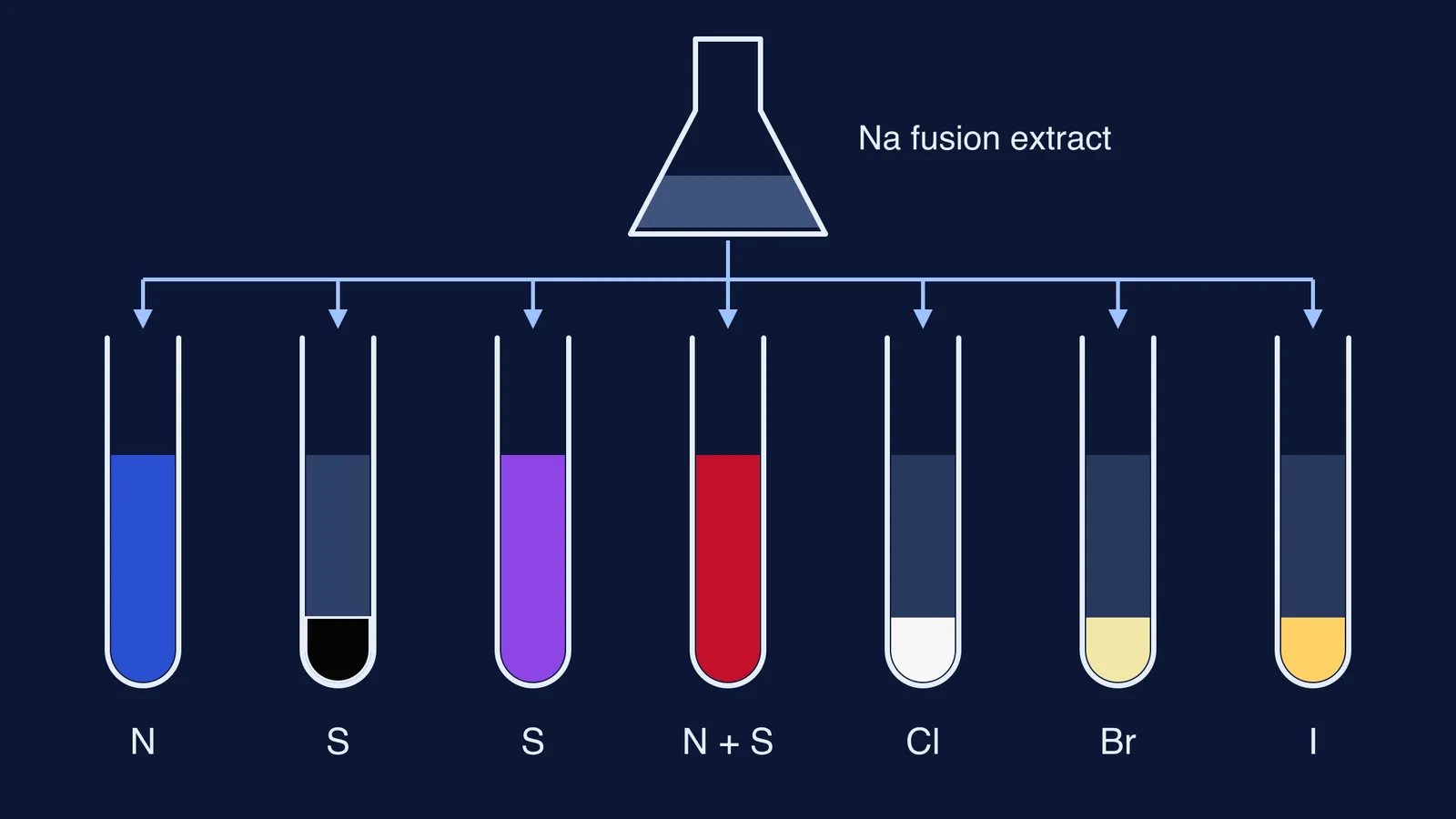
First, the set-up. Fusing the organic compound with sodium metal turns nitrogen, sulphur and halogens from covalent into ionic form: Na + C + N → NaCN, 2Na + S → Na₂S and Na + X → NaX. Boiling the fused mass with distilled water gives the sodium fusion extract, which every test starts from (NCERT Unit 8, page 284).
These are the results as NCERT states them on page 285:
Nitrogen: boil the extract with iron(II) sulphate, then acidify with concentrated sulphuric acid. Prussian blue confirms nitrogen: 6CN⁻ + Fe²⁺ → [Fe(CN)₆]⁴⁻, then 3[Fe(CN)₆]⁴⁻ + 4Fe³⁺ → Fe₄[Fe(CN)₆]₃·xH₂O.
Sulphur, lead acetate test: acidify with acetic acid and add lead acetate. A black precipitate of lead sulphide forms: S²⁻ + Pb²⁺ → PbS.
Sulphur, nitroprusside test: add sodium nitroprusside. A violet colour appears: S²⁻ + [Fe(CN)₅NO]²⁻ → [Fe(CN)₅NOS]⁴⁻.
Nitrogen and sulphur together: sodium thiocyanate forms and gives blood red, Fe³⁺ + SCN⁻ → [Fe(SCN)]²⁺, and no Prussian blue, because there are no free cyanide ions.
Halogens: acidify with nitric acid and add silver nitrate, X⁻ + Ag⁺ → AgX. White and soluble in ammonium hydroxide means chlorine; yellowish and sparingly soluble means bromine; yellow and insoluble means iodine.
How should you ask AI about Lassaigne's test?
Write your own version from memory first. Then paste a prompt like this:
"For Lassaigne's test as given in NCERT Class 11 Chemistry Unit 8, list for nitrogen, sulphur (both tests), nitrogen and sulphur together, and chlorine, bromine and iodine: the reagent added to the sodium fusion extract, the acid used, the colour or precipitate, and the ionic equation. Stay within NCERT."
Mark every line where your version, the AI's and the book's disagree. That is your revision list, whoever made the slip.
Which AI slips should you check for?
Check each against the NCERT Unit 8 chapter and its exercises.
Prussian blue and violet swapped. Prussian blue is nitrogen, by the iron(II) sulphate route. Violet is sulphur, with sodium nitroprusside.
The wrong blue formula. The blue is Fe₄[Fe(CN)₆]₃·xH₂O, iron(III) hexacyanidoferrate(II). Na₄[Fe(CN)₆], sodium hexacyanidoferrate(II), is only the intermediate; NCERT exercise 8.37 lists both as options.
The wrong acid. Concentrated sulphuric acid for nitrogen, acetic acid for the lead acetate test, nitric acid for halogens. Exercise 8.31 asks why acetic and not sulphuric acid is used with lead acetate.
No source for Fe³⁺. NCERT says some iron(II) ions are oxidised to iron(III) on heating with concentrated sulphuric acid. If the AI uses Fe³⁺ without saying where it came from, ask.
Prussian blue when both N and S are present. Expect blood red [Fe(SCN)]²⁺. With excess sodium, NCERT adds, the thiocyanate decomposes, NaSCN + 2Na → NaCN + Na₂S, and the usual tests then work.
Halogen colours or ammonia solubility mixed up. Check all three pairs: white and soluble, yellowish and sparingly soluble, yellow and insoluble.
Skipping the nitric acid boil. If nitrogen or sulphur is present, the extract is first boiled with concentrated nitric acid to decompose sodium cyanide or sulphide, which would otherwise interfere with the silver nitrate test; exercise 8.25 asks about this step. Our explainer on why nitric acid is boiled before silver nitrate in Lassaigne's test goes through the chemistry.
Charges that don't balance. Add up the charges on both sides.
What should you do when the AI and NCERT disagree?
Go with the textbook, then make the AI explain the line it got wrong: "NCERT says sodium nitroprusside gives violet with sulphide. Explain the reaction behind that colour." Keep a short slip log with three columns: the line, the wrong version, the right version. Test yourself from it before your next practical.
If the gap is the chemistry behind a colour, such as why thiocyanate blocks the blue, the Fermi Concept Library gives each chemistry concept its own lesson and its place in the map. For question practice, the Fermi Problem Library has worked problems with a step-by-step solver that explains the reasoning rather than printing an answer.
The same predict-then-check habit works for inorganic salts; see how to check salt analysis precipitate colours, and for the practical exam, using AI for titration end-point doubts and viva practice.
Tonight, write the five results from memory, run the prompt above, and check each line against page 285.