

On this page
The chemistry practical exam is notoriously stressful. You are juggling glassware, trying to read a fading pink meniscus, and preparing to defend your results to an external examiner. In volumetric analysis—titration—a drop too many changes the result entirely, leaving students second-guessing their own eyes.
ai for chemistry practical titration doubts?
If you constantly get different readings for the same titration, you are not alone. Visual judgement is a primary source of variability, even for careful students. A study measuring human error in visual endpoint detection found that visually judged endpoints produced a relative standard deviation of 3.36% in molarity calculations [[1]](https://doi.org/10.30574/wjarr.2026.30.1.1089).
Students often doubt whether the first permanent pale pink is truly the endpoint. The chemical reality is that human eyes are simply subjective when interpreting a colour gradient. This doubt grows when you are asked to perform an unfamiliar back titration: finding purity when direct titration fails. Instead of blindly repeating the experiment until two readings match, you need to understand the mechanism behind the indicator.
How does AI help understand titration end points?
When you practice the calculation at home, the textbook gives you a clean volume to work with. In the lab, you must determine that volume. This is where you can use Fermi's AI tutor to close the gap between theory and practicals.
Before your exam, you can open the Fermi Simulation Lab to see the ideas that are easier to see than to read. The AI tutor runs the simulation and checks your understanding as it goes, deciding whether to explain or ask about the difference between the equivalence point (where moles are equal) and the endpoint (where the indicator changes colour).
Because the tutor holds a line of reasoning across a session, you can ask it why phenolphthalein is not used for strong acid-weak base titrations. It will write out the pH range on the board and guide you through selecting methyl orange instead, ensuring you understand the reasoning before you are tested on it.
What questions are asked in chemistry titration viva?
The viva voce is where the examiner checks if you actually understand the procedure you just performed. They are looking for conceptual clarity, not just whether your reading matched the standard.
Here are the most common concepts tested during a titration viva:
Equivalence Point vs Endpoint: The equivalence point is when the exact stoichiometric amounts of acid and base have reacted, while the endpoint is the physical colour change you observe.
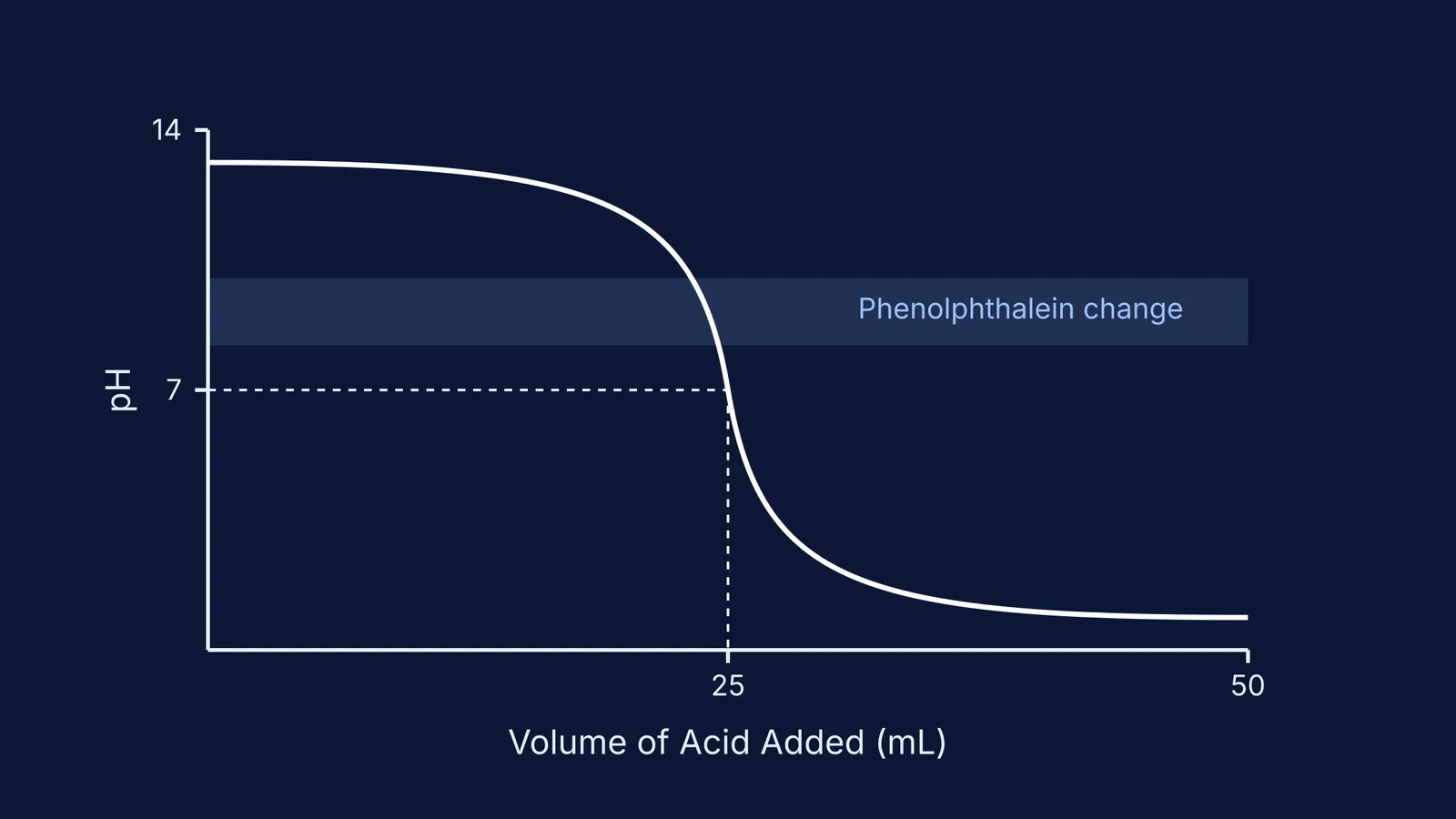
Choice of Indicator: You must know the working pH range of your indicator. Phenolphthalein works between pH 8.2 and 10.0, making it suitable when the salt hydrolysis produces a basic solution.
Primary vs Secondary Standards: Examiners frequently ask why sodium hydroxide cannot be a primary standard. You must explain that it is deliquescent and absorbs carbon dioxide from the air, meaning its concentration changes over time. Instead, you use a stable primary standard like oxalic acid or Mohr's salt to standardise it first.
Reading the Meniscus: You should always read the lower meniscus for colourless or pale liquids (like water or dilute acids), but the upper meniscus for dark liquids (like potassium permanganate) where the bottom is obscured.
Temperature Effects: A clever examiner might ask if heating the solution changes the neutral point. The dissociation constant of water shifts with heat; neutral pH is not always 7: how Kw changes with temperature.
Avoiding common practical errors
Beyond visual detection errors, procedural mistakes are common. If you rinse the titration flask with the acid or base instead of distilled water, you inadvertently add extra moles of reactant. Always rinse the burette and pipette with the solutions they will hold, but rinse the conical flask only with distilled water.
When you bring your rough data home, you can feed the numbers into the Fermi Problem Library. Rather than just giving you the final molarity, the step-by-step solver explains the reasoning behind each stoichiometric ratio, helping you verify if your practical data falls within the expected theoretical range. This active verification builds the confidence you need to face the examiner calmly.


