On this page
You finish school chapters before the class does, and the textbook problems feel easy. An AI tutor can take you further: deeper why questions, harder problems and ideas just past the syllabus. The catch is that how you use it decides whether you actually get stronger.
Does using AI for hard problems help or hurt learning?
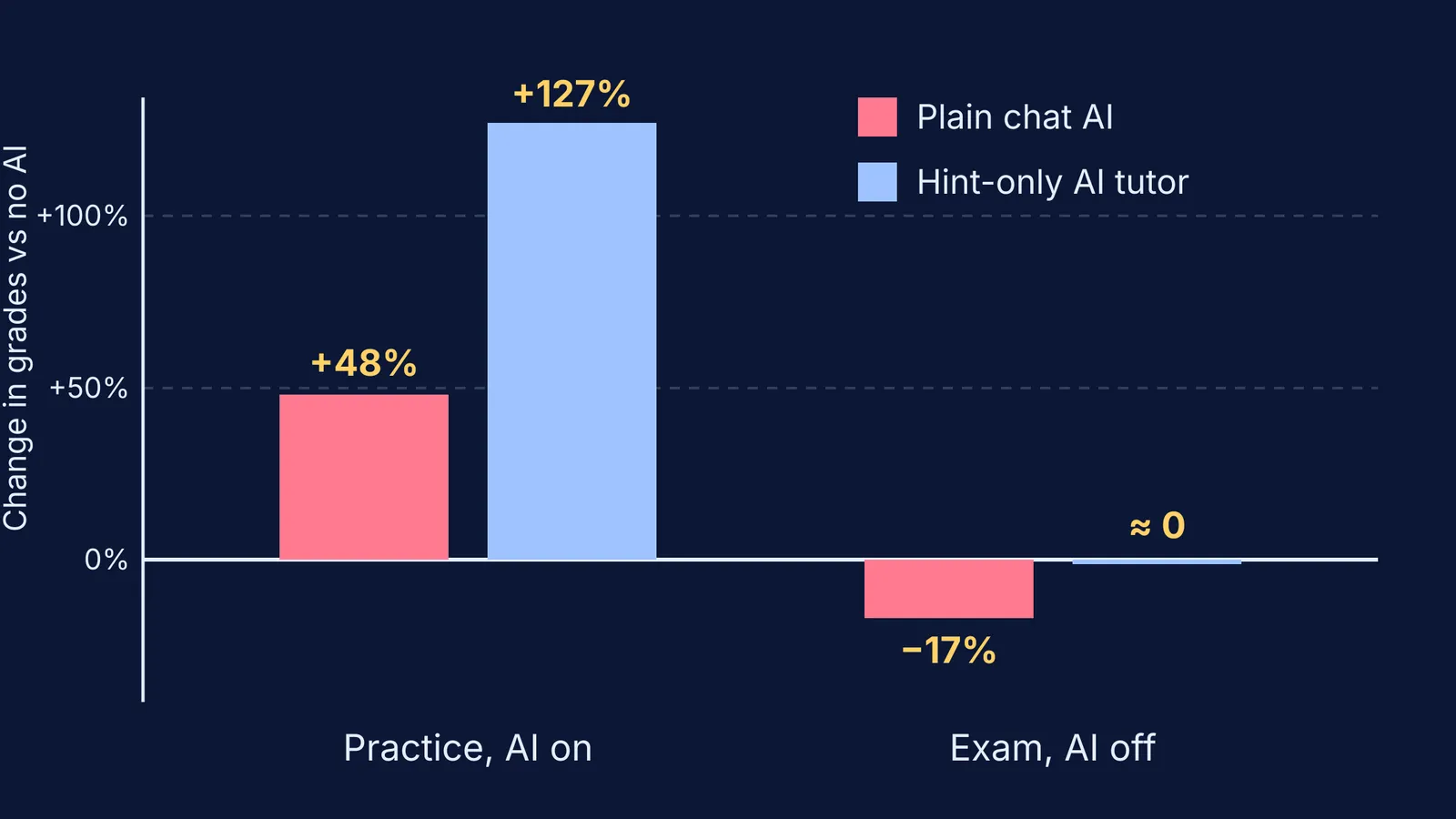
It depends on who does the thinking. In a field experiment published in PNAS, researchers gave nearly 1,000 high school maths students in Turkey access to GPT-4, either through a plain chat interface or through a tutor version prompted to give hints without directly giving the answer. With AI available during practice, grades rose 48% with the plain chat and 127% with the hint-giving tutor. On a later exam taken without AI, the plain-chat group scored 17% lower than students who never had AI, while the tutor group was statistically indistinguishable from them. The plain-chat students also did not notice that they had learned less.
A 2025 randomised trial in Scientific Reports points the same way from the other side. In an introductory physics course at Harvard with 194 students, an AI tutor built to guide students through each part of a problem in turn produced median learning gains more than double those of an in-class active learning lesson.
The lesson for a student who is ahead: speed is not the risk. Letting the AI do the hard part is.
How can advanced students use an AI tutor for enrichment?
Use it for three moves, in this order.
Ask why, then why again. Explaining why a fact is true is called elaborative interrogation; a major review of ten learning techniques rated it of moderate utility, promising but less tested in real classrooms than practice testing or spaced practice.
Try the harder problem before asking for help. A meta-analysis of 53 studies found that trying a problem before being taught the method beat teaching first, with a moderate effect (Hedges' g of 0.36). So struggle first, then take one hint at a time, as in our guide to the AI hint ladder for hard maths and physics problems.
Stretch the answer. Change one condition and predict what happens before you check: add friction, double a mass, push a quantity to zero or to infinity.
A worked example: a why-ladder on vertical motion
Say you have just done motion in a straight line and the exercise felt easy. Here is a script to type, one line at a time, waiting for each reply:
"Don't solve anything yet. I think a ball thrown straight up takes the same time to go up as to come down. Ask me why that is true."
After you answer: "Is my reason complete? Point out one gap, but don't fill it."
"Now add air resistance. I predict the fall takes longer than the rise. Give me one hint about the forces on the way up versus the way down."
"Give me one harder problem on this idea that still uses only the maths I know. No solution until I send my attempt."
"Here is my attempt. Check each step and tell me the first place I went wrong, if any."
If a reply uses calculus or other methods you have not met, ask for a school-level route or treat it as a preview, as explained in what to do when AI solves Class 9 physics with calculus. Some ideas, like how drag changes a trajectory, are easier to see than to read; the Fermi Simulation Lab has interactive simulations for exactly that.
How do you go ahead without skipping school basics?
Enrichment sits on top of school work, not in place of it. Board exams and entrance tests still reward accurate, quick work on standard problems, and the plain-chat result above is a warning that skills you hand over to AI can fade. A simple weekly plan:
Finish the school exercise for each chapter on your own, timed, before any enrichment on it.
Pick two or three enrichment sessions a week, each tied to a chapter you have just finished.
End each session by writing, without AI, the one new idea you met and one problem you can now solve.
Once a week, redo an earlier enrichment problem with no AI at all. If you cannot, the session did too much of the work for you.
Fermi's AI tutor works out what you already know, builds a plan for the session and decides whether to explain, ask or show, so a stretch session can start from where your syllabus ends.
What should parents watch for?
A child who is ahead can look busy with AI while learning little. Ask to see the attempt made before the AI's reply, not just the final answer, and ask your child to explain one new idea to you in their own words. If school feels too easy overall, our piece on what to do when your child finds class too easy covers talking to teachers and other options.
Start tonight with one why question from today's chapter, and answer it yourself before the AI does.