

On this page
You are working on a Class 9 physics problem about a train slowing down as it pulls into a station. You have the initial velocity, the final velocity and the time, and you need to find the distance. You paste the question into a standard AI chatbot, hoping for a quick hint on how to start. A second later, the screen fills with integral symbols (∫) and derivatives (dv/dt).
It is a common frustration for students trying to use generative AI for self-study. According to a 2026 survey, 54% of U.S. teens now say they have used AI chatbots to help with their schoolwork, making it one of the most common study aids (Pew Research Center). But when students ask for help, the AI frequently brings a sledgehammer to crack a nut. It uses university-level mathematics to solve problems that were designed to be solved with simple algebra, making the solution impossible to use in class.
Here is why standard AI models overcomplicate your homework, and how to get an answer you can actually write down in a school exam.
Why does AI use calculus for Class 9 questions?
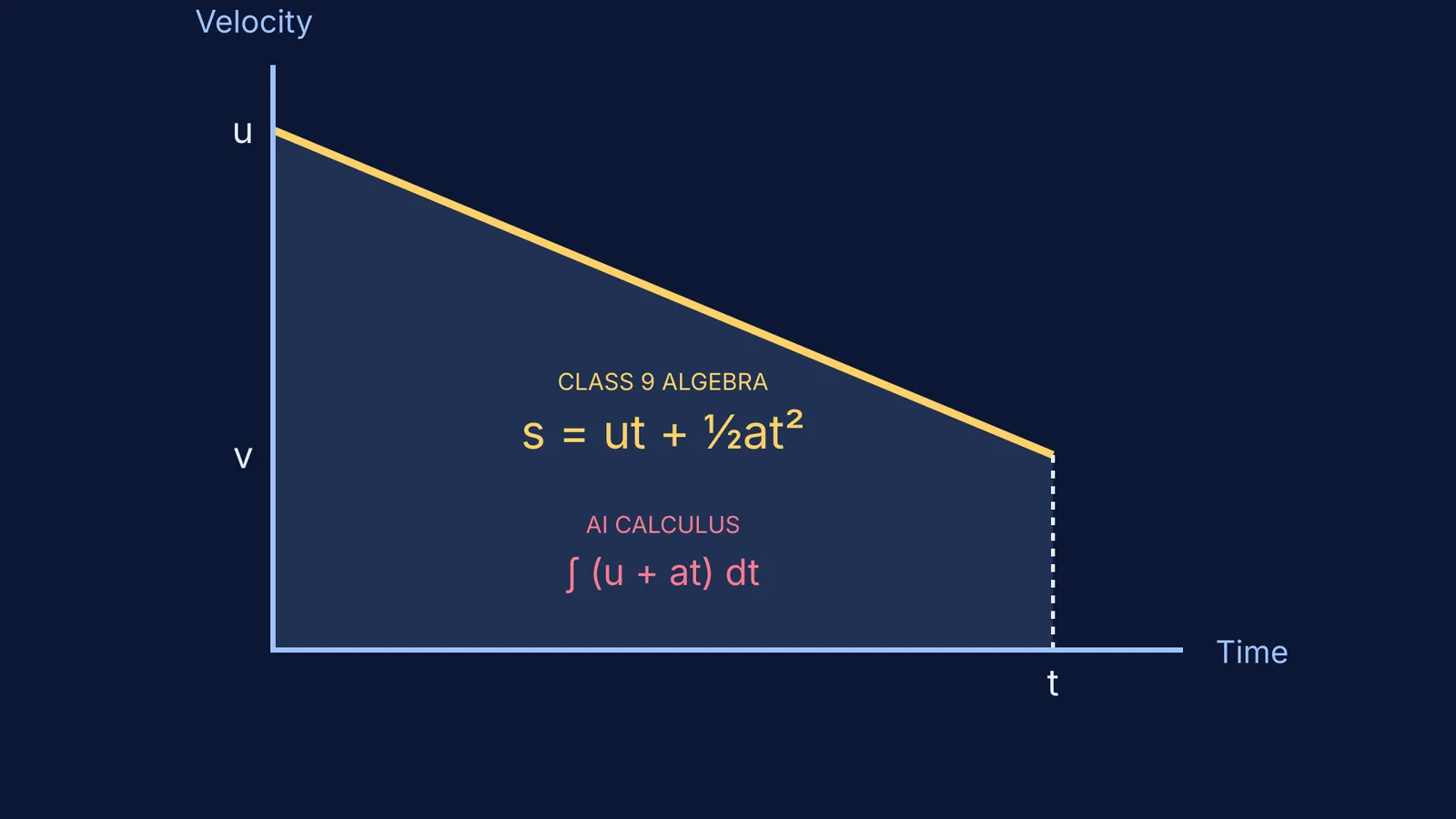
Calculus is the native language of mechanics. If acceleration is changing over time—say, the air resistance against a falling object increases as it speeds up—you must use calculus to find the answer. As you will learn in higher grades, dealing with an acceleration given as a function of v requires setting up an integral to sum up all the tiny changes in velocity.
But in Class 9, you are taught special, simplified cases. You learn that if acceleration is perfectly constant, you do not need to integrate. You can use three neat algebraic equations, such as v = u + at and s = ut + ½at².
The problem is that a general-purpose AI chatbot has read the entire internet. It does not know whether you are a 14-year-old school student or a first-year engineering undergraduate. Because university papers, scientific journals and advanced textbooks make up a huge portion of its training data, its default "voice" is that of a university professor. When it sees a physics problem involving rates of change, its safest mathematical bet is to integrate. It reaches for the most general, powerful tool it has, entirely ignoring the limits of your syllabus.
This happens across all subjects. If you ask about chemical bonds, it might throw quantum mechanics at you when you only needed a Lewis dot structure.
What happens if I write a calculus answer in my exam?
In school board exams, including the CBSE and ICSE, you do not just get marks for arriving at the correct final number. Examiners mark your working against a very specific, step-by-step rubric.
A typical three-mark kinematics question expects you to demonstrate a clear method:
Write down the given values (for example, u = 0, t = 5 s).
State the standard formula you are about to use.
Substitute the values into the formula and calculate the result.
If you write down a calculus derivation instead, you break the marking scheme. The examiner might assume you copied the answer from a source you did not understand, or they might simply be unable to award the marks allocated for "stating the formula". Even if the maths is flawless, you lose marks because you did not demonstrate the specific skill—using the algebraic equations of motion—that the syllabus was testing.
How do I ask AI for a method I am allowed to use?
If you want to use a standard chatbot for homework help without getting overwhelmed, you have to frame your prompt carefully. You must tell the AI exactly what tools it is allowed to use, fencing it into your specific syllabus.
Next time you ask a physics or maths question, add these three rules to your prompt:
Set the grade level: Start by saying, "Act as a Class 9 physics teacher." This helps the AI filter out university-level concepts.
Restrict the method: Be specific about what it cannot do. Say, "Solve this using only the three equations of motion. Do not use calculus, integrals or derivatives."
Ask for the exam steps: Tell it how to format the output. Say, "Show the given values first, then state the formula, then do the substitution."
This forces the AI to put away its advanced maths and stick to the algebra you actually need. You can use similar rules for other subjects, such as asking it to stick to Class 10 rules for drawing ray diagrams, or asking it to balance a chemical equation without using half-reactions.
A tutor that knows your level
Writing long, restrictive instructions every time you get stuck can interrupt your flow and turn studying into a chore of managing the AI. The alternative is to use a learning tool built specifically for students.
When you bring a problem to Fermi's AI tutor, it does not just print the most advanced mathematical answer it can find. Instead, it works out what you already know and builds a plan for the session. If you are practising basic kinematics, it will explain the reasoning using the algebra you are comfortable with, checking your understanding as it goes. It will never blind-side you with a university-level Lagrangian when you are just trying to find the distance in the nth second.
By using the right tools, or simply setting clear boundaries for the generic ones you already use, you can ensure the AI helps you master your syllabus rather than rewriting it.


