On this page
NCERT's Class 10 science chapter on chemical reactions teaches the types one heading at a time: combination, decomposition, displacement, double displacement, and oxidation and reduction (NCERT Class 10 Science, Chapter 1). So many students assume each reaction gets one label, until zinc displacing copper from copper sulphate is called displacement in Class 10 and redox in Class 11. Both are right. Below is a prompt, a nine-reaction practice set with answers, and a checklist for testing the AI's labels.
Can a reaction be both displacement and redox?
Yes. NCERT's Class 11 chemistry unit sorts redox reactions into four types: combination, decomposition, displacement and disproportionation (NCERT Class 11 Chemistry, Unit 7: Redox Reactions). The same unit defines a displacement reaction as one in which an ion (or an atom) in a compound is replaced by an ion (or an atom) of another element.
Displacement describes what swaps places; redox describes what happens to electrons. Different questions, so one reaction can carry both labels.
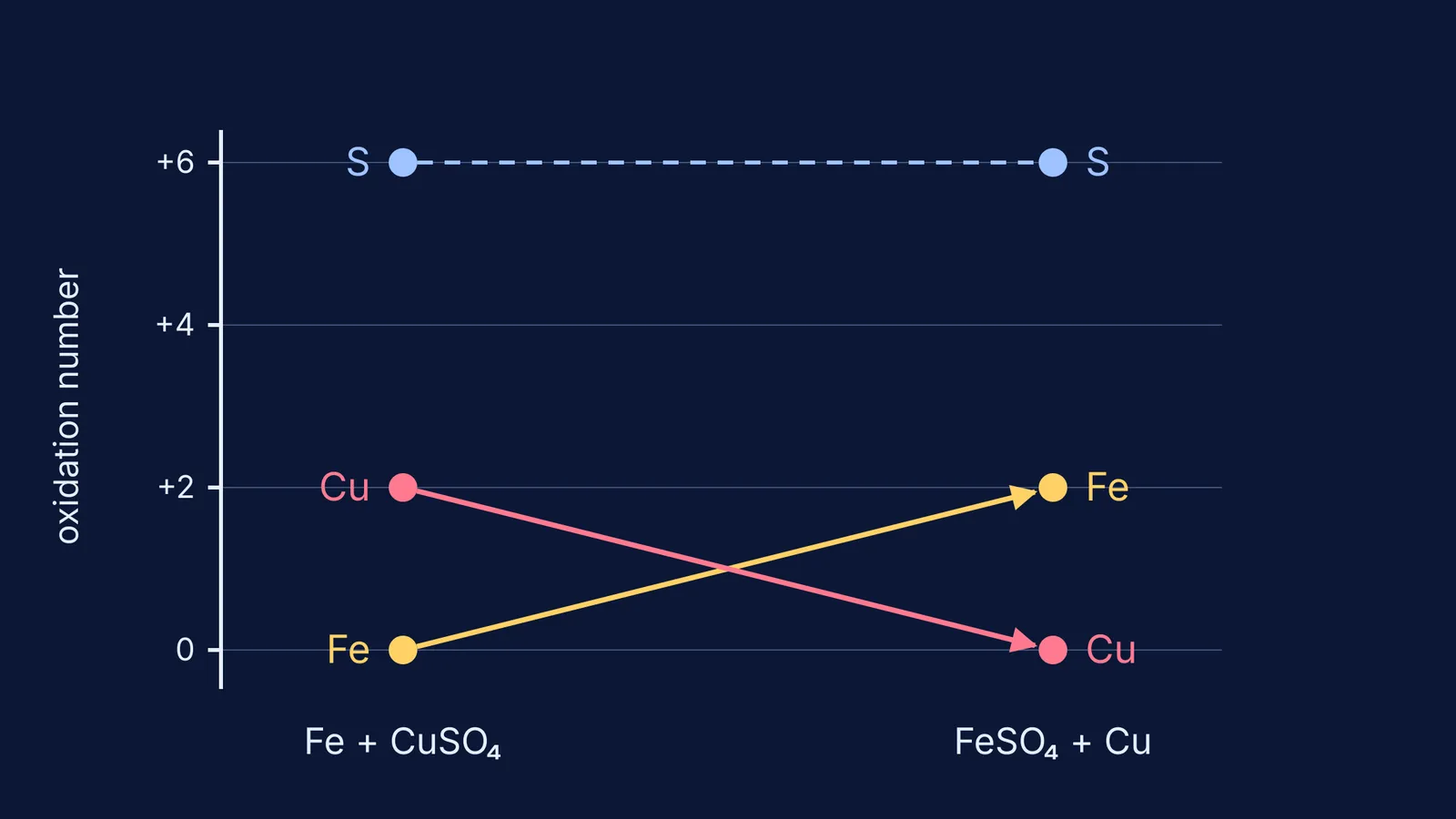
The confusion starts in Class 10, which defines oxidation as gaining oxygen or losing hydrogen (NCERT Class 10 Science, Chapter 1). Fe + CuSO₄ → FeSO₄ + Cu involves neither, so it doesn't look like redox. The Class 11 unit widens the idea: oxidation is the loss of electrons by any species, and reduction is the gain of electrons (NCERT Class 11 Chemistry, Unit 7). Iron goes from 0 to +2 and copper from +2 to 0, so the reaction is redox.
But not every reaction of a type is redox: NCERT notes that decomposing calcium carbonate is not.
How do you ask AI to classify reactions with a reason?
Label the list yourself on paper first. Then paste the reactions with this prompt:
"For each reaction, list every type it belongs to from: combination, decomposition, displacement, double displacement, precipitation, redox, disproportionation. Give a one-line reason for each label. For every redox label, write the oxidation number of each element that changes, before and after. Flag any reaction that fits two or more types."
A practice set, all from the two NCERT chapters above, with what a correct answer should say:
Fe + CuSO₄ → FeSO₄ + Cu: displacement and redox (Fe 0 → +2, Cu +2 → 0).
Fe₂O₃ + 2Al → Al₂O₃ + 2Fe: displacement and redox (Al 0 → +3, Fe +3 → 0). In the Class 10 exercise, redox isn't an option, so displacement is the answer.
Zn + 2HCl → ZnCl₂ + H₂: displacement of hydrogen and redox (Zn 0 → +2, H +1 → 0).
2KClO₃ → 2KCl + 3O₂: decomposition and redox (Cl +5 → −1, O −2 → 0).
CaCO₃ → CaO + CO₂: decomposition only; no oxidation number changes.
C + O₂ → CO₂: combination and redox (C 0 → +4, O 0 → −2).
CaO + H₂O → Ca(OH)₂: combination only; no oxidation number changes.
Na₂SO₄ + BaCl₂ → BaSO₄ + 2NaCl: double displacement and precipitation, not redox.
2H₂O₂ → 2H₂O + O₂: decomposition and disproportionation, a kind of redox (oxygen at −1 goes to both −2 and 0).
What should you check when the AI says a reaction is two types?
Run each label through these tests:
Redox: the AI must name one element whose oxidation number rises and one whose number falls.
Not redox: you wrote every oxidation number on both sides and none changed.
Displacement: a free element on each side, in the pattern X + YZ → XZ + Y.
Double displacement: two compounds swap partners, with no free element anywhere.
Quick flag: an element free on one side and in a compound on the other usually means redox. Confirm with the numbers.
If oxidation numbers are your weak spot, see our guide to checking oxidation numbers in compounds with AI.
When the AI's answer and yours disagree, don't just accept its version. Ask: "Which element's oxidation number changes in reaction 5? Show before and after." A wrong redox claim often falls apart here.
For writing the equations themselves, see how to write chemical equations in board exams.
Why make the AI give a reason, not just a label?
A label alone doesn't show understanding. A 2013 review led by John Dunlosky rated 10 learning techniques and gave self-explanation and elaborative interrogation (asking why a fact is true) moderate utility, while practice testing was rated high utility (Dunlosky et al., Psychological Science in the Public Interest). Labelling the set yourself is a form of practice testing; explaining your reasons and comparing them with the AI's is self-explanation.
If a label keeps going wrong because the method itself is shaky, the Fermi Problem Library has worked problems with a step-by-step solver that explains the reasoning rather than printing an answer. Fermi's AI tutor can also work out what you already know and build a plan for the session, so you start from the gap, not the whole chapter.
Once two-type reactions feel easy, flip the exercise with odd one out questions using AI: give four reactions and ask which one is not redox, and why.