On this page
In a chemistry board paper, an equation that is only roughly right can lose marks. Here is what a complete equation looks like in CBSE's own marking schemes, a worked example, and a short daily drill that makes it automatic.
What do examiners check in a chemical equation?
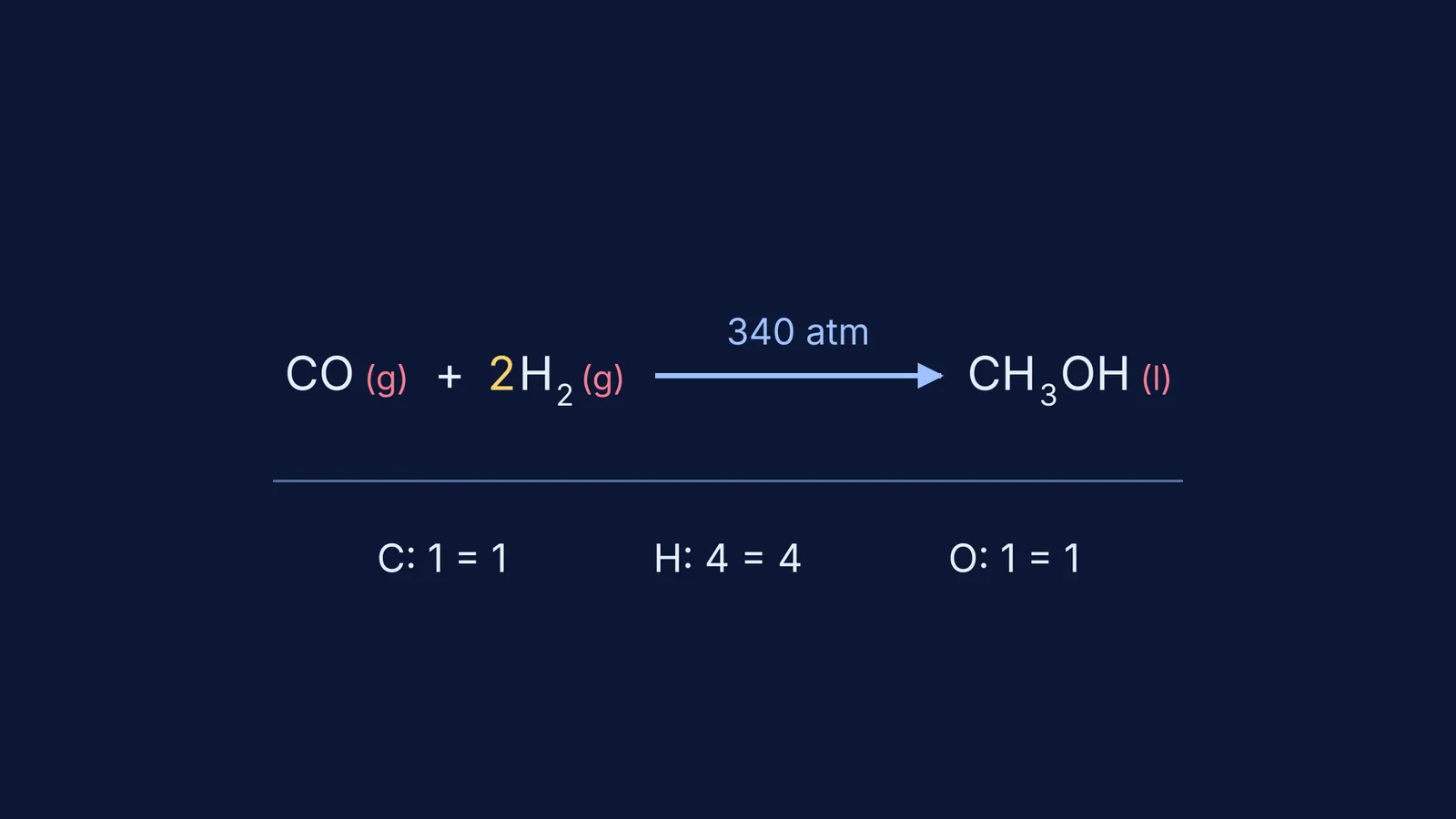
The NCERT Class 10 chapter Chemical Reactions and Equations says an equation is balanced when the number of atoms of each element is the same on both sides of the arrow. An equation that is not balanced is called a skeletal equation. The same chapter says an equation becomes more informative when you add state symbols, (s), (l), (g) and (aq), and write conditions such as temperature, pressure or catalyst above or below the arrow.
So every equation you write has four parts an examiner can check:
Formulae. If a formula is wrong, balancing cannot fix it. If valencies still trip you up, start with our guide to writing chemical formulae using valency.
Balance. The same atoms of each element on both sides, with the smallest whole-number coefficients.
States. NCERT says states are usually left out unless needed, so add them when the question says "with state symbols" or when the state matters (steam, not water).
The arrow. Put the catalyst, reagent, heat (Δ) or pressure on it.
The model answers follow the same pattern. In CBSE's Class 10 Science marking scheme for 2025-26, the hydrogenation of propene is written C₃H₆ + H₂ → C₃H₈ with Ni, the catalyst, over the arrow.
How do you balance a chemical equation quickly?
Use NCERT's hit-and-trial order. Here is the chapter's own example, iron and steam: Fe + H₂O → Fe₃O₄ + H₂.
Draw a box around each formula. Nothing inside a box may change: to get four oxygens you write 4H₂O, never H₂O₄.
Start with the compound that has the most atoms (Fe₃O₄) and, within it, the element with the most atoms (oxygen). There are 4 O on the right, so write 4H₂O.
Hydrogen is now 8 on the left, so write 4H₂ on the right.
Iron is 3 on the right, so write 3Fe on the left.
Recount every element: 3Fe + 4H₂O → Fe₃O₄ + 4H₂.
Add states: 3Fe(s) + 4H₂O(g) → Fe₃O₄(s) + 4H₂(g). The (g) on water shows it is steam.
If you keep losing atoms in the same kind of equation, the Fermi Problem Library has a step-by-step solver that explains the reasoning rather than printing an answer.
How do you write conditions and named reactions in Class 12?
In Class 12, the reagent on the arrow is part of the answer. In CBSE's Class 12 Chemistry marking scheme for 2025-26, question 26 asks for four conversions and gives ½ mark for each. Every one of those model answers has its reagent over the arrow: acidified K₂Cr₂O₇ to turn CH₃CH₂OH into CH₃COOH, and Br₂/red P to make CH₃CHBrCOOH. Question 27 gives 1 mark per reaction, with "dry ether", "anhyd. AlCl₃" and Δ for heat written on the arrows.
The same scheme uses named reactions and tests: ozonolysis with Zn/H₂O, the Cannizzaro reaction, Wolff-Kishner reduction, Tollens' test and the iodoform test. For each one, learn three things together: the kind of starting compound, the reagent and condition on the arrow, and the product. A name without its reagent is only half a reaction.
How should you practise writing equations fast?
Practise by writing from memory, not by rereading. In a 2006 study in Psychological Science, Henry Roediger and Jeffrey Karpicke found that students who took recall tests on prose passages remembered substantially more on tests two days and one week later than students who reread them, even though rereading did better on a test five minutes later.
Here is a 15-minute daily equation drill:
Pick one chapter and list 10 reactions by name only, for example "zinc with dilute sulphuric acid" or "ozonolysis of an alkene".
Close the book and write each one in full: formulae, coefficients, states if relevant, and conditions on the arrow.
Check against NCERT with a different-coloured pen. Give each of the four parts a tick or a cross.
Copy every crossed equation onto a repeat list and start tomorrow's drill with it.
Once a week, mix chapters so you must recall which reagent goes with which reaction.
If a reaction keeps going wrong because the idea behind it is unclear, the Fermi Concept Library gives every chemistry concept its own lesson.
In the exam, check each equation before moving on: formulae right, atoms counted, states if asked, arrow filled in. Next, read what a balanced chemical equation gives and its limitations, or see how to write maths steps in board exams.