On this page
A chatbot will make you a C3 vs C4 table in seconds, but a wrong row looks exactly like a right one. So treat it as a draft and check it, row by row, against Chapter 11 of the Class 11 NCERT Biology book, Photosynthesis in Higher Plants. NCERT ends section 11.9 by asking you to fill in a blank comparison grid, Table 11.1. That grid is your checklist.
How do you ask AI for a C3 vs C4 table you can check?
Ask for the table in NCERT's own rows, so every line has something to be checked against. Paste something like this:
"Make a C3 vs C4 plants table for Class 11 NCERT Biology, Chapter 11. Use these rows: cell type where the Calvin cycle happens, cell type for the first carboxylation, primary CO2 acceptor and its number of carbons, first CO2 fixation product and its number of carbons, which cells have RuBisCO, whether PEPcase is present, photorespiration, leaf anatomy. For each row, name the NCERT section you took it from."
If the AI cannot point to a section, mark that row. Then open the chapter.
What does NCERT say for each row?
Here is the answer key, with the section of the NCERT photosynthesis chapter for each line:
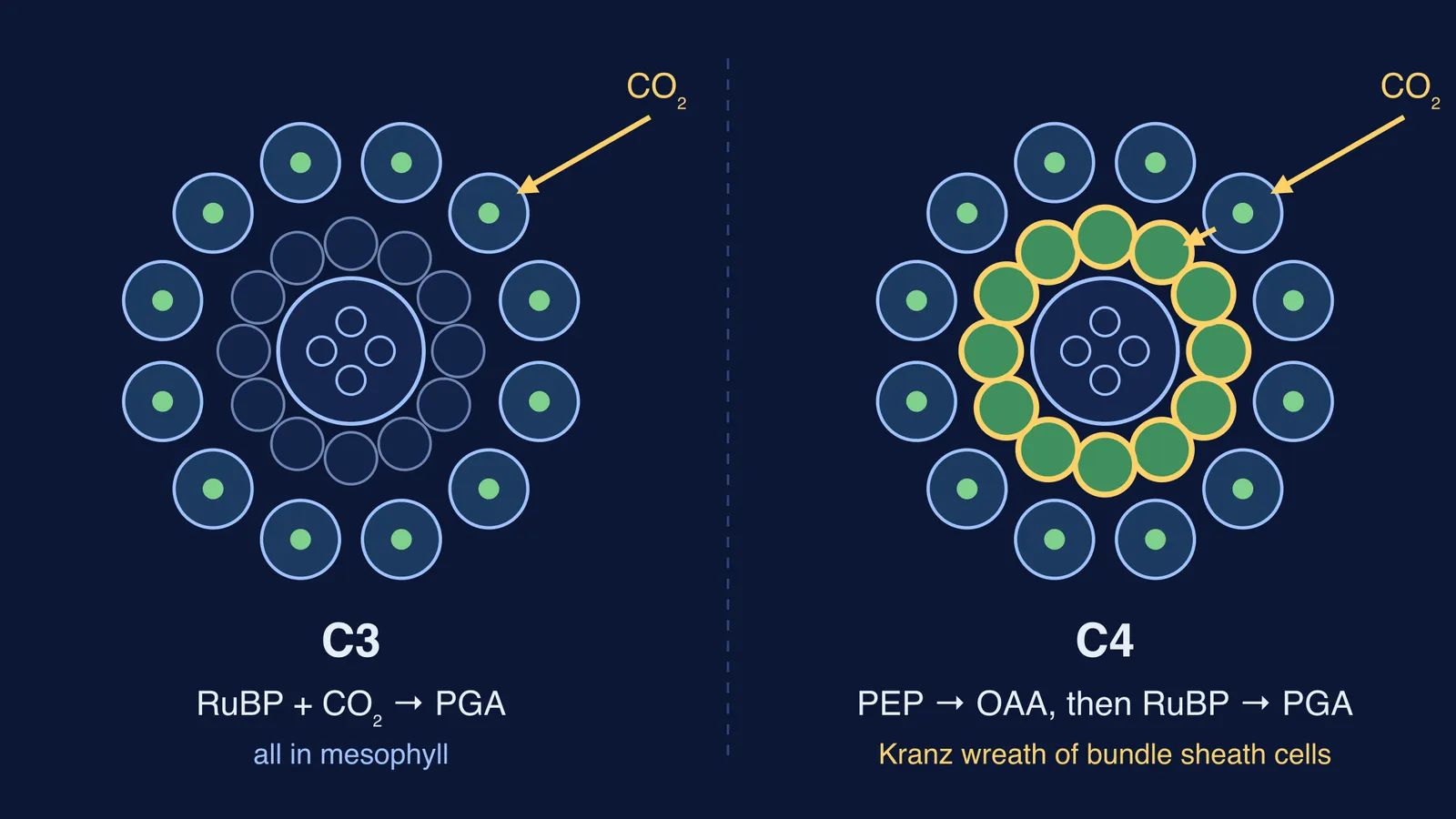
First CO2 acceptor: RuBP, a 5-carbon ketose sugar, in C3 plants (11.7.1); PEP, a 3-carbon molecule present in the mesophyll cells, in C4 plants (11.8).
First product: PGA, a 3-carbon acid, in C3 plants; OAA, a 4-carbon acid, in C4 plants (11.7).
Enzyme for the first fixation: RuBisCO in C3 plants; PEP carboxylase, or PEPcase, in C4 plants (11.7.2, 11.8).
Where the Calvin cycle runs: in all the mesophyll cells of C3 plants; only in the bundle sheath cells of C4 plants (11.8).
Where the enzymes sit in C4 plants: mesophyll cells lack RuBisCO; bundle sheath cells are rich in RuBisCO but lack PEPcase (11.8).
Photorespiration: in C3 plants some O2 binds RuBisCO, so CO2 fixation drops; in C4 plants photorespiration does not occur (11.9).
Leaf anatomy: C4 plants have Kranz anatomy; NCERT suggests cutting maize or sorghum leaves to see it (11.8).
The Calvin cycle itself runs in all photosynthetic plants, C3 or C4 (11.7.2); our Calvin cycle in numbers post counts its ATP and NADPH.
Which rows of an AI C3 vs C4 table should you check first?
Check these three first, because a wrong answer in them is still a real term from the same pages of the chapter.
First acceptor, RuBP or PEP. The trap is the letter P. PGA, PEP and RuBP appear within a few pages of each other, and Table 11.1 itself offers "RuBP/PEP/PGA" as the choices for this row. PGA is never the acceptor; it is a product. If a table says the C4 acceptor is RuBP, it has described the second fixation, the Calvin cycle inside the bundle sheath, not the first.
First product, OAA or malic acid. NCERT names OAA, oxaloacetic acid, as the first stable product of CO2 fixation in C4 plants. OAA then forms other 4-carbon compounds, such as malic acid or aspartic acid, in the mesophyll, and these are carried to the bundle sheath. A table that lists malate as the first product has skipped a step.
Kranz anatomy, and which cells form the wreath. NCERT says Kranz means wreath, a reflection of how the cells are arranged: leaves with particularly large bundle sheath cells around their vascular bundles have Kranz anatomy. These cells may form several layers and have a large number of chloroplasts, thick walls impervious to gaseous exchange and no intercellular spaces. Two slips to look for: calling the wreath mesophyll, and giving bundle sheath cells PEPcase.
What should you do when the AI's table disagrees with NCERT?
Write what the textbook says. For school exams, the chapter is the answer key.
Paste the NCERT sentence into the chat and ask the AI to redo only that row.
Watch for rows NCERT leaves open. Table 11.1 offers three temperature optimum choices (30-40°C, 20-25°C, above 40°C), but the chapter text only says C4 plants tolerate higher temperatures. If the AI gives a confident figure, ask your teacher.
Next day, rewrite the corrected table from memory.
If one row keeps tripping you, the gap is usually the idea behind it. The Fermi Concept Library covers every concept in physics, chemistry, biology, mathematics and computing, each with its own lesson and its place in the map, so you can go back to the step you keep mixing up.
C4 is not the only adaptation to dry heat: CAM plants open their stomata at night. The same draft-then-check method works for tracking ATP and NADPH from the light reactions to the Calvin cycle.
Open the chapter at Table 11.1 tonight and check your AI's table, one row at a time.