On this page
To take in carbon dioxide, a plant must open its stomata, and every open pore lets water vapour out. Plants with crassulacean acid metabolism (CAM), such as cacti, change the timing. They open stomata at night, store the carbon dioxide as an acid, and use it the next day with their pores shut.
CAM is the third pathway in your photosynthesis chapter, after C3 and C4.
What is CAM photosynthesis?
Crassulacean acid metabolism is a specialised mode of photosynthesis with night-time CO2 uptake that raises water-use efficiency and lets plants live in semi-arid deserts and seasonally dry forests, according to a 2015 research roadmap in New Phytologist. The name comes from the Crassulaceae, a family of succulents that includes Kalanchoë, a group still used as a model for studying CAM.
A 2014 review in Trends in Plant Science reports that CAM evolved independently many times, in at least 343 genera across 36 plant families, which together make up more than 6% of higher plant species (Borland and colleagues, 2014).
Pineapple is the most economically valuable crop that uses CAM, according to the 2015 pineapple genome study in Nature Genetics. That team found the pineapple lineage moved from C3 photosynthesis to CAM by rewiring genes that C3 plants already have, not by gaining new ones through gene duplication.
Why do CAM plants open their stomata at night?
Because night air pulls less water out of a leaf. Borland and colleagues point out that at night the leaf-to-air vapour pressure deficit, the drying pull of the air on a wet leaf, is usually lower than during the day (Trends in Plant Science). The same stomatal opening costs less water after dark.
That is why CAM raises water-use efficiency: the carbon a plant gains for each unit of water it loses. The same review estimates that CAM plants grown on irrigated land could produce similar amounts of biomass to C3 species using up to 80% less water.
What happens in the four phases of CAM?
Here is one 24-hour day, using the phases set out by Borland and colleagues in Trends in Plant Science:
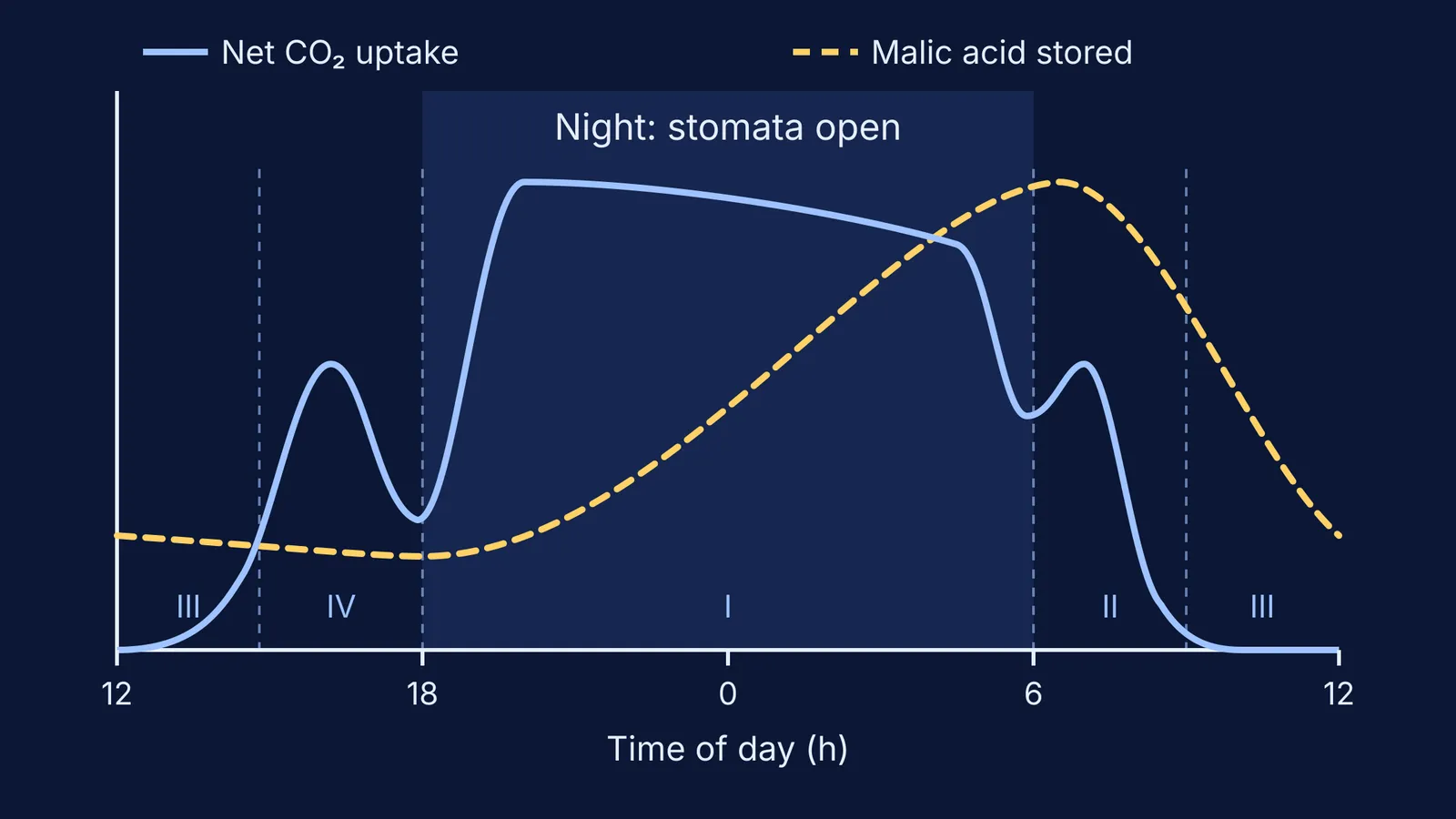
Phase I, night: stomata open. The enzyme PEP carboxylase fixes CO2 into oxaloacetate, which is reduced to malate and stored in the vacuole as malic acid. Acid builds up all night and peaks around dawn.
Phase II, early morning: as light increases, fixation passes from PEP carboxylase to Rubisco.
Phase III, daytime: stomata close and net CO2 uptake falls to zero. Malic acid is broken down to release CO2, which builds up behind the closed stomata, 2 to 60 times more concentrated around Rubisco, and is fixed in the Calvin cycle.
Phase IV, late afternoon: the stored acid runs out, the CO2 level inside the leaf drops, stomata open again and the plant takes in some CO2 straight from the air.
Not every CAM plant shows every phase. The same review notes that a phase can be shortened or dropped depending on conditions and on how succulent the tissue is. In facultative CAM species, salt, water shortage or strong light switch CAM on, and the authors list further variants such as CAM cycling and CAM idling.
Shaky on the Calvin cycle? See our guide to tracking ATP and NADPH from the light reactions to the Calvin cycle.
How is CAM different from C3 and C4?
One line holds it: C4 separates its two CO2-fixing steps in space, across mesophyll and bundle sheath cells; CAM separates them in time, inside single cells (Borland and colleagues, Trends in Plant Science).
Use this checklist when a question gives you a plant or a graph:
First enzyme to fix CO2: Rubisco in C3; PEP carboxylase first, then Rubisco, in both C4 and CAM.
When stomata open: by day in C3 and C4; mainly at night in CAM.
What a graph shows: if acid content rises overnight and falls by day, it is CAM.
Examples to write: pineapple, Opuntia and Agave.
For the side-by-side of the other two pathways, see our C3 vs C4 plants comparison of primary acceptors and first products. To see the pores themselves, try a temporary mount of a leaf peel for stomata.
How do you check you have understood CAM?
Explain the graph at the top of this page aloud in five sentences: when stomata open, why acid rises, what happens at dawn, where the CO2 goes by day, and why stomata reopen late. The sentence that will not come is your gap.
The Fermi Concept Library has a lesson for every concept in biology. When a question trips you up, the Fermi Problem Library has worked problems with a step-by-step solver that explains the reasoning rather than printing an answer.
Next time you see a pineapple or a cactus, say what its cells will be doing between tonight and tomorrow noon.