On this page
Say you are group O, your mother is group A and your father is group B. Nothing has gone wrong. The ABO groups follow simple rules, and you can work out every possible child of any parent pair once you know what to write down. Predict first, then run the cross: the guess shows you which rule you have not yet understood.
Can parents with A and B blood have an O child?
Yes, but only when both parents carry the i allele.
The NCERT Class 12 Biology chapter on Principles of Inheritance and Variation explains that ABO blood groups are controlled by the gene I, which has three alleles: IA, IB and i. The same chapter says IA and IB each produce a slightly different sugar on the surface of red blood cells, while i produces no sugar.
Each person carries two of the three alleles, one from each parent. IA and IB are both dominant over i, so a person with IAi has group A and a person with IBi has group B. When IA and IB are together, both are expressed. NCERT gives this as an example of co-dominance: the person has group AB. Group O appears only with ii, two copies of the silent allele.
So a blood group tells you the phenotype, not the full genotype: a group A parent could be IAIA or IAi.
How do you run the cross with IA, IB and i?
For an O child, each parent must pass on an i, so your group A mother must be IAi and your group B father must be IBi.
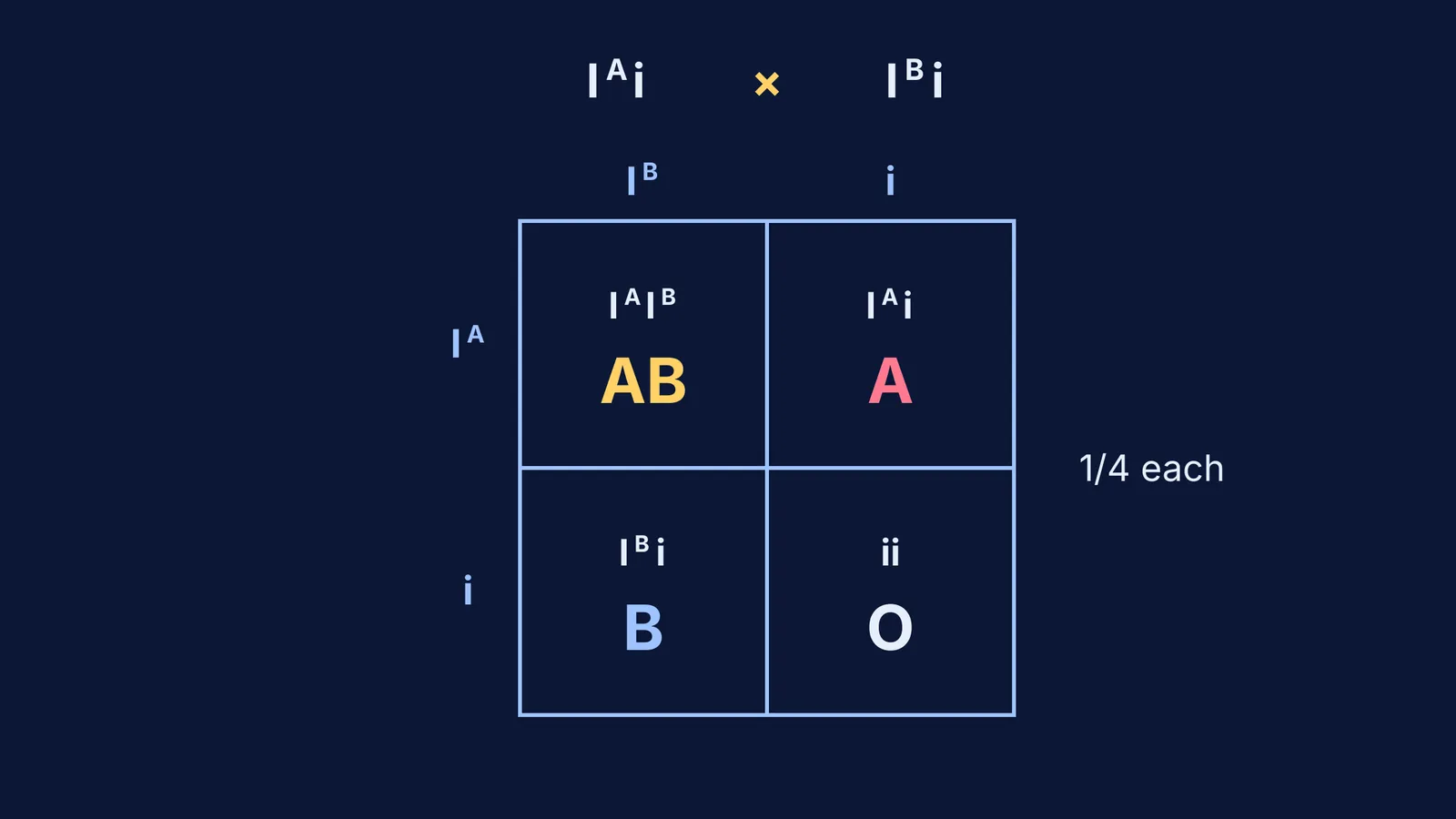
Write each parent's gametes. Each allele goes into a gamete with a 50 per cent chance, as NCERT explains, so the mother makes IA or i, half of each. The father makes IB or i, half of each.
Draw a 2 by 2 Punnett square, with one parent's gametes along the top and the other's down the side.
Fill each box with one allele from the top and one from the side: IAIB, IAi, IBi, ii.
Read the phenotypes: AB, A, B and O.
Each box has a 1 in 4 chance. So this one couple can have children of all four ABO groups. If either parent had been homozygous, IAIA or IBIB, no child of theirs could be O.
What blood groups can children have for each parent pair?
Cover the answers, predict each one, then check against NCERT's ABO allele table.
O and O: only O.
A and O: A or O.
B and O: B or O.
A and A: A or O.
B and B: B or O.
A and B: A, B, AB or O.
AB and O: A or B only. Never AB, never O.
AB and A: A, B or AB.
AB and B: A, B or AB.
AB and AB: A, B or AB, in a 1 : 2 : 1 ratio of A : AB : B.
The pair that catches most students is AB and O: every child gets IA or IB from one parent and i from the other, so the only results are IAi (A) and IBi (B).
A 1 in 4 chance does not mean one child of each group in a family of four. Small families often miss the expected ratio, which we explain with a simulator in why small families often miss the 3:1 Punnett ratio.
Why does a real blood test sometimes break these rules?
There are rare exceptions, and one of them was first found in India. A 2015 case report in the Saudi Journal of Anaesthesia describes the Bombay blood group, first detected by Dr Bhende in Bombay in 1952. People with it lack the H antigen, so their blood looks like group O in a routine test even though they may carry IA or IB.
The same report puts the Bombay group at about 1 in 10,000 people in India. So a classroom cross is not proof of who is related to whom. If a family result puzzles you, ask a doctor or a blood bank, who can run the right tests.
How can you practise ABO crosses so they stick?
Use this routine on any question, including NEET-style ones:
Write both phenotypes, then every genotype each could have.
Predict the possible child groups before drawing anything.
Run the Punnett square for the case the question needs.
Compare your result with your prediction and write one line on what you missed.
For the same rules from another angle, read our guide to ABO blood group inheritance and multiple alleles. Ideas like random gametes and ratios are easier to see than to read, and the Fermi Simulation Lab has interactive simulations for that kind of idea. If you get stuck on a longer cross, our post on using an AI tutor for genetics cross problems shows how to ask for hints instead of answers.
Next time you see a blood group question, predict first, then cross.