On this page
In 2021 a team led by Tom van der Valk and Love Dalén reported genome-wide DNA from three mammoth specimens from eastern Siberia, two of them more than a million years old (Nature, 2021). If we can read a mammoth's DNA, can we bring the animal back? Turning it into a living animal is a different problem, and gene editing solves only part of it.
What mammoth DNA have scientists actually sequenced?
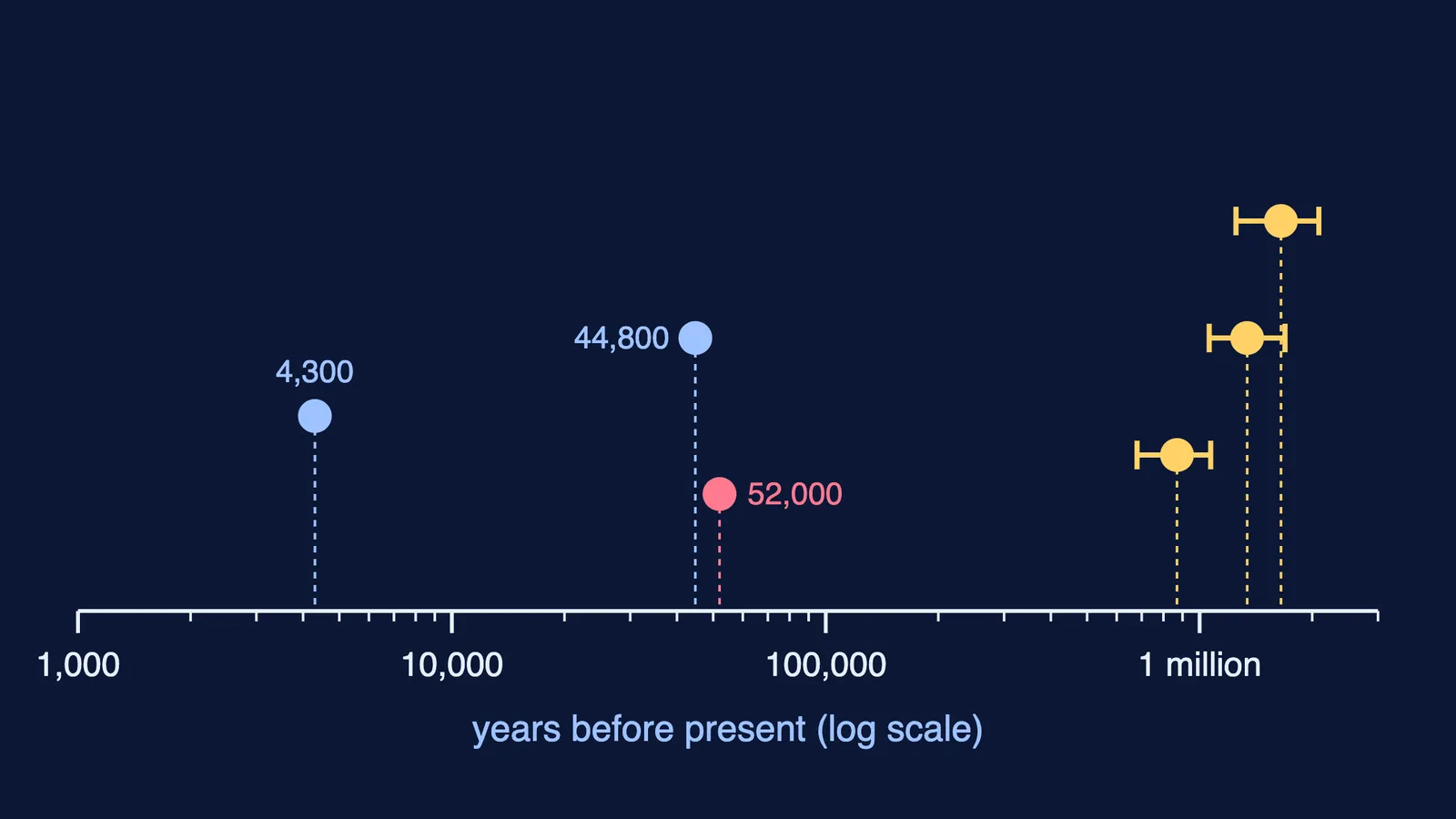
Complete genomes. In 2015 Eleftheria Palkopoulou and colleagues published two high-quality woolly mammoth genomes: one about 44,800 years old from north-eastern Siberia, and one about 4,300 years old from Wrangel Island, among the last mammoths alive (Current Biology, 2015). The Wrangel mammoth had 20% lower heterozygosity, a sign of a small population losing genetic diversity shortly before extinction.
The genes that made a mammoth. Vincent Lynch and colleagues compared two mammoth genomes with three Asian elephant genomes and found mammoth-specific changes in genes for hair and skin, fat metabolism, circadian rhythm and temperature sensing (Cell Reports, 2015). They rebuilt one gene, TRPV3, and showed that a single amino-acid change strongly affects how the channel responds to temperature.
DNA over a million years old. The 2021 study estimated its three specimens at about 1.65, 1.34 and 0.87 million years old, and found that most protein-coding changes linked to cold adaptation were already present a million years ago (Nature, 2021, full text).
The genome's 3D shape. Skin from a female mammoth that died 52,000 years ago kept the folded architecture of its chromosomes, which let a team assemble 28 chromosome-length scaffolds (Cell, 2024).
Our post on the steps of DNA isolation, including chilled ethanol shows how DNA is separated from cells in the Class 12 lab method.
Why can't scientists just clone a mammoth from frozen DNA?
Cloning needs an intact cell whose nucleus can be moved into an egg. IUCN guidance on de-extinction says the existence of any mammoth cells suitable as nuclear donors "seems highly unlikely" (IUCN SSC Guiding Principles, 2016). What survives is DNA broken into short pieces.
In 158 radiocarbon-dated bones of the extinct New Zealand moa, with an effective burial temperature of 13.1°C, a 242-base-pair stretch of mitochondrial DNA had an average half-life of about 521 years (Proceedings of the Royal Society B, 2012). The same study found that nuclear DNA broke down at least twice as fast as mitochondrial DNA.
Frozen Siberian remains have kept DNA far longer, as the million-year-old specimens show, but only as fragments. Ancient DNA work usually sequences those short pieces and aligns them to the genome of a related living species, for mammoths the elephant (Cell, 2024).
What could gene editing actually do?
With no mammoth cell to clone, current de-extinction efforts focus on genetically modifying the Asian elephant to express woolly mammoth traits, according to a 2025 preprint (bioRxiv, 2025). As a test, the team edited mice with up to seven genes changed at once, in genes linked to hair and fat metabolism, and got mice with curly, textured coats and golden-brown hair. The preprint had not been peer reviewed when it was posted in March 2025.
Tools such as CRISPR, which our profile of Feng Zhang's work on CRISPR in human cells explains, change chosen letters in a genome. What that could and could not do:
Could: copy a known mammoth variant into an elephant cell, such as the TRPV3 change Lynch's team tested.
Could: change several hair, fat and cold-tolerance genes together, as the mouse work did.
Could not: make the animal a mammoth. The IUCN Species Survival Commission states that none of the current pathways will produce a faithful replica of any extinct species, because of genetic, epigenetic, behavioural and physiological differences (IUCN SSC Guiding Principles, 2016). It uses the word "proxy" instead.
Could not: solve the habitat question. The same guidance treats proxies as conservation translocations that need suitable habitat.
So, can scientists bring back the woolly mammoth?
Not the original animal. What may become possible is an elephant carrying some mammoth gene variants, which the IUCN guidance calls a proxy and frames around conservation benefit. The same guidance says the priority must remain preserving the species that still exist. What pushes living species towards extinction is covered in our explainer on the evil quartet of biodiversity loss.
How can you check a de-extinction headline?
What was actually sequenced: a full genome, fragments, or one gene?
Which living animal was edited, and how many genes were changed?
Is the result peer reviewed, or a preprint or press release?
Does the headline say "mammoth" when the evidence supports "an elephant or mouse with some mammoth-like traits"?
Try it on the woolly mouse story (bioRxiv, 2025). Sequenced: genome comparisons that pointed to candidate genes. Edited: a mouse, up to seven genes. Status: a preprint. The honest headline: "Mice edited in several hair and fat genes grow woolly coats." Real science, but not a mammoth.
If the biology underneath, from base pairs to gene expression, is shaky, the Fermi Concept Library has a lesson for every concept in biology, each with its place in the map.