On this page
If you are revising Biotechnology: Principles and Processes for CBSE boards or NEET-UG, isolation of DNA is the first process in the recombinant DNA sequence, and its steps are a common short-answer question. It comes down to five steps, and each one has a clear reason. Learn the reasons and the order follows on its own.
What are the steps of DNA isolation in NCERT?
Section 9.3.1 of the NCERT Class 12 Biology chapter on biotechnology gives the sequence. To be cut with restriction enzymes, the chapter says, DNA has to be in pure form, free from other macromolecules, so everything else in the cell has to go.
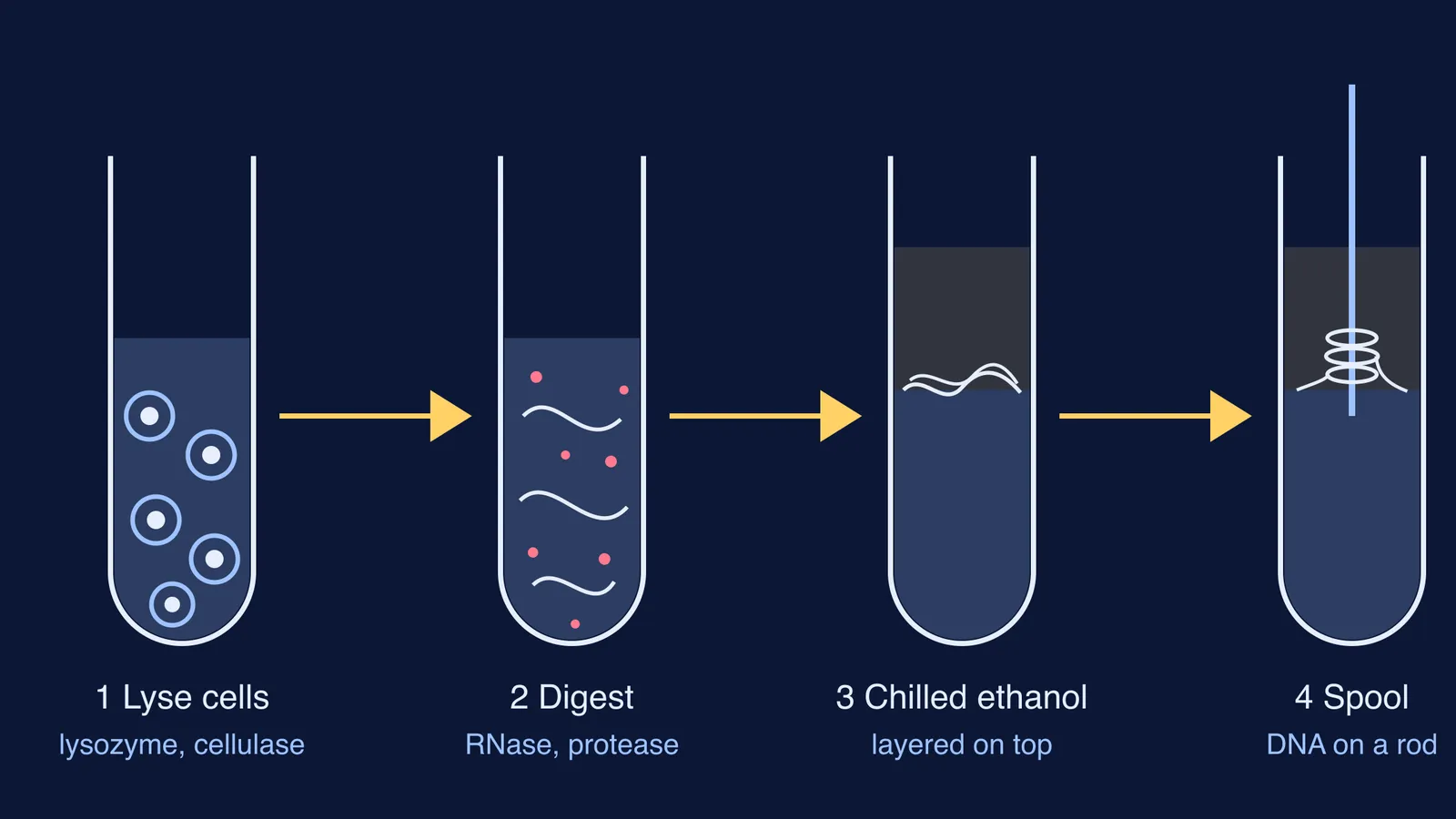
Break the cell open. Treat bacterial cells, or plant or animal tissue, with enzymes: lysozyme for bacteria, cellulase for plant cells, chitinase for fungi. This releases DNA along with RNA, proteins, polysaccharides and lipids.
Remove RNA. Treat with ribonuclease.
Remove proteins. Treat with protease. This matters because DNA is intertwined with proteins such as histones.
Remove other molecules with treatments suited to them.
Precipitate the DNA. Add chilled ethanol. The purified DNA comes out as fine threads in the suspension and can be lifted out by spooling (NCERT Figure 9.5).
Why does each enzyme match its cell?
The step 1 enzyme depends on what the cell wall is made of. Lysozyme breaks the beta-1,4-glycosidic bonds between N-acetylmuramic acid and N-acetylglucosamine in peptidoglycan, the material of the bacterial cell wall, according to a 2021 review in the journal Antibiotics. The same review notes that lysozyme works best on Gram-positive bacteria. Its effect on Gram-negative bacteria is much weaker because of a protective lipopolysaccharide layer on their outer membrane.
When a question names the source organism, use this match:
Bacterium (for example Bacillus): lysozyme, because the wall is peptidoglycan.
Plant cell (onion, a leaf): cellulase, because the wall is cellulose.
Fungus (for example a mould): chitinase, because the wall contains chitin.
The clean-up enzymes are named after what they destroy: ribonuclease for RNA, protease for protein. If you know the name, you know the job.
Why is chilled ethanol used to precipitate DNA?
DNA stays dissolved in water because its phosphate backbone carries negative charges. In their Cold Spring Harbor Protocols method, Michael Green and Joseph Sambrook explain that cations from added salt neutralise that charge, and that ethanol is generally preferred to isopropanol for bringing the DNA out of solution.
A 2021 quantitative study in Nano Select shows why the alcohol matters. Without ethanol, monovalent ions such as sodium could not make DNA condense and precipitate. Divalent magnesium and calcium ions did so only at about 50 mM, and adding ethanol significantly boosted precipitation with both kinds of ion.
Why chilled? The University of Utah's Genetic Science Learning Center recommends ice-cold alcohol because cold helps DNA precipitate faster. It describes the result as white, stringy clumps where the water and alcohol layers meet. DNA is a long, stringy molecule, so the strands tangle into threads you can wind onto a glass rod. That winding is spooling.
For the full practical with plant material, including what to do when no threads appear, see our guide on how to isolate DNA from plant tissue and why each step works.
How do you write DNA isolation as a 3-mark answer?
A complete answer covers three things: the enzyme matched to the organism, the order of the steps, and the final observation. Here is a model answer you can adapt:
*DNA is isolated by first breaking the cells open with lysozyme (bacteria), cellulase (plant cells) or chitinase (fungi), which releases the cell contents. RNA is removed with ribonuclease, and proteins, including histones, with protease. Other contaminants are removed by suitable treatments. Adding chilled ethanol precipitates the purified DNA, which appears as fine threads and is collected by spooling.*
Before you hand in, check for these common slips:
Steps out of order. Ethanol comes last, because it collects DNA that is already clean.
Lysozyme paired with plants, or cellulase with fungi.
No observation. Write "fine threads" and "spooling".
Saying ethanol dissolves DNA. It does the opposite.
If a word like peptidoglycan or precipitate still feels shaky, the Fermi Concept Library covers every concept in physics, chemistry, biology, mathematics and computing, each with its own lesson and its place in the map, so you can see how ideas connect instead of memorising them as separate facts.
The chapter goes on to cut the DNA with restriction enzymes and check the digest on a gel. Our explainer on how gel electrophoresis separates DNA fragments picks up from there, and Biotechnology for NEET: restriction enzymes, PCR and cloning vectors covers the whole sequence. To practise ordering and reasoning questions, the Fermi Problem Library has worked problems with a step-by-step solver that explains the reasoning rather than printing an answer.