

On this page
If your school follows the CBSE 2026-27 Biology curriculum, "Isolate DNA from available plant material such as spinach, green pea seeds, papaya, banana etc." is experiment 5 on the Class 12 list, and it is the one set as the major experiment (CBSE Biology curriculum 2026-27). In that 3-hour practical exam, the major experiment carries 5 of the 30 marks, according to the same CBSE document.
The steps are easy. The viva tests whether you know why each one is there, so this guide covers both.
What does NCERT say about isolating DNA?
Section 9.3.1 of NCERT's Class 12 biotechnology chapter explains that DNA sits inside membranes, so the cell has to be broken open, which releases RNA, proteins, polysaccharides and lipids along with the DNA (NCERT Biology Class 12, chapter 9). The enzymes it names are lysozyme for bacteria, cellulase for plant cells and chitinase for fungi. Ribonuclease removes RNA, and protease removes proteins such as histones. Then "purified DNA ultimately precipitates out after the addition of chilled ethanol" as fine threads that can be removed by spooling.
How do you isolate DNA from plant material, step by step?
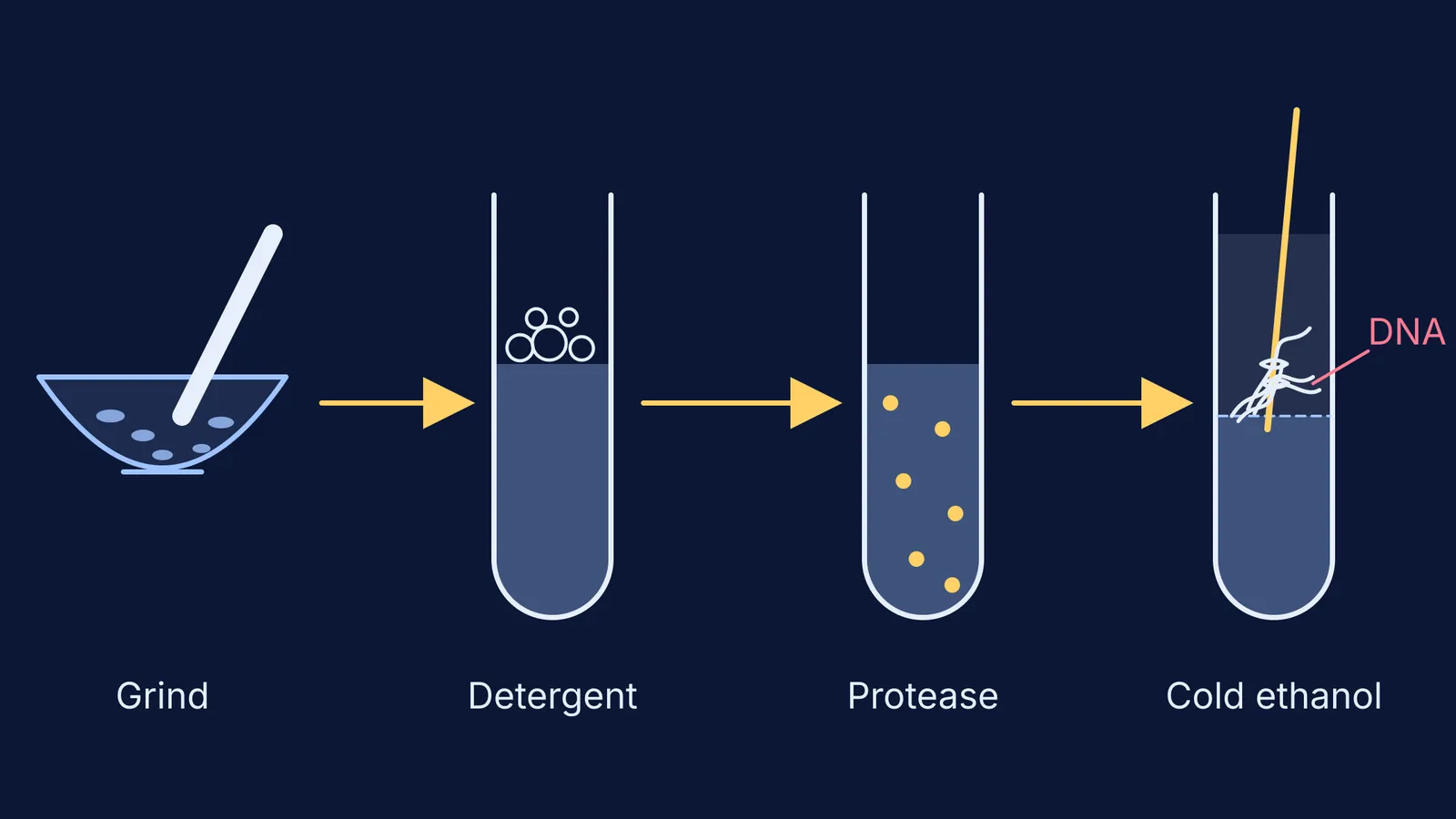
The steps here follow a classroom protocol by the University of Utah's Genetic Science Learning Center (How to Extract DNA from Anything Living). It uses green split peas, which fit the green pea seeds on CBSE's list.
Grind the leaves or soaked peas with a pinch of salt and cold water to make a thin green soup.
Strain out the large pieces.
Stir in liquid detergent and leave it for 5-10 minutes.
Add a pinch of enzyme (Utah uses meat tenderiser) and stir gently.
Tilt the tube and pour chilled ethanol slowly down the side until the alcohol layer is about as deep as the plant mixture. Utah accepts 70-95% isopropyl or ethyl alcohol; NCERT specifies chilled ethanol.
Wind the white threads that form where the two layers meet onto a glass rod (Utah uses a wooden stick or a straw).
Why is each step needed?
Grinding separates the cells from each other (Science Learning Hub). NCERT uses cellulase to break the plant cell wall; in a school lab, the mortar and pestle does a similar job mechanically.
Salt gives positive sodium ions that protect the negative phosphate groups on the DNA backbone (Science Learning Hub), and it helps the DNA stick together (Utah).
Detergent breaks down the lipids in the cell and nuclear membranes, which releases the DNA (Science Learning Hub).
Protease breaks down the proteins associated with DNA, such as histones (Science Learning Hub; NCERT).
Ethanol makes DNA insoluble. DNA dissolves in water, but salty DNA comes out of solution in alcohol, which is called precipitation (Utah). Ethanol's lower dielectric constant lets sodium ions neutralise the phosphate charges (Bitesize Bio).
Chilling is NCERT's instruction. Bitesize Bio adds that freezer temperatures are not needed: nucleic acids precipitate well at 0-4 °C, so a short spell on ice is enough.
Layering works because alcohol is less dense than water, so it floats on top (Utah).
Spooling collects what is really a tangle of many DNA molecules, not a single one (Utah).
What questions come up in the DNA isolation viva?
Cover each answer and say it aloud.
Why grind? To separate the cells and break open the tissue.
Which enzyme digests a plant cell wall? Cellulase (lysozyme for bacteria, chitinase for fungi).
Why detergent? To dissolve the lipid membranes of the cell and the nucleus.
Why protease? To remove proteins, such as histones, that are bound to DNA.
How would you remove RNA? With ribonuclease.
Why chilled ethanol? DNA is insoluble in it, so it precipitates.
Why pour down the side? So the alcohol forms a separate layer.
What are the threads? Many tangled DNA molecules.
What if no DNA threads appear?
You stirred too hard. Utah warns that stirring too hard breaks up the DNA and makes it harder to see.
The layers mixed. Pour the alcohol slowly down the tilted tube.
The grinding was too short. If whole leaf pieces are left, fewer cells have been broken open.
The ethanol was warm. NCERT specifies chilled ethanol, so keep it on ice until you use it.
You left out the salt. Utah notes that the salt helps the DNA stick together into visible clumps.
Isolation is the first step in NCERT's recombinant DNA sequence. Next, the DNA is cut and the fragments are checked on a gel, which our explainer on how gel electrophoresis separates DNA fragments covers. For the whole chapter, see our guide to biotechnology principles and processes for NEET. For the slide-preparation part of the same practical exam, read about the onion root tip mitosis practical.
If vectors or histones still feel hazy, the Fermi Concept Library has a lesson for every concept in biology, each with its place in the map. For viva practice, Fermi's AI tutor can work out what you already know and build a plan for the session.


