On this page
In 2012, Martin Jinek, Jennifer Doudna, Emmanuelle Charpentier and colleagues showed in Science that engineered RNAs can program the Cas9 enzyme to cut chosen DNA sequences. That work used purified components outside living cells.
A living human cell is a harder place. The DNA is wrapped in chromatin, the enzyme is a bacterial protein that has to be made inside a mammalian nucleus, and the RNAs have to find one address in a whole human genome. Showing that the system still works there was the next step towards a tool for editing mammalian genomes.
What did Feng Zhang's lab actually show in 2013?
The paper is "Multiplex Genome Engineering Using CRISPR/Cas Systems" by Le Cong, F. Ann Ran, David Cox and colleagues with Feng Zhang, published online on 3 January 2013 and in print in Science 339, 819–823.
Its own abstract states the result plainly: "Cas9 nucleases can be directed by short RNAs to induce precise cleavage at endogenous genomic loci in human and mouse cells."
Three things in that sentence matter.
Endogenous loci. Not a reporter gene the team added, but genes already in the genome: the human *EMX1* and *PVALB* genes, and mouse *Th*, as reported in the full text.
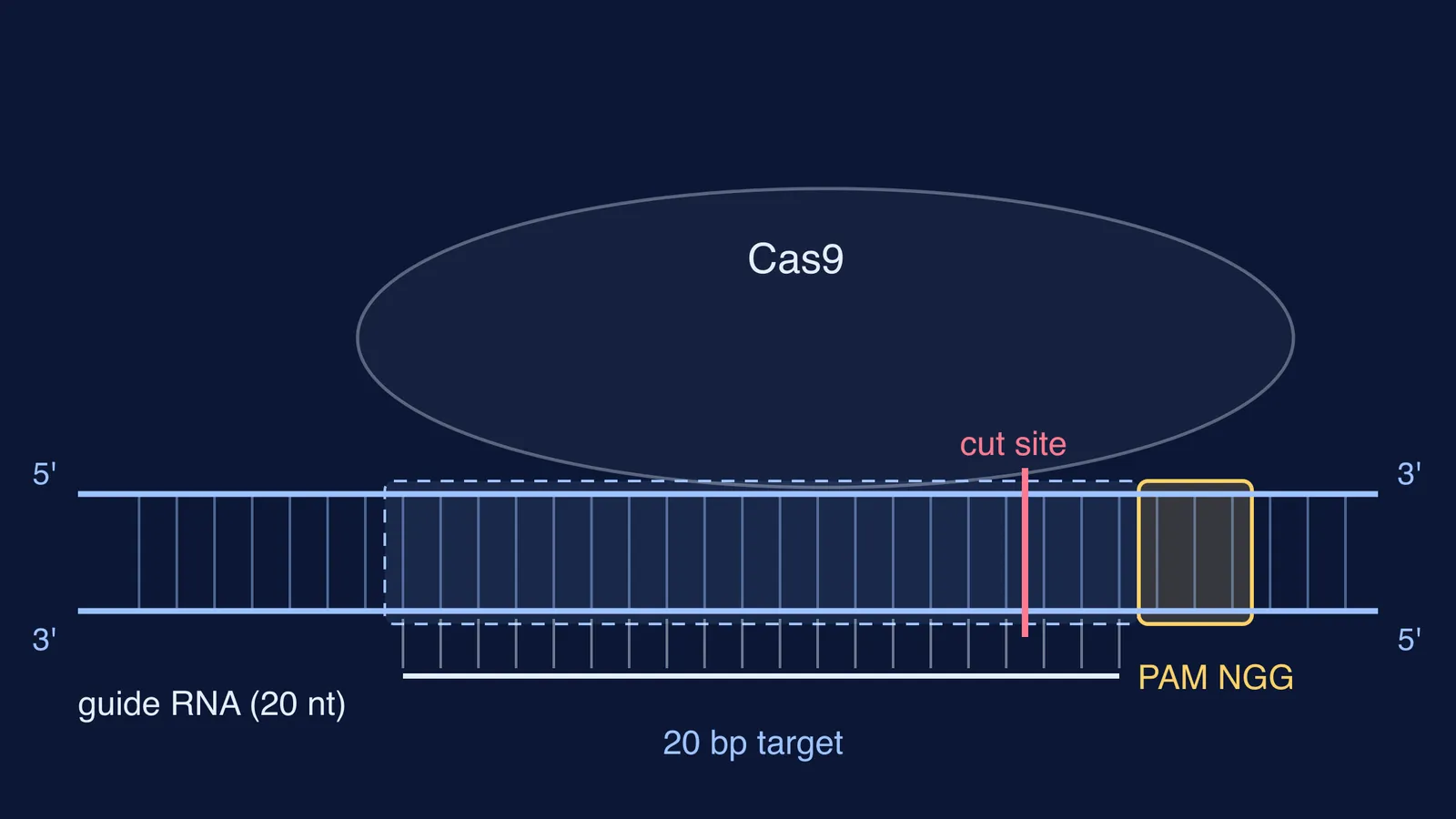
Short RNAs. A 20-base-pair spacer picks the target; the enzyme used was Cas9 from *Streptococcus pyogenes*, which needs an NGG motif (the PAM) next to the target site.
Human and mouse cells. The human work used 293FT cells — a cultured human cell line, not a person.
The same issue of Science carried an independent demonstration in human cells from George Church's lab, Science 339, 823–826. Two independent labs reported the result back to back.
What else was in the paper besides cutting?
The same paper reported two further tools.
A nicking enzyme. A single amino-acid change, D10A, turned Cas9 into a nickase that cuts one strand only. The abstract says this version can "facilitate homology-directed repair with minimal mutagenic activity" — repair that copies in a supplied template — and the authors report that sequencing of 327 amplicons detected no indels from the nickase.
Multiplexing. Several guide sequences were encoded in one CRISPR array, so several sites could be edited simultaneously; a single array targeting *EMX1* and *PVALB* cut both. That is where the title's word "multiplex" comes from.
The paper also reports that Cas9 cut the same *EMX1* site as efficiently as a pair of TALE nucleases. That comparison is the practical argument: a tool you program by changing a short RNA, instead of engineering a new protein each time.
How do you read a methods claim like this one?
This is the habit a paper like this is good practice for. Try it on the abstract above.
Where? In cultured cells, in an animal, or in a test tube? "Human cells" in 2013 meant a cell line in a dish.
Which gene, named? Named genes let you check the claim against the paper's own data.
How often did it work? Look for the percentage and the denominator — "3 out of 182" in the 2013 paper tells you more than "efficient".
Who checked? An independent lab in the same issue is strong; a press release is not.
For a worked example of the guide-design logic, take a target strand reading GAGTCCGAGCAGAAGAAGAA followed by GGG. The GGG is the PAM, the 20 bases just before it are the guide sequence you would order, and the cut lands about 3–4 nucleotides upstream of the PAM, per Addgene's CRISPR guide. Change those 20 bases, change the address.
Which gene-editing tool does which job?
School syllabi introduce these in separate chapters; they are really one toolkit, built up over decades.
Cut DNA at a fixed short sequence, the same one every time: restriction enzymes. See how EcoRI cuts and pastes DNA.
Change one chosen base in a cloned gene: site-directed mutagenesis, the subject of Michael Smith's method for editing a gene.
Cut a chosen address in a living genome: Cas9 plus a guide RNA, the 2013 result. Background on the discovery is in how the genetic scissors were found.
Emmanuelle Charpentier and Jennifer Doudna shared the 2020 Nobel Prize in Chemistry "for the development of a method for genome editing". Zhang is the James and Patricia Poitras Professor of Neuroscience at MIT and a core institute member of the Broad Institute, per his Broad Institute profile. On 8 December 2023 the US FDA approved Casgevy, the first FDA-approved therapy using CRISPR/Cas9, for sickle cell disease in patients 12 and older — almost 11 years after the 2013 papers.
If the geometry is the part that will not sit still in your head — guide, PAM, cut site, repair — it is easier to watch than to read. Fermi's Simulation Lab has interactive simulations for ideas like that, and the Fermi Concept Library carries the surrounding biology concept by concept.