On this page
Before the late 1970s, molecular biologists faced a frustrating problem: they could read the genetic code, but they could not edit it with precision. Mutations were created by blasting DNA with radiation or soaking it in chemicals, which caused random changes across the entire genome. If a scientist wanted to understand the function of a single amino acid in a protein, they had to rely on chance to find a useful mutation.
This changed when a British-Canadian biochemist named Michael Smith devised a method to rewrite DNA exactly where he wanted. For this work, Smith was awarded a share of the 1993 Nobel Prize in Chemistry.
What is site-directed mutagenesis?
Site-directed mutagenesis is a molecular technique used to create specific, targeted changes in a known DNA sequence. Think of a gene as a long set of instructions for baking a cake. Random mutagenesis is like spilling ink over the recipe and hoping the cake still bakes. Site-directed mutagenesis is like using an eraser and pencil to change exactly one ingredient—say, swapping salt for sugar—to see what happens to the final product.
By changing the DNA code, scientists can change the amino acids in the resulting protein. This allows researchers to study how specific parts of a protein contribute to its structure and function, effectively starting the field of protein engineering.
How did Michael Smith change DNA?
Smith's elegant solution used the natural machinery of DNA replication against itself. His landmark 1978 paper, "Mutagenesis at a specific position in a DNA sequence," was published in the *Journal of Biological Chemistry*.
Smith and his team used the bacteriophage ΦX174 as their model system. Here is how the process worked:
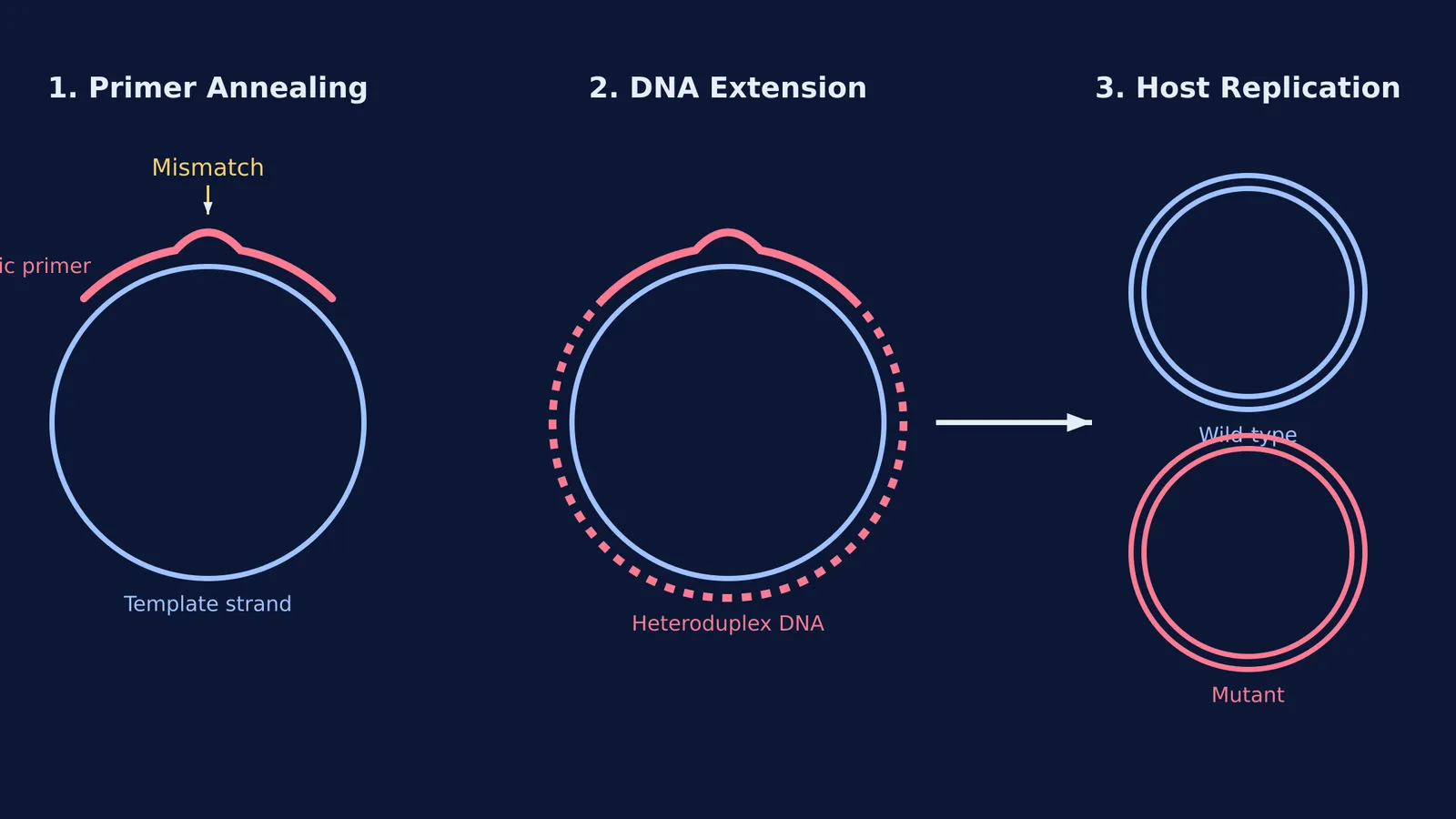
The Primer: They synthesised a short strand of DNA, called an oligonucleotide. This strand was perfectly complementary to the viral template DNA, except for a single, intentional mismatch at the exact position they wanted to mutate.
The Extension: They annealed this mismatched primer to the single-stranded viral DNA. Using an enzyme called DNA polymerase I, they extended the primer all the way around the circle, and sealed it with DNA ligase.
The Result: This created a double-stranded circular DNA molecule called a heteroduplex. One strand had the wild-type (original) sequence, and the other had the mutant sequence.
Replication: When this heteroduplex was inserted into an *E. coli* host cell, the cell's own machinery replicated both strands. The experiment was highly efficient: approximately 15% of the progeny phages carried the specific mutation.
When you are studying genetics for exams, understanding these mechanisms is crucial. You can review related topics on gene expression through resources like our guide to Assertion-reason traps on replication, genetic code and operons.
Why do we need to edit one base at a time?
The ability to edit a single base changed the course of molecular biology. It allowed scientists to create modified proteins with improved stability or new functions. This has been fundamental in medical research, such as understanding the genetic basis of diseases like cystic fibrosis and Alzheimer's, and in biotechnology for producing synthetic human insulin in yeast.
Smith's legacy extends beyond the laboratory. He famously donated his entire $500,000 Nobel Prize to support research on the genetics of schizophrenia, public science education through Science World BC, and the Society for Canadian Women in Science and Technology (SCWIST). His name lives on through the Michael Smith Genome Sciences Centre in Vancouver.
If you are trying to picture exactly how enzymes like polymerase interact with a mismatched DNA strand, interactive tools like the Fermi Simulation Lab allow you to explore biological models that are much easier to see than to read about in a textbook.
How to answer genetics exam questions?
If you are a student, site-directed mutagenesis is a classic example of how point mutations affect proteins. When facing a genetics question about mutations, use this checklist to structure your answer:
Identify the mutation type: Is it a substitution, insertion, or deletion? Site-directed mutagenesis typically uses substitutions (changing one base for another).
Determine the effect on the reading frame: A substitution does not shift the reading frame, whereas an insertion or deletion (frameshift) alters all subsequent amino acids.
Predict the protein change: Will the substitution cause a silent mutation (same amino acid), a missense mutation (different amino acid), or a nonsense mutation (stop codon)?
Connect to function: Explain how changing the specific amino acid might alter the protein's folding or active site.
If you encounter a difficult problem on how plasmids and vectors are used in genetic engineering, you can look into how natural vectors work, such as The Ti plasmid of Agrobacterium tumefaciens as a vector. And if you get stuck on a homework problem about DNA replication or gene editing, you can bring it to the Fermi Problem Library, where a step-by-step solver will explain the reasoning behind the genetic mechanism rather than just printing the final answer.