

On this page
*Agrobacterium tumefaciens* is a soil bacterium that infects dicotyledonous plants at wound sites, causing tumors known as crown galls. But this pathogen is highly unusual: it forces the plant to grow the tumor by literally editing the plant's genome. It acts as nature's own genetic engineer, crossing the boundary between bacteria and plants.
Biotechnologists recognised that if a bacterium can transfer DNA on its own, it could be trained to carry genes we actually want. This discovery gave rise to the most widely used methods for creating transgenic crops today, a concept fundamental to your Class 12 NEET preparations.
How does Agrobacterium tumefaciens act as a natural genetic engineer?
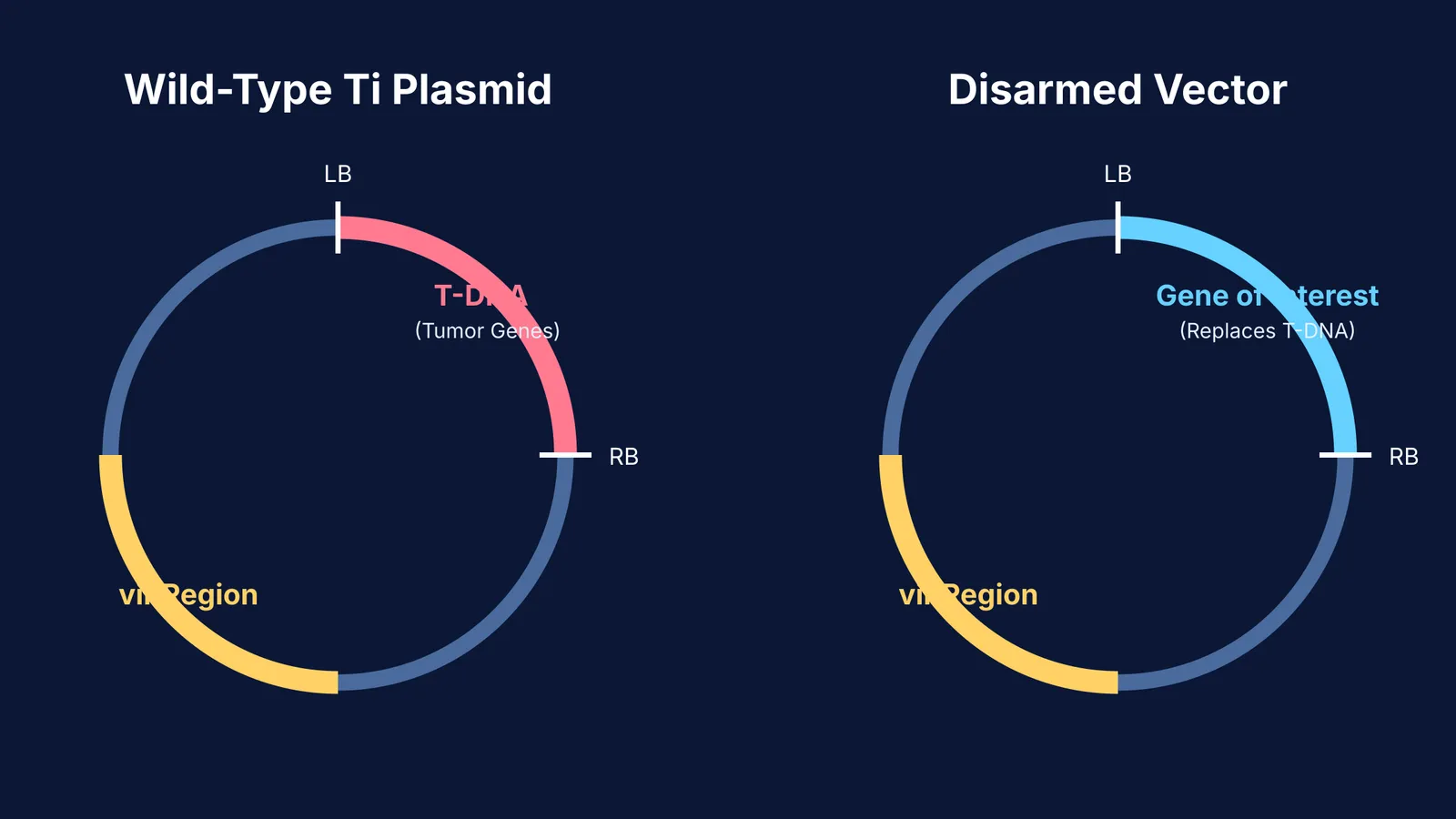
The secret to this bacterium's ability lies in a large ring of DNA known as the Ti (tumor-inducing) plasmid. The complete Ti plasmid is typically about 200 kb90169-0) (kilobase pairs) in size. Within this massive plasmid is a specific segment called the T-DNA (transferred DNA) that usually measures between 10 to 30 kb90169-0). This segment is flanked by two 25-base-pair90169-0) border sequences that mark the exact piece of DNA to be moved.
When the bacterium senses chemical signals from a wounded plant, it activates its *vir* (virulence) genes. These genes act like molecular scissors and a delivery team, cutting out the T-DNA at its borders and shuttling it directly into the plant cell's nucleus. Once inside, the T-DNA integrates into the plant's own chromosomes. Because the T-DNA contains genes that produce growth hormones (auxin and cytokinin), the infected plant cells begin dividing rapidly, forming the crown gall tumor.
What is a disarmed Ti plasmid?
To use *Agrobacterium* safely in biotechnology, scientists had to stop it from causing disease while keeping its delivery mechanism intact. They achieved this by creating a "disarmed" Ti plasmid.
In a disarmed vector, the oncogenic (tumor-inducing) genes inside the T-DNA are completely removed. The crucial 25-base-pair borders and the *vir* genes outside the T-DNA are left untouched, as they are essential for the transfer process. You can then insert your gene of interest—such as a gene for pest resistance—between the T-DNA borders. When this modified bacterium infects a plant, it delivers the beneficial gene instead of the tumor genes.
If you struggle to picture how these sequences sit relative to each other, you can use the Fermi Concept Library to map out the functional regions of a plasmid. Understanding these distinct zones is essential for answering questions about vector design. For more on getting engineered vectors into hosts, see Getting DNA into cells: heat shock, microinjection and gene gun.
How do retroviruses compare in animal cells?
While *Agrobacterium tumefaciens* is the master of plant cell transformation, the animal kingdom has its own natural genetic engineers: retroviruses.
Retroviruses integrate their viral genome directly into the DNA of the animal cells they infect. In their natural state, many retroviruses carry oncogenes that transform normal animal cells into cancerous cells. Just like the Ti plasmid, scientists have disarmed retroviruses by removing their harmful replication and disease-causing genes.
These disarmed retroviral vectors can carry new genetic material into an animal cell. They are widely used in gene therapy to deliver healthy copies of genes into human cells to treat genetic disorders. This is the exact same principle applied across different kingdoms of life. For more details on testing the success of such genetic transfers in medicine, review Transgenic animals and molecular diagnosis: ELISA and PCR uses.
A vector selection checklist
When facing exam questions on biotechnology vectors, use this simple framework to match the tool to the task:
Identify the target host: Is the target a plant (usually a dicot) or an animal cell?
Choose the vector: Select the Ti plasmid for plants and a retrovirus for animals.
Check the natural state: Recall that the Ti plasmid naturally causes crown gall tumors, whereas retroviruses cause cancer.
Verify the disarmed state: Ensure the T-DNA oncogenes (in plants) or viral replication genes (in animals) have been deleted and replaced with the gene of interest.
Confirm the transfer mechanism: The *vir* genes must remain on the Ti plasmid to facilitate the move, just as viral entry proteins remain on the retrovirus shell.
By seeing both *Agrobacterium* and retroviruses as two sides of the same coin, the underlying logic of genetic engineering becomes much easier to master.


