On this page
Titanium is light, strong and resists corrosion, yet for a long time after its discovery nobody could make the metal economically in useful amounts. William Justin Kroll, a Luxembourg metallurgist, changed that, and his magnesium-based method is still the main way titanium is made.
Who invented the Kroll process?
William Kroll was born in Luxembourg on 24 November 1889 and died on 30 March 1973, according to his National Inventors Hall of Fame profile. In 1932 he combined titanium tetrachloride with calcium to make ductile titanium, and by 1938 he had produced 50 pounds of the metal. He came to the United States in 1940 to escape the Nazi invasion, worked for the US Bureau of Mines in Albany, Oregon, and was inducted into the Hall of Fame in 2000.
The element was much older. The Royal Society of Chemistry notes that Martin Klaproth named titanium in 1795, and that M. A. Hunter at General Electric made pure titanium in 1910 by heating titanium tetrachloride with sodium. What Kroll added was, in the words of the Engineering and Technology History Wiki, an "economical process" that established the primary means of producing high-purity titanium.
How does the Kroll process work?
Kroll's US patent 2,205,854, filed in July 1938 and granted on 25 June 1940, reacts a titanium halide, preferably the tetrachloride, with an alkaline earth metal under a protective gas at normal pressure. He preferred magnesium to calcium for its low price and much lower boiling point, which the patent gives as 1070 °C. The patent names argon as a protective gas and describes an average crucible temperature of about 800 °C, kept no higher than about 950 °C so the magnesium does not boil.
In outline, the process runs in three steps:
Chlorination: titanium dioxide ore is heated with carbon to about 1000 °C while chlorine passes over it, giving titanium tetrachloride, TiCl₄ (Royal Society of Chemistry).
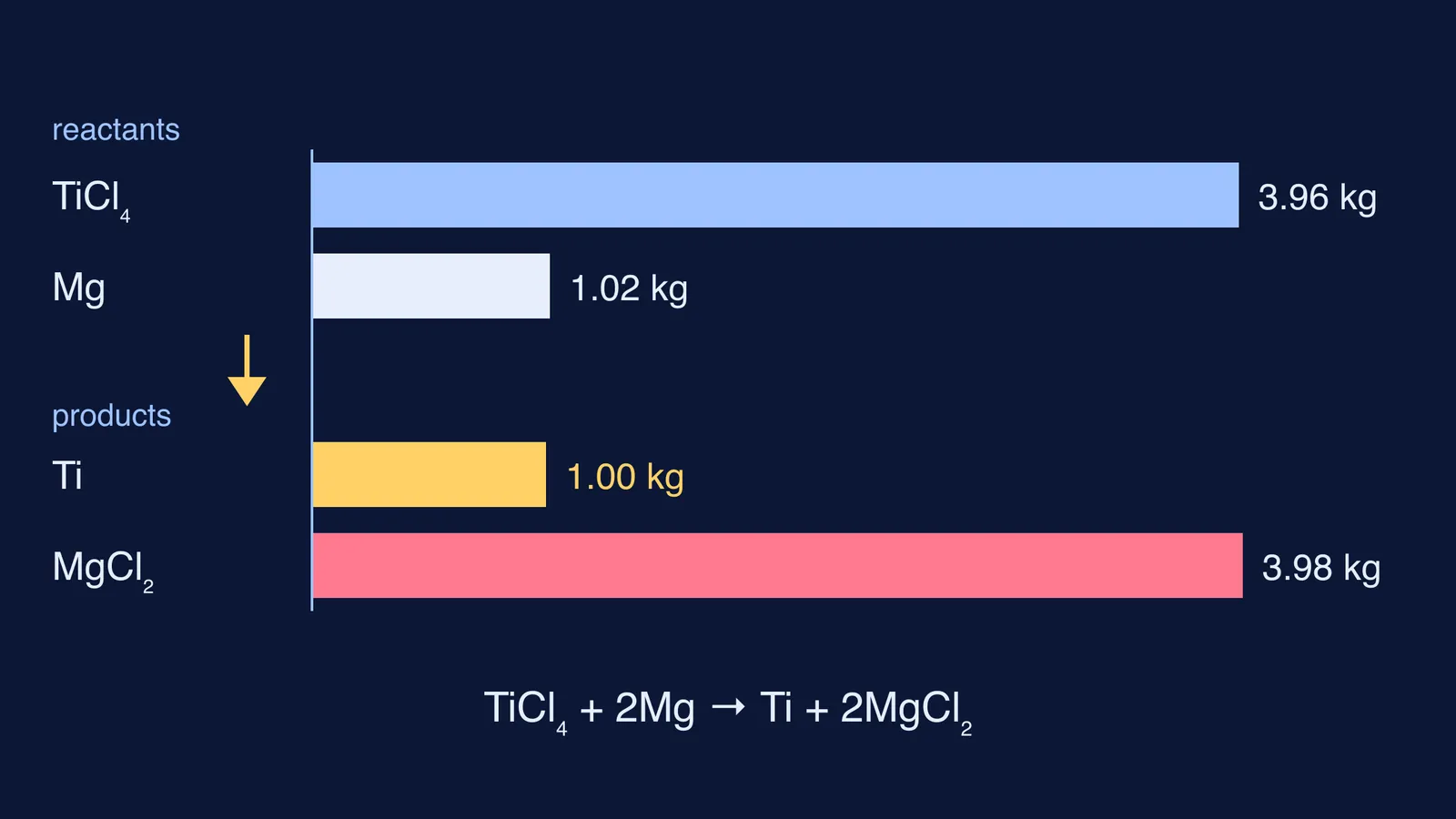
Reduction: TiCl₄ reacts with hot magnesium, around 850 °C, under argon: TiCl₄ + 2Mg → Ti + 2MgCl₂.
Clean-up: the titanium comes out as a porous solid called sponge, which is separated from the magnesium chloride and melted into usable metal.
For a different route to very pure titanium in small amounts, see our explainer on how the van Arkel–de Boer process makes pure titanium.
Why can't titanium be made with carbon, like iron?
Chemguide explains that heating titanium with carbon forms titanium carbide, TiC, which makes the metal brittle. The Royal Society of Chemistry adds that hot titanium reacts even with nitrogen to form titanium nitride, which is why the reduction runs under argon rather than air. Our guide on how to read an Ellingham diagram shows why some oxides give way to carbon and others don't.
The cost is speed and money. Chemguide notes that titanium is made in batches, with the reduction taking about two days followed by several more days of cooling, and that the magnesium itself has to be extracted from its ore by an expensive process; see Lloyd Pidgeon and how magnesium is made.
Worked example: how much magnesium makes 1 kg of titanium?
Use standard atomic weights from IUPAC's Commission on Isotopic Abundances and Atomic Weights: Ti 47.867, Mg 24.305 and Cl 35.45 (magnesium and chlorine are listed as narrow ranges; these are conventional values within them).
Moles of titanium in 1 kg: 1000 ÷ 47.867 = 20.89 mol.
The equation needs 2 mol of Mg per mol of Ti, so 2 × 20.89 = 41.78 mol, and 41.78 mol × 24.305 g/mol ≈ 1.02 kg of magnesium.
TiCl₄ has a molar mass of 189.67 g/mol: 20.89 mol × 189.67 g/mol ≈ 3.96 kg of TiCl₄.
MgCl₂ has a molar mass of 95.21 g/mol: 41.78 mol × 95.21 g/mol ≈ 3.98 kg of MgCl₂.
Check: 3.96 + 1.02 = 4.98 kg in, and 1.00 + 3.98 = 4.98 kg out. Mass is conserved.
So only about a quarter of the mass of TiCl₄ ends up as titanium, and every kilogram of metal leaves nearly four kilograms of magnesium chloride. If a chain like this falls apart at step two, the Fermi Problem Library has worked problems with a step-by-step solver that explains the reasoning rather than printing an answer.
Where is the Kroll process used today?
His Hall of Fame profile says that in 1945 he turned zirconium into a workable product, and that his process remains the main method for extracting both titanium and zirconium from their ores. His own account, "How commercial titanium and zirconium were born", appeared in the Journal of the Franklin Institute in 195590727-4).
The US Geological Survey's 2026 titanium summary estimates world titanium sponge production at 370,000 tonnes in 2025, including 260,000 tonnes in China, 53,000 tonnes in Japan and 300 tonnes in India. The same report puts the average landed price of sponge imported into the US at about $12 per kilogram in 2025.
To place extraction alongside redox and electrolysis, the Fermi Concept Library gives every concept in chemistry its own lesson and its place in the map.