

On this page
In 1925, two chemists at the Philips laboratory in Eindhoven, Anton Eduard van Arkel and Jan Hendrik de Boer, found a way to make titanium and zirconium pure enough to be ductile. Their trick was to turn the metal into a gas in one part of a sealed vessel and back into metal in another. Textbooks call it the van Arkel method.
Who were van Arkel and de Boer?
Van Arkel (1893–1976) worked with de Boer at the Philips Laboratory in Eindhoven and later became professor of chemistry at Leiden, according to the University of North Texas Rediscovery of the Elements profile of van Arkel. The same profile notes that he first prepared metallic hafnium in 1925. De Boer (1899–1971) was born in Ruinen and studied at Groningen, as his biography records.
Their paper, "Darstellung von reinem Titanium-, Zirkonium-, Hafnium- und Thoriummetall" (Preparation of pure titanium, zirconium, hafnium and thorium metal), appeared in Zeitschrift für anorganische und allgemeine Chemie, volume 148, pages 345–350, on 13 October 1925 (DOI record).
The van Arkel–de Boer process was the first industrial process for the commercial production of pure ductile titanium, zirconium and some other metals (overview).
How does the van Arkel–de Boer process work?
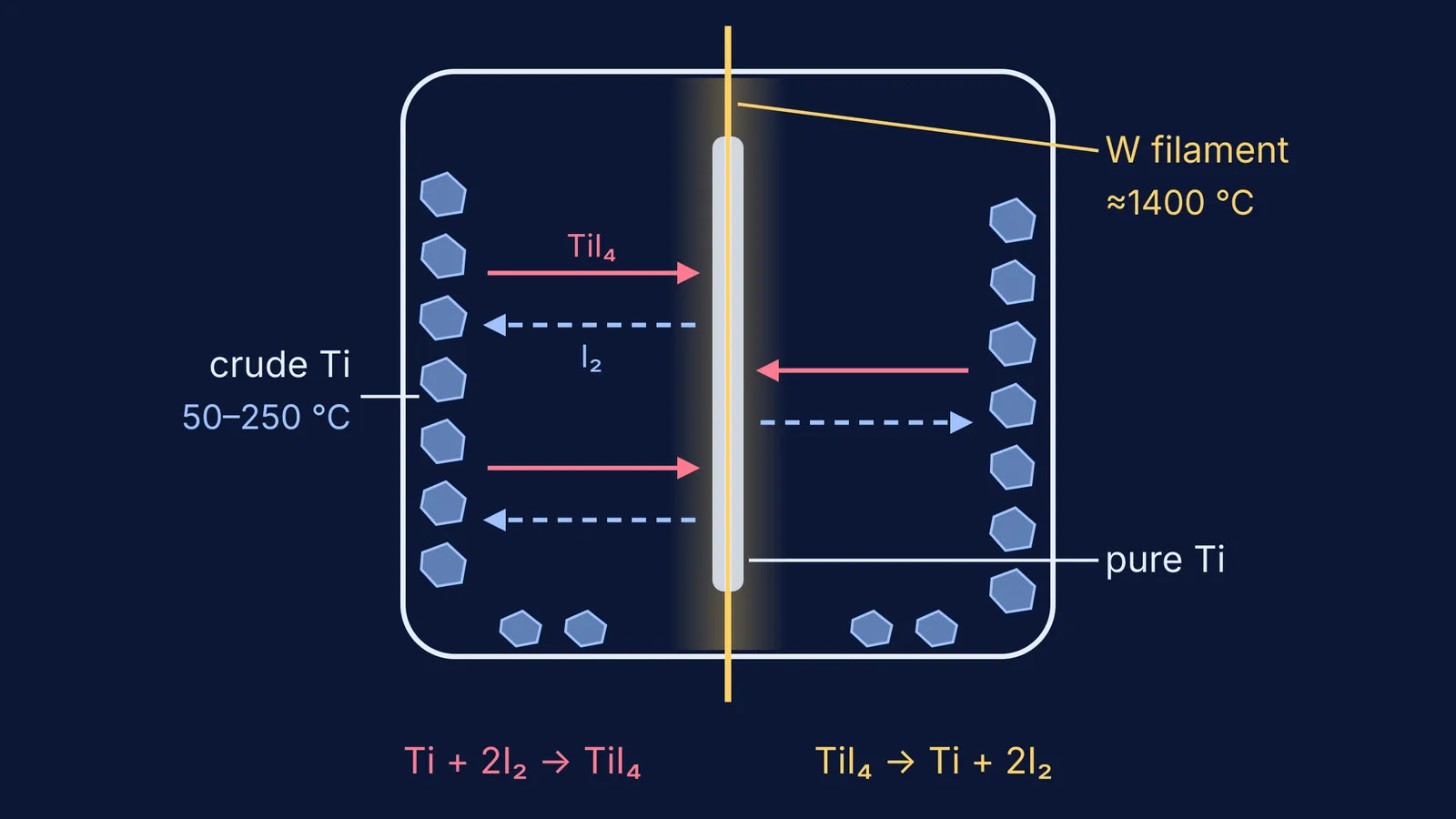
Based on the process overview and de Boer's biography, it runs in four stages:
Impure metal is heated with iodine in an evacuated vessel, at 50–250 °C according to the overview.
The metal forms its tetraiodide, TiI₄ or ZrI₄, which goes into the gas, while impurities stay behind as solids.
The iodide vapour reaches a white-hot tungsten filament, given as 1400 °C in the overview (the biography says 1700 °C), and decomposes.
Pure metal coats the filament, and the freed iodine reacts with more metal, so the cycle keeps turning. The process is also called the crystal bar process.
For titanium, the two reactions are:
At the cooler walls: Ti + 2I₂ → TiI₄
At the hot filament: TiI₄ → Ti + 2I₂
Zirconium works the same way, with ZrI₄ in place of TiI₄.
Why does the metal travel to the hottest spot?
The process is a chemical transport reaction. When the reaction between the solid and the transport agent is exothermic, the solid is carried from the cooler end of the vessel to the hot end, where the equilibrium constant is less favourable and crystals grow (chemical transport reactions).
In plain terms: forming the iodide is favoured where it is cool, and breaking it apart is favoured where it is very hot. That is Le Chatelier's principle at work, and if you want the equilibrium side made rigorous, see our post on the relation between Kp, Kc and Kx and Le Chatelier's rule.
The same idea runs inside halogen lamps. Tungsten that evaporates from the filament combines with traces of oxygen and iodine to form WO₂I₂, which breaks down again near the hot filament (chemical transport reactions). For the ordinary-bulb version of that story, read why old filament light bulbs turn black inside.
Why is the Kroll process used for titanium today?
Most titanium today is made by the Kroll process, which reduces titanium tetrachloride with magnesium (TiCl₄ + 2Mg → Ti + 2MgCl₂) at 800–850 °C in a stainless steel retort; it remains the dominant technology for producing titanium metal (Kroll process). The iodide route is now used for small quantities of ultrapure titanium and zirconium (overview).
Choosing a way to extract a metal is a question about energy, and our post on how Harold Ellingham created the Ellingham diagram shows how chemists compare those options on one chart.
How do you answer a van Arkel question in an exam?
A complete answer to "Explain the van Arkel method" covers five points. Check yours against this list:
Name it: van Arkel (van Arkel–de Boer) method, a vapour-phase refining method.
Name the metals: zirconium and titanium.
State the setup: crude metal heated with iodine in an evacuated vessel.
Write both equations, formation and decomposition.
Say where the pure metal collects: on the hot tungsten filament.
Three slips to avoid:
Writing that iodine is the impurity being removed. Iodine is the carrier.
Mixing it up with zone refining, which moves a molten zone along a solid bar and involves no gas.
Giving one equation only. The answer needs the round trip.
Worked example: a reasoning question
Question: What would happen if the filament were kept at the same temperature as the walls?
Answer: No place would favour decomposition over formation, so there would be no net transport and no pure metal would build up on the filament. The temperature gap drives the whole process.
If the equilibrium step still feels shaky, the Fermi Concept Library has every concept in chemistry, each with its own lesson and its place in the map, so you can revisit Le Chatelier's principle first. For practice, the Fermi Problem Library has worked problems with a step-by-step solver that explains the reasoning rather than printing an answer.


