On this page
William Kamkwamba was born on 5 August 1987 in Dowa, Malawi, and dropped out of secondary school in 2001 because a famine meant his parents could no longer pay the fees, according to his Wikipedia biography. The Wall Street Journal reported in 2007 that the tuition was $80 a year.
In 2002, only 5.6% of Malawi's population had access to electricity, according to World Bank data, and in rural areas the World Bank figure was 1.5%. Kamkwamba's home village, in Kasungu district according to the Daily Times, was one of those rural communities.
Which library book did William Kamkwamba use?
His TED speaker profile says that at 14 he built an electricity-producing windmill from spare parts and scrap, working from rough plans in a library book called Using Energy and modifying them to fit his needs. A 2006 report on AfriGadget names a second book, How it Works.
How did William Kamkwamba's windmill work?
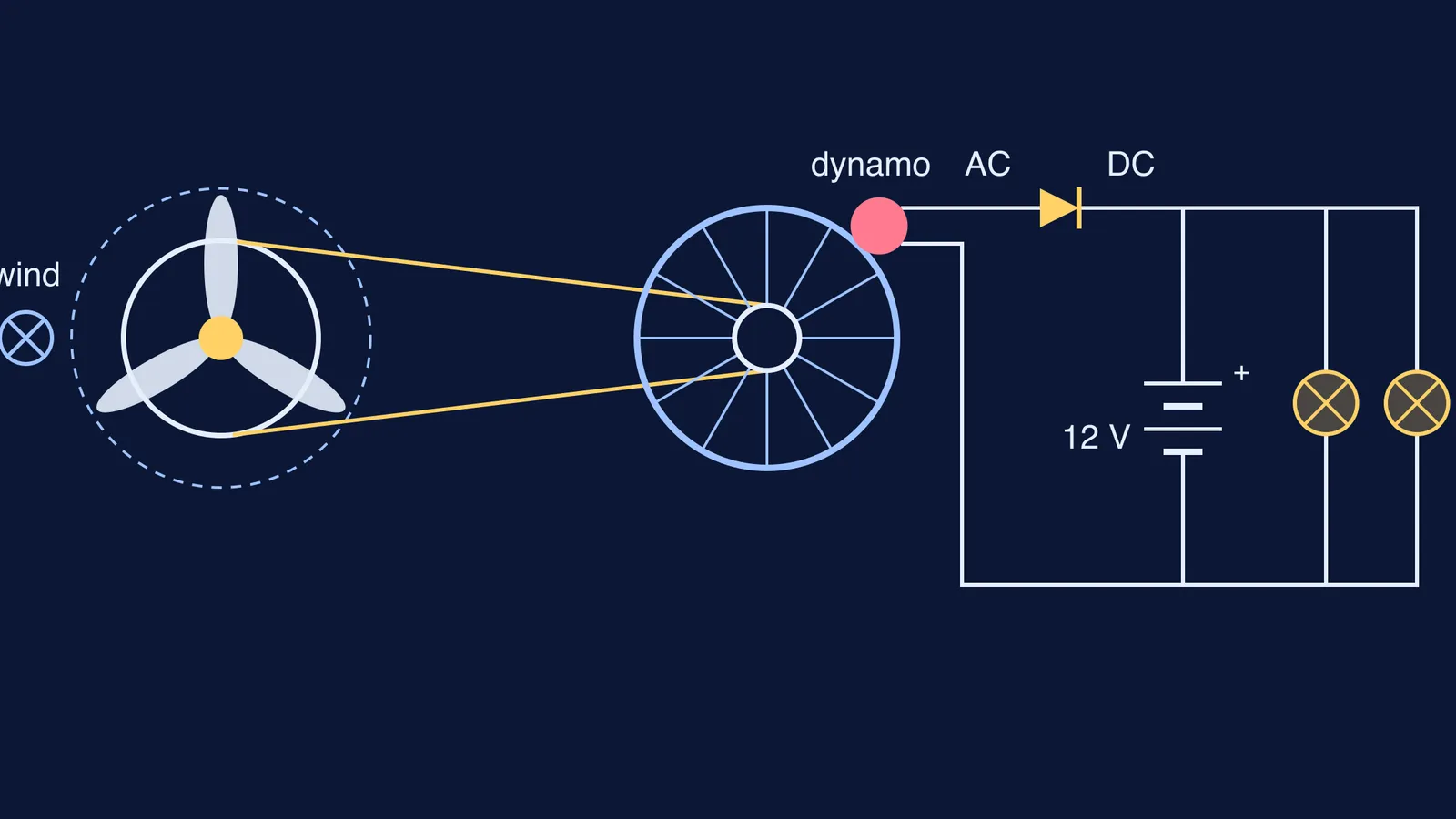
An early newspaper account, by Sangwani Mwafulirwa in Malawi's Daily Times on 20 November 2006 (reposted on Kamkwamba's blog), describes it as an energy chain:
Tower. A tripod of wooden poles held the rotor about five metres above the ground.
Blades. The propellers were plastic pipes supported by sticks. The Wall Street Journal says the pipes were flattened and the tower was lashed-together blue-gum trunks.
Pulleys. Instead of driving the generator straight off the shaft, he ran the motion through three pulleys to raise the speed.
Bicycle wheel and dynamo. The last pulley turned a bicycle wheel, and the wheel spun a bicycle dynamo, the kind that powers a headlamp.
Rectifier diode. The dynamo's output passed through a diode that converts alternating current to direct current.
Battery and lamp. By day the current charged a 12-volt car battery, kept as a reserve for when the wind was not blowing; the electricity lit a car lamp in the house.
The same report lists his spending: K500 for two bearings, K500 for the dynamo, K400 for a fan belt and K800 for a bicycle frame.
Why did he need pulleys to speed it up?
A dynamo is a small generator: a magnet turning near a coil. By Faraday's law, the voltage it makes depends on how fast the magnetic flux through the coil changes, so a slowly turning dynamo gives a feeble voltage. Large blades in a light wind turn slowly but with plenty of force. AfriGadget noted that, unlike most windmills, his used pulleys to increase speed. Pulleys trade that force for speed.
With a belt between two pulleys, the rim speed is shared, so the speed ratio is the inverse of the diameter ratio. A pulley three times as wide as the one it drives makes the small one turn three times as fast. Chain several stages and the ratios multiply. The cost is that the blades must push harder, which is why a loaded generator feels stiff; we explain that in why a generator is harder to turn when current is drawn.
Can you check his numbers yourself?
By late 2007 the Wall Street Journal counted 10 six-watt bulbs, a TV and a radio in the family home. The article does not give their voltage, so assume they ran from a 12-volt battery like the one in the Daily Times report and use P = VI.
One bulb: I = P / V = 6 W / 12 V = 0.5 A.
Ten bulbs in parallel: 10 x 0.5 A = 5 A, or 60 W in total.
An evening of four hours (our assumption): 60 W x 4 h = 240 watt-hours.
That last line is the real design problem: the windmill must put at least those 240 watt-hours back into the battery during the windy hours, plus whatever is lost along the way.
What can a student learn from how he worked?
Kamkwamba later built more windmills, the tallest 12 metres high, and graduated from Dartmouth College in 2014, per his Wikipedia biography. His method transfers to any project or hard chapter:
Draw the chain first. Before touching parts, sketch where energy enters, every place it changes form, and where it leaves.
Name the job of each part. Tower: height. Pulleys: speed. Diode: one-way current.
Do one number per link. A speed ratio, a current, a watt-hour total. Numbers expose the weak link.
Change one thing at a time. Kamkwamba adapted the book's plan to the parts he could find; record each change and what it did.
If the idea of a coil and turning magnet is hard to picture from a textbook figure, the Fermi Simulation Lab has interactive simulations for ideas that are easier to see than to read. To compare his machine with industrial designs, read how wind turbines make electricity from moving air and the story of Charles Brush's 1888 wind turbine.
Pick one machine at home this week, a fan or a mixer, and draw its energy chain the way Kamkwamba drew his.