On this page
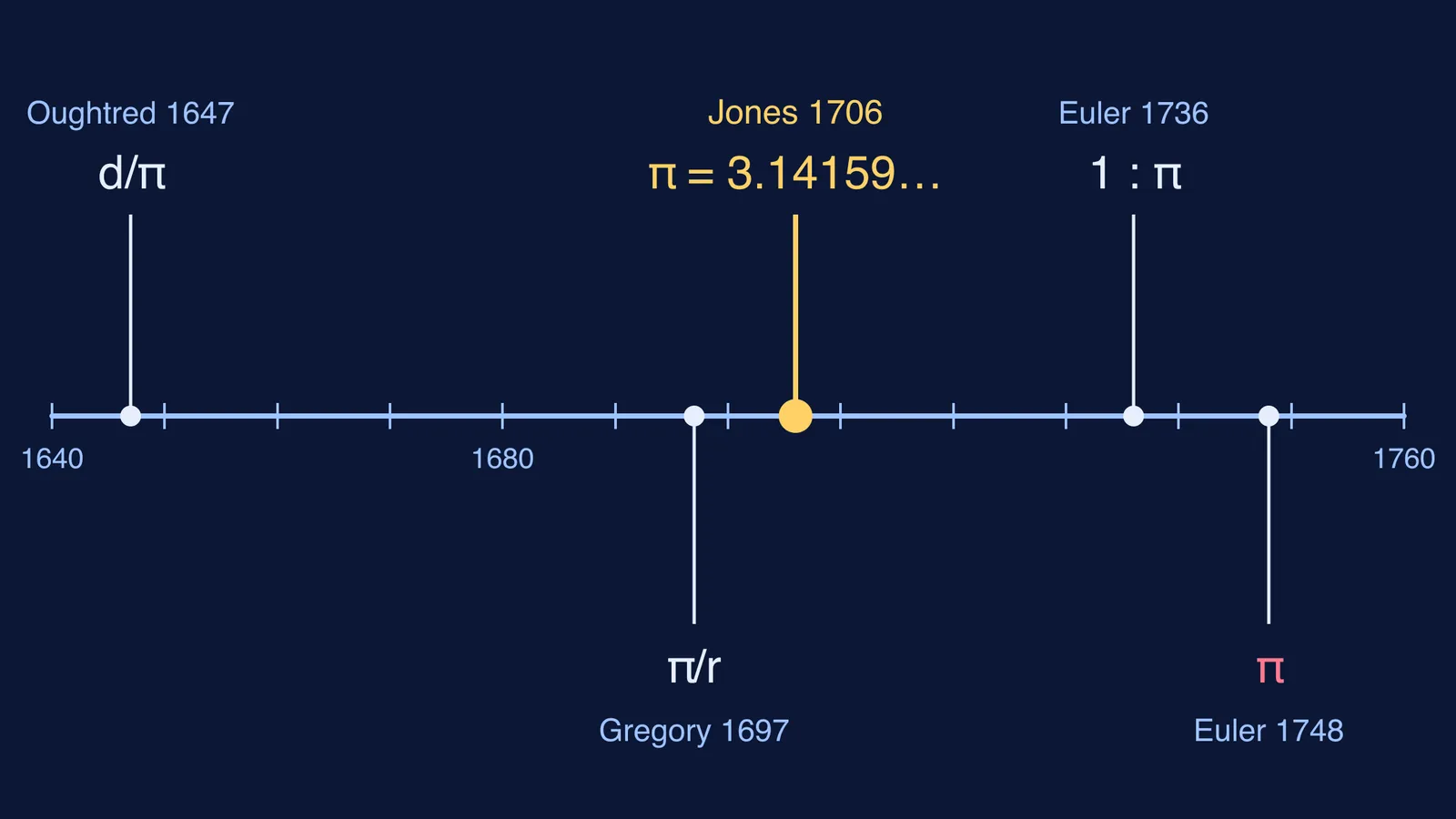
Every circle you meet in a Class 9 textbook carries a Greek letter that is only about 320 years old in this job. According to the MacTutor history of mathematics archive, the first person to use π with its present meaning was William Jones in 1706, when he wrote "3.14159 etc. = π". The number was ancient; the name was new.
Who first used the symbol π for the circle ratio?
William Jones did, in a 1706 book called Synopsis Palmariorum Matheseos. MacTutor's biography says the book is famed since the symbol π is used in it with its modern meaning.
Others had used the letter before him, but for something different. The same MacTutor page on pi records that William Oughtred in 1647 wrote d/π for the ratio of the diameter to the circumference, and David Gregory in 1697 wrote π/r for the circumference over the radius. In both, π meant the circumference itself, a length that changes with the circle.
Jones let π stand for the ratio instead: one fixed number shared by every circle. To see why that ratio is the same for a coin and a cycle wheel, our explainer on why circumference is π times diameter for every circle walks through it.
Who was William Jones?
Jones was born on a farm on Anglesey in north Wales and went to a charity school at Llanfechell, according to his MacTutor biography. He corresponded with many mathematicians of his time, including Isaac Newton. He was elected a Fellow of the Royal Society in 1711.
In an article for The Conversation, republished by PBS NewsHour, Gareth Ffowc Roberts traces his route: a merchant's accountant, then a mathematics instructor on a naval ship, then a maths teacher in London. Roberts writes that Jones went on to edit Newton's manuscripts.
The 1706 book grew from Jones's teaching notes and was written for beginners. It also reported a long calculation: MacTutor's page on John Machin quotes Jones reporting π computed "to above 100 places" by Machin.
Why did Jones choose the letter π?
Jones did not leave a clear explanation, so treat any single answer with care. Roberts notes that scholars suggest π is the first letter of the Greek words for periphery or perimeter, or both. That fits the older use by Oughtred and Gregory, where π already meant the distance round the circle.
Roberts also argues that Jones understood the digits never end or repeat, so the exact value could not be written out and needed a symbol. A proof that π is irrational came later; read how Lambert proved pi is irrational in 1761.
How did Euler make π popular?
Jones's symbol might have stayed in one textbook. Jeff Miller's record of early mathematical symbols, hosted by MacTutor, notes that Leonhard Euler wrote 1 : π in his 1736 Mechanica, and that he either adopted Jones's notation deliberately or reached it on his own.
MacTutor states that Euler adopted the symbol in 1737 and it quickly became a standard notation. Miller's record adds that Euler's 1748 Introductio in Analysin Infinitorum defined π as the semicircumference of a circle of radius 1, which is the same number seen a different way.
How should you use π in your own answers?
Jones's idea, a symbol for a number you cannot write out exactly, is still the right habit in exams. Here is a worked example.
A circle has radius 7 cm. Find its area.
Write the exact answer first: A = πr² = 49π cm².
If the question says use 22/7, then A = 49 × 22/7 = 154 cm².
If it asks for two decimal places with a calculator, A = 49 × 3.14159... ≈ 153.94 cm².
If it says nothing, give 49π cm² and add a decimal only if asked.
The two decimal answers differ because 22/7 is an approximation, slightly larger than π. Keeping π as a letter until the last line stops rounding from creeping into a long JEE problem.
If circle formulas still feel like things to memorise rather than understand, the Fermi Concept Library gives each concept in mathematics its own lesson and shows where it sits in the map. For practice, the Fermi Problem Library has worked problems with a step-by-step solver that explains the reasoning rather than printing an answer.
To go back further, see how Archimedes trapped π between 223/71 and 22/7.