

On this page
Wrap a thread once around a steel tumbler and lay it flat along a ruler. Do the same with a bangle and a bicycle wheel. Divide each length by the object's width straight across the middle. Every answer lands a little above 3, and the more carefully you measure, the closer they get to one number: π.
What does π actually mean?
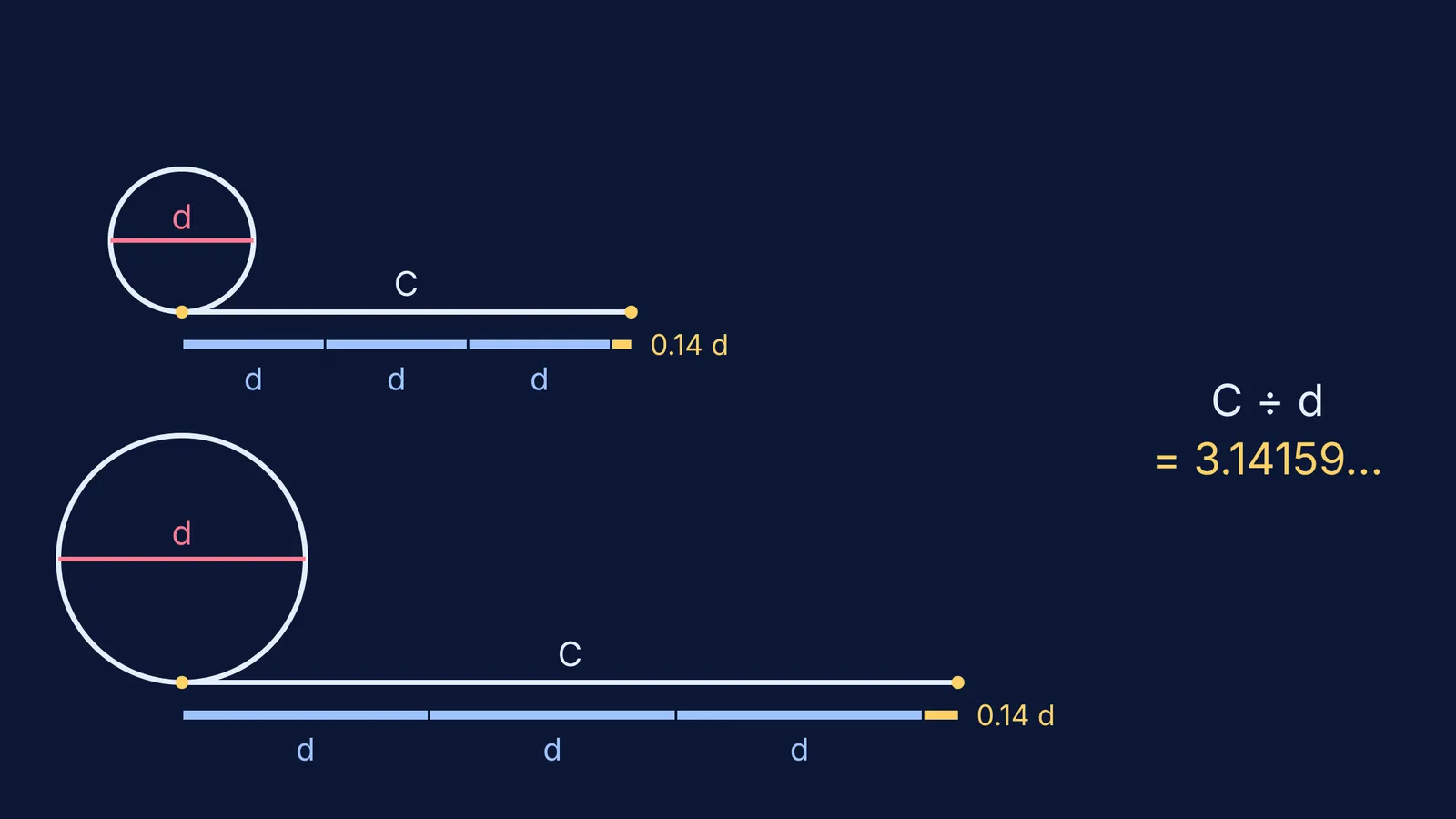
π is defined as the ratio of a circle's circumference to its diameter, as Wolfram MathWorld states.
Its value begins 3.14159265358979, according to MathWorld. So π answers a simple question: how many diameters fit around the edge of a circle? Just over three.
That means "circumference is π times diameter" is not a separate rule to memorise. It is the definition of π, rearranged: if C ÷ d = π, then C = π × d. The real question is why C ÷ d gives the same number for a one-rupee coin and a Ferris wheel.
Why is C/d the same for every circle?
All circles have the same shape. They differ only in size, the way a photo and its enlargement differ. When you enlarge a picture by some factor, every length in it grows by that factor, curved lengths included. A circle with twice the diameter has twice the circumference, so the ratio C/d stays put. The Wikipedia article on π states that in Euclidean geometry the ratio C/d is constant regardless of the circle's size.
Polygons make this concrete. Draw a regular hexagon inside a circle. Each of its six sides equals the radius, so its perimeter is 6r, which is 3d. The circle bulges outside the hexagon, so C must be more than 3d.
Now double the sides again and again. A regular polygon with n sides drawn inside a circle has perimeter n × d × sin(180°/n). Look at where d sits: it is only a multiplier. Divide by d and what is left depends on n alone, not on how big the circle is. As n grows, the polygon hugs the circle more tightly and that number closes in on π.
How did Archimedes trap π between polygons?
Use n × sin(180°/n) for polygons inside the circle and n × tan(180°/n) for polygons drawn outside it. With a calculator in degree mode you get:
6 sides: between 3.0000 and 3.4641
12 sides: between 3.1058 and 3.2154
24 sides: between 3.1326 and 3.1597
48 sides: between 3.1394 and 3.1461
96 sides: between 3.1410 and 3.1427
This is the method Archimedes devised around 250 BC: start from hexagons inside and outside the circle and keep doubling to 96 sides, which proves 223/71 < π < 22/7, as the history of π on Wikipedia describes. In India, Aryabhata used the value 3.1416 in his Āryabhaṭīya in 499 AD, the same article notes.
No fraction is exactly right: Johann Heinrich Lambert proved π irrational in the 1760s, as both MathWorld and Wikipedia record. That is why its decimals never end or repeat.
How does C = 2πr follow from C = πd?
The diameter is two radii laid end to end, so d = 2r. Substitute that into C = πd and you get C = π × 2r, usually written C = 2πr.
A quick check: a wheel of radius 35 cm has C = 2 × 22/7 × 35 = 220 cm. Roll it once and it moves 220 cm along the road.
Three slips cost marks in school and board exams:
Writing 2πd. That counts the diameter twice and doubles the answer.
Reading "radius" in the question and plugging it into πd.
Forgetting the straight edge in a semicircle: its perimeter is πr + 2r, not just πr.
If you keep making one of these, the Fermi Problem Library has worked problems with a step-by-step solver that explains the reasoning rather than printing an answer.
How can you check it yourself at home?
You need a few household objects:
Collect four round things of very different sizes, such as a bottle cap, a tumbler, a plate and a bicycle wheel.
Measure each diameter twice, at right angles, and take the average.
Measure the circumference by rolling the object one full turn along a sheet of paper from a pencil mark, or by wrapping a thread that does not stretch.
Divide C by d for each object and write the result to two decimal places.
Plot C on the vertical axis against d on the horizontal axis. The points should fall on a straight line through the origin, and its slope is your estimate of π.
Expect the small objects to scatter most, since being 1 mm out on a 6.5 cm bottle cap shifts the ratio by roughly one part in 65.
π returns in arc length, radians and the area of a circle. The Fermi Concept Library gives every concept in mathematics its own lesson and its place in the map, so you can trace π from this ratio to the topics built on it.
Pick up a thread and a tumbler tonight, and find π for yourself.


