On this page
Who proved pi is irrational, and when?
Johann Heinrich Lambert gave the first proof that π is irrational in 1761, and it was published in 1768 (ProofWiki historical note). An irrational number is one that cannot be written as a fraction a/b of two whole numbers, which is why the decimals of π never stop and never settle into a repeating pattern.
Lambert was born in Mulhouse in 1728 and died in Berlin in 1777 (MacTutor biography). A review of the 2024 second edition of an annotated English translation of his work describes him as a self-taught polymath who rose from a tailor's workshop in Mulhouse to the Berlin Academy of Sciences (review by Bharath Sriraman). The proof sits in his memoir on "remarkable properties of transcendental, circular and logarithmic quantities", printed in the Mémoires of the Berlin Academy (Proof that π is irrational).
How did Lambert use the tangent function?
Lambert wrote tan x as a continued fraction: a fraction whose denominator contains another fraction, whose denominator contains another, without end (Proof that π is irrational).
tan x = x / (1 − x² / (3 − x² / (5 − x² / (7 − …))))
The odd numbers 1, 3, 5, 7 carry on for ever. From this formula Lambert proved that if x is a nonzero rational number, then tan x is irrational, and he proved the same for e^x (MacTutor biography).
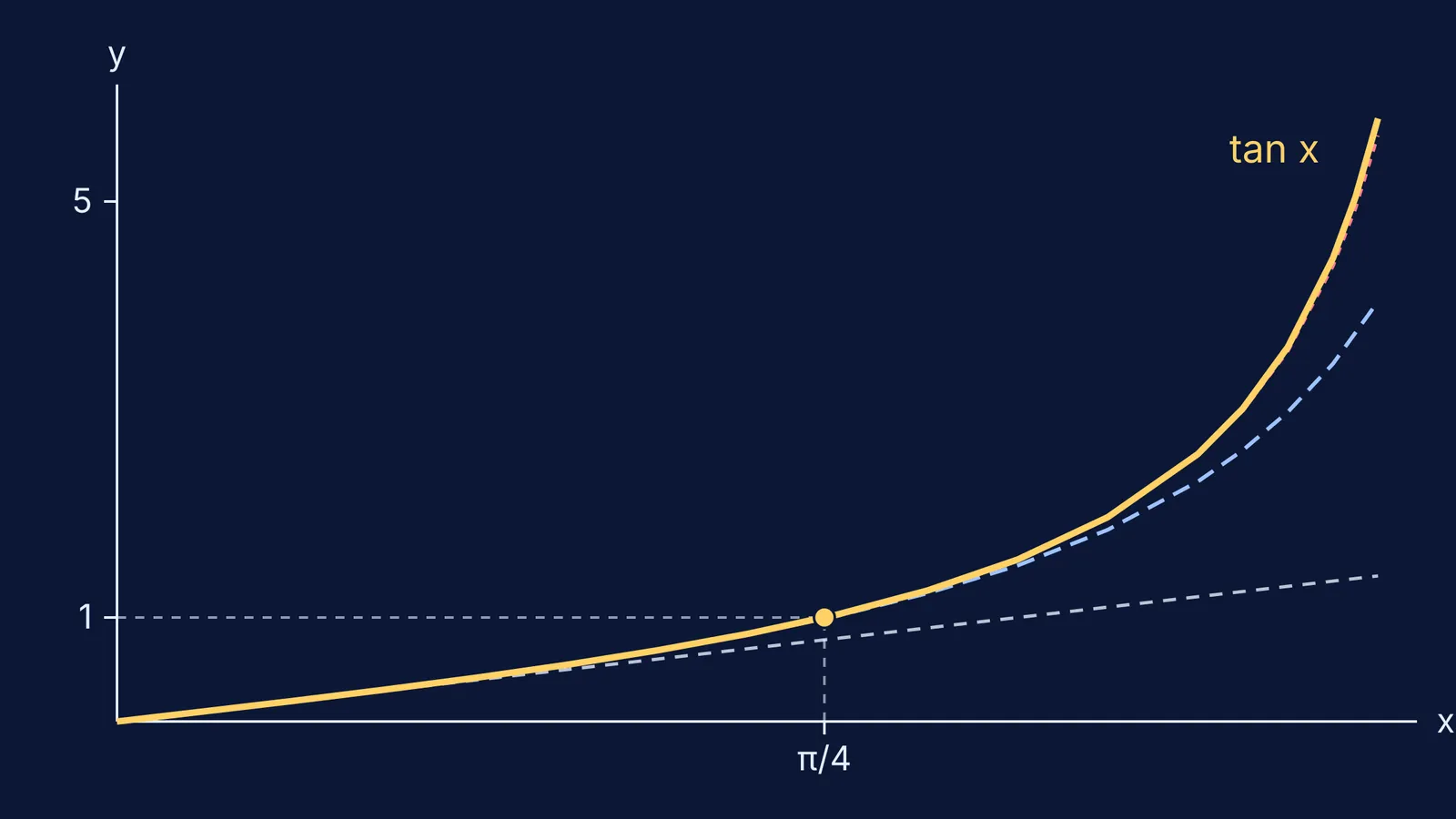
The last step needs only one fact from your Class 10 trigonometry table: tan(π/4) = 1.
It has the same shape as the √2 proof: assume a fraction, follow the logic, reach something impossible. If that method is new to you, read proving root 2 is irrational by contradiction first.
Worked example: watch the fraction close in on tan 1
Take x = 1 (in radians) and cut the continued fraction off at different depths. Each cut-off gives an ordinary fraction, called a convergent.
Stop at 1: the value is 1/1 = 1.
Stop at 3: 1 / (1 − 1/3) = 3/2 = 1.5.
Stop at 5: first 3 − 1/5 = 14/5, then 1 − 5/14 = 9/14, so the value is 14/9 ≈ 1.5556.
Stop at 7: you get 95/61 ≈ 1.55738.
Stop at 9: you get 841/540 ≈ 1.557407.
A calculator in radians gives tan 1 ≈ 1.5574077. Every convergent is a fraction, each is closer than the last, and none lands exactly on tan 1. Try step 4 on paper, working from the bottom up.
Why does a never-ending fraction prove anything?
A never-ending fraction alone is not a proof, because some infinite expressions still add up to a rational number. If x = a/b and tan x were also a fraction, the pieces in the tail of the continued fraction, cleared of their denominators, would give a list of positive whole numbers that keeps getting smaller for ever. No such list exists, since you run out of positive whole numbers. This kind of argument is called infinite descent (Proof that π is irrational).
Some later writers claimed the proof was incomplete and needed a result by Legendre to finish it; MacTutor notes that Wallisser showed it is complete and an outstanding achievement for its time (MacTutor biography).
What came after Lambert?
Long before Lambert, scribes such as Ahmes in the Rhind papyrus approximated π. After him, the story moved on (Proof that π is irrational):
In the same memoir, Lambert conjectured that e and π are transcendental, a claim that took about a century to settle (MacTutor biography).
In 1873 Charles Hermite gave a proof needing only basic calculus, which in fact showed that π² is irrational.
In 1882 Ferdinand von Lindemann proved that π is transcendental, which is stronger than irrational.
In 1947 Ivan Niven published a short proof using polynomials.
How should you study a proof like Lambert's?
Read it actively rather than nodding along. Use this five-step checklist:
Write the theorem in one line: x rational and x ≠ 0 means tan x is irrational.
Find the bridge fact that connects it to π: tan(π/4) = 1.
Say the contradiction out loud in your own words, as in the callout above.
Test the machinery with numbers, as in the worked example.
Ask where it would break. Why must x be nonzero? Because tan 0 = 0, which is rational.
It also helps to picture the function: revise the graph of tan x and its asymptotes.
If continued fractions or proof by contradiction feel shaky, the Fermi Concept Library gives each mathematics concept its own lesson and its place in the map, so you can fill that gap before tackling the proof. For practice, the Fermi Problem Library has worked problems with a step-by-step solver that explains the reasoning rather than printing an answer.