On this page
The Rhind Mathematical Papyrus is one of the best-known maths books to survive from ancient Egypt, and it reads like a homework book: share loaves, measure fields, fill granaries. The scribe who copied it, Ahmes (also written Ahmose), signed his work. Below is what it contains, and three of its problems you can solve with Class 6 to 9 maths.
Who was Ahmes, and when was the Rhind papyrus written?
In the translation quoted in the Wikipedia article on the Rhind papyrus, which cites Marshall Clagett's source book, Ahmes writes that the book "was copied in regnal year 33" of King Awserre "from an ancient copy made in the time of" King Nimaatre. Awserre is the Hyksos king Apepi, and Nimaatre is the pharaoh Amenemhat III.
Sources differ on the exact date. MacTutor's history of Egyptian mathematics says Ahmes wrote it around 1650 BC, copying a document 200 years older. The Wikipedia article gives about 1550 BC.
The scroll is named after the Scottish Egyptologist A. Henry Rhind, who bought it in Luxor in 1858, and it is now in the British Museum in London, according to MacTutor. The Wikipedia article adds that its two main pieces are 295.5 cm and 199.5 cm long.
What is in the Rhind mathematical papyrus?
MacTutor notes that 81 of the papyrus's 87 problems involve fractions (MacTutor). The Wikipedia summary, which follows Arnold Buffum Chace's edition, groups the contents like this:
A table writing 2/n as sums of unit fractions, for every odd n from 3 to 101.
Problems 1 to 6: sharing 1, 2, 6, 7, 8 and 9 loaves among 10 men.
Problems 24 to 34: "aha" problems, which today we would write as linear equations.
Problems 41 to 46: volumes of cylindrical and rectangular granaries.
Problems 48 to 55: areas of circles, rectangles, triangles and trapezoids.
Problem 79: 7 houses, 49 cats, 343 mice, 2401 spelt plants and 16807 hekat, a chain of powers of 7.
How do Egyptian fractions work?
Ahmes wrote fractions as sums of unit fractions (fractions with 1 on top), with 2/3 as the one allowed exception, according to MacTutor's page on the Egyptian papyri. The 2/n table is his lookup table. Here are three entries from the doubling table MacTutor gives, with the check you can do using the LCM:
2/5 = 1/3 + 1/15. Over 15: 5/15 + 1/15 = 6/15 = 2/5.
2/7 = 1/4 + 1/28. Over 28: 7/28 + 1/28 = 8/28 = 2/7.
2/17 = 1/12 + 1/51 + 1/68. Over 204: 17/204 + 4/204 + 3/204 = 24/204 = 2/17.
Rusty? See our guide to adding fractions with different denominators using the LCM.
How did Ahmes estimate pi?
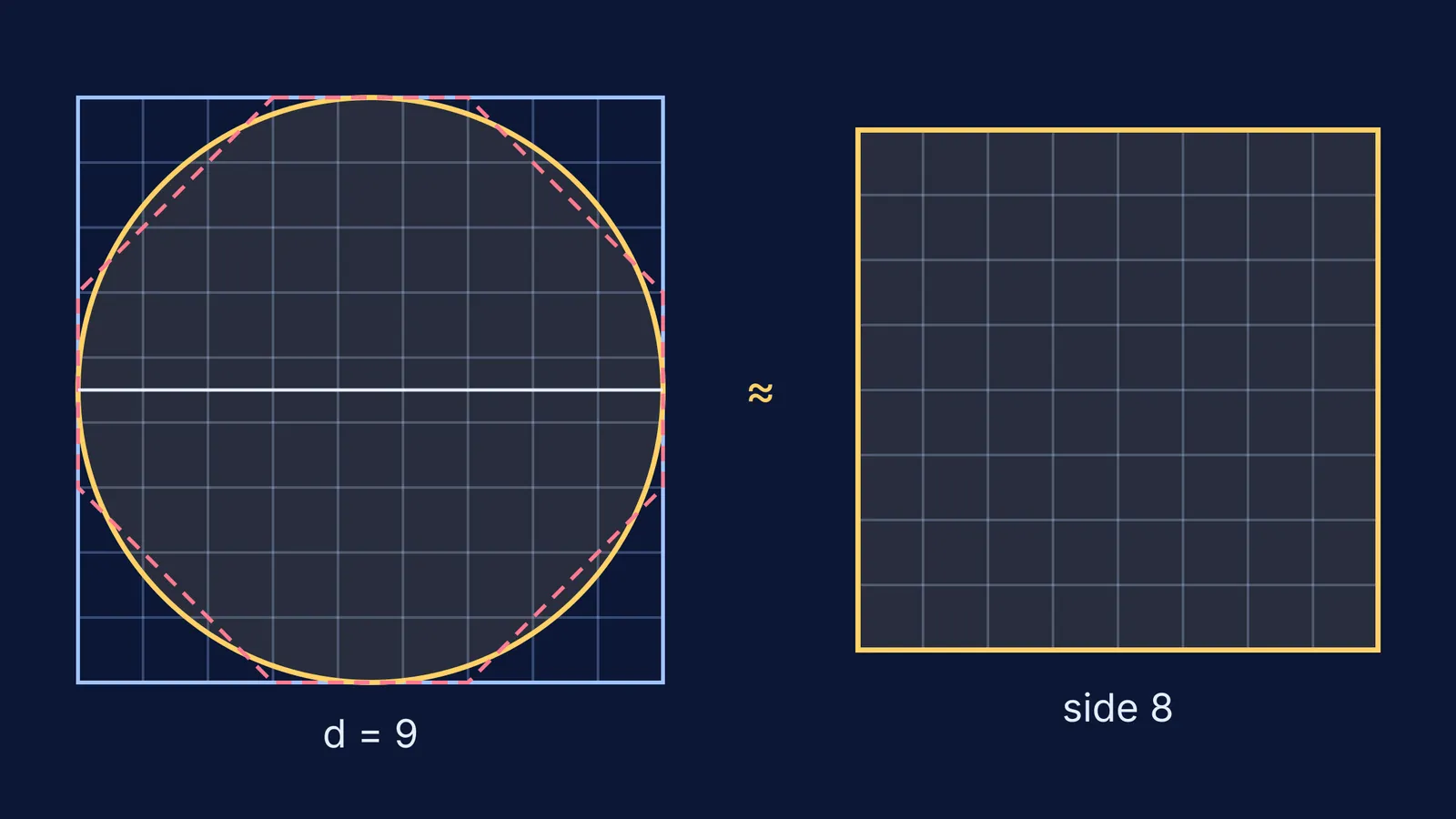
Problem 50 asks for the area of a round field 9 khet across. Its working, as translated on MacTutor's Egyptian papyri page, is: "Take away 1/9 of the diameter, namely 1; the remainder is 8. Multiply 8 times 8; it makes 64." The answer is 64 setat.
Ahmes gives a rule, not a number called pi. In modern symbols the rule is area = (8d/9)², and setting that equal to pi times r² gives pi = 4 × (8/9)² = 256/81, which MacTutor works out as 3.1605.
Check it against the modern value:
True area: pi × 4.5² = 3.1416 × 20.25 ≈ 63.62 setat.
Ahmes's area: 64 setat.
Difference: 0.38 out of 63.62, or about 0.6 percent.
The hero image gives one way to see why the rule comes so close. Cut the four corner triangles (3 units along each side) off a 9 by 9 grid and the octagon left over has area 81 − 4 × 4.5 = 63, just under the true 63.6, while Ahmes's 64 is just over. Polygons came back much later, when Archimedes trapped pi between 223/71 and 22/7.
How do you solve an aha problem the Egyptian way?
Problem 24 says: "A quantity added to a quarter of that quantity become 15. What is the quantity?" MacTutor explains that Ahmes uses the method of false position (MacTutor). Here it is step by step:
Guess a number that makes the quarter easy: 4.
Test it: 4 + 1 = 5.
You needed 15, which is 3 times 5.
Scale the guess by the same factor: 4 × 3 = 12.
Check: 12 + 3 = 15.
In Class 8 terms this is x + x/4 = 15, and false position is still a handy way to check such answers.
If you get stuck on a step, the Fermi Problem Library has worked problems with a step-by-step solver that explains the reasoning rather than printing an answer. If fractions themselves feel shaky, the Fermi Concept Library covers every concept in mathematics, each with its own lesson.
Next in the story of how people wrote parts of a whole: Al-Uqlidisi and the earliest known decimal fractions.