On this page
In 1313 a Yuan-dynasty official named Wang Zhen published the Nong Shu, or Book of Agriculture, a 22-chapter guide to grains, silkworms, ploughs, irrigation and textile tools (Wikipedia, drawing on Joseph Needham)). At the end he added an appendix on something quite different: printing books with carved wooden type sorted on two rotating tables. It survives in the original Chinese in juan 22 of the Nong Shu on Wikisource, the source for most details below.
Who was Wang Zhen and what is the Nong Shu?
Wang Zhen came from Shandong and served as magistrate of Jingde county, in today's Anhui province, from 1290 to 1301 (Wikipedia)). His book runs to more than 110,000 Chinese characters, and chapters 11 to 22 are an illustrated treatise on farm implements, from hand tools to irrigation machines. The same source credits it with the first drawn and printed illustration of water-powered bellows for a blast furnace.
Movable type was not new. Bi Sheng had made fired clay type in the 11th century, as we tell in how Bi Sheng invented clay movable type. Wang Zhen's appendix notes that earlier clay and cast tin type were hard to ink, so many prints were spoiled (Nong Shu, juan 22).
How did Wang Zhen's rotating type wheel work?
The appendix sets out the method in steps (Nong Shu, juan 22).
Sort the characters. Characters from the official rhyme book were listed under the five tones, written out by a good calligrapher and pasted onto wooden boards. Common words such as particles and numerals got extra copies, for more than 30,000 pieces in all.
Cut and trim. Carvers cut the board, sawed it into single characters and trimmed each piece. In Needham's translation, quoted on Wikipedia's history of printing page, the pieces were "compared and tested till they are exactly the same height and size."
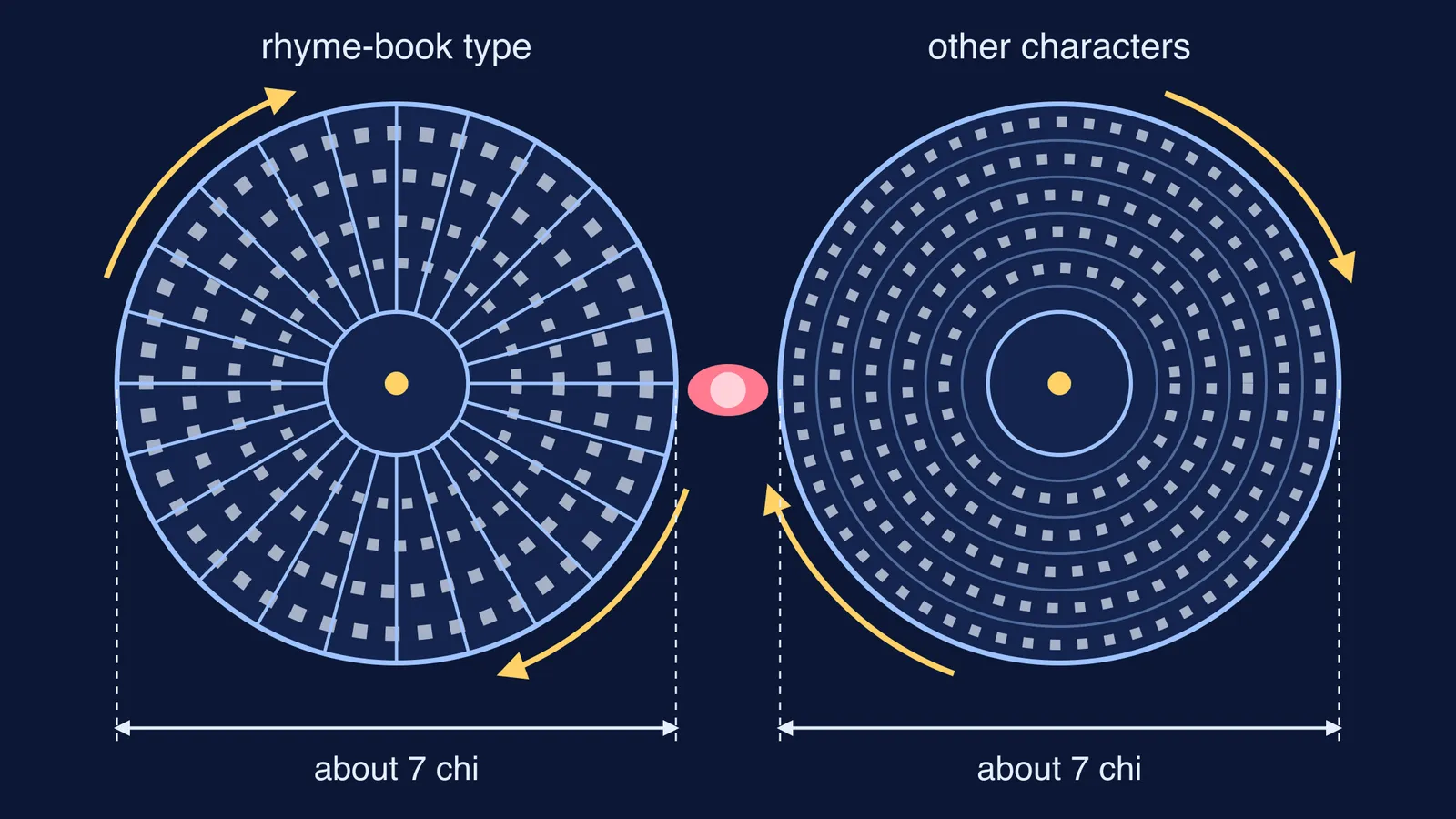
Build two wheels. Each wheel was made of light wood, with a round top about seven chi (traditional Chinese feet) across on an axle about three chi high. One wheel held the rhyme-book characters; the other held miscellaneous characters.
Call and pick. One person called out each character's number from a list. A second, sitting between the wheels, turned them and set the piece in a wooden frame. Missing characters were carved on the spot.
Wang Zhen's reasoning, in plain English: it is hard for a person to go looking for characters, but easy when the characters come to the person. After printing, each piece went back to its numbered slot. The historian Endymion Wilkinson, as cited on the same Wikipedia page, describes the rhyme wheel as divided into 24 trays.
How fast could wooden movable type print?
Wang Zhen says the type took two years to make. As a trial he printed his county's gazetteer, a text of some 60,000 characters, and had 100 copies ready in less than a month (Nong Shu, juan 22). You can check what those figures imply with simple arithmetic.
The text had about twice as many characters as the set had pieces. So the whole book could never be set at once: pages had to be printed, broken up and the type returned to the wheel.
If every character was set once within 30 days, the team averaged roughly 2,000 characters a day, before counting printing time.
Each page was set once but printed 100 times, so fast picking and fast return of type mattered most.
This is a lower bound, not a measurement.
Why didn't Wang Zhen print the Nong Shu with his own type?
He meant to: the appendix says he made the type because his book had so many characters. But when the book was done he had moved to a post in Yongfeng, and found that in Jiangxi it was already being cut onto ordinary woodblocks. So he stored the type and wrote the method down so it would not be lost. Europe's version of reusable type came later, in metal: see Johannes Gutenberg and the idea of reusable metal type.
What can a student borrow from the type wheel?
Wang Zhen's real problem was retrieval, and revision has the same shape. Try this with one subject this week.
Number your material. Give every formula sheet, worked example and notebook page a code, such as P-12 for physics page 12.
Keep one index page, like his rhyme list: kinematics graphs, P-12 and P-31.
Bring the material to the desk. Put everything for tonight's chapter within reach before you start.
Play caller and picker. A friend or parent calls a code or a question. You recall the idea from memory first, then check the page.
Put it back in its slot, so tomorrow's search is just as quick.
When your index keeps pointing to ideas you never properly learned, the Fermi Concept Library has every concept in physics, chemistry, biology, mathematics and computing, each with its own lesson and its place in the map.
For another old book that recorded farm methods so others could use them, read about Ibn al-Awwam and the Book of Agriculture in medieval Seville.