On this page
What was Ibn al-Awwam's Book of Agriculture?
In the late 12th century, during the Almohad period in Al-Andalus, the agronomist Abu Zakariya Yahya ibn Muhammad ibn Ahmad ibn al-Awwam completed his masterwork, *Kitab al-Filaha* (*The Book of Agriculture*), in Seville. Known as Ibn al-Awwam al-Ishbili, he farmed and ran systematic agricultural trials on his estate in the Aljarafe district west of Seville. When the 14th-century historian Ibn Khaldun reviewed agricultural scholarship in his *Muqaddimah*, Ibn al-Awwam was the only agronomist he cited by name.
The treatise is organized into 34 chapters: the first 30 focus on soils, irrigation, manures, and crops, while the final 4 examine livestock, poultry, and veterinary medicine. According to the Filāḥa Texts Project, Ibn al-Awwam synthesized 1,900 citations from 112 earlier authorities, comprising 615 Byzantine references (32.5%), 585 Near Eastern references (31%), and 690 Andalusian citations (36.5%). Furthermore, a philological analysis in the International Journal of Multidisciplinary Research and Literature confirms that he catalogued 585 plant species and documented cultivation techniques for over 50 fruit trees. Much like Theophrastus's early classification of plant structures organized Mediterranean flora by form, Ibn al-Awwam established an agronomic taxonomy grounded in cultivation requirements.
How did Ibn al-Awwam classify and test agricultural soils?
Chapter 1 of *Kitab al-Filaha* insists that all husbandry depends on understanding the earth. In the *Geographical Review*, soil scientists Lois Olson and Helen L. Eddy showed how Ibn al-Awwam operated as an early pedologist, classifying soils by color, texture, consistency, and moisture retention. He distinguished rich alluvial black and red clays from stony, sandy, and chalky earths.
To evaluate a field, he directed farmers to examine crumb structure, smell freshly dug earth, and taste a suspended sample for salinity or acidity. Wild indicator plants guided assessment: wild mustard, chicory, and fennel signaled fertile, aerated soil, whereas dense rushes warned of standing water. He then amended soils mechanically, lightening stiff clay with sand and organic compost while stabilizing loose sand with heavier loam. Centuries before Justus von Liebig's law of the minimum for plant nutrients defined chemical limits, Ibn al-Awwam recognized that physical soil structure governs root aeration and moisture storage.
Which composting and grafting methods did Kitab al-Filaha introduce?
Chapters 2 and 8 govern fertility and propagation. Ibn al-Awwam established a manure hierarchy based on thermal potency. Concentrated pigeon dung ranked highest, requiring dilution with loam or water to avoid root scorch. Sheep and horse manures provided moderate warmth for heavy soils, while cow manure offered cool moisture suited to dry sands.
To restore soil vitality, he designed pit composting protocols where manures, weeds, straw, and wood ash fermented for months into dark humus. As geographer Karl W. Butzer documented in Ecumene, this organic recycling powered the medieval agricultural expansion across southern Iberia, anticipating George Washington Carver's work on rebuilding depleted soils with compost and legumes.
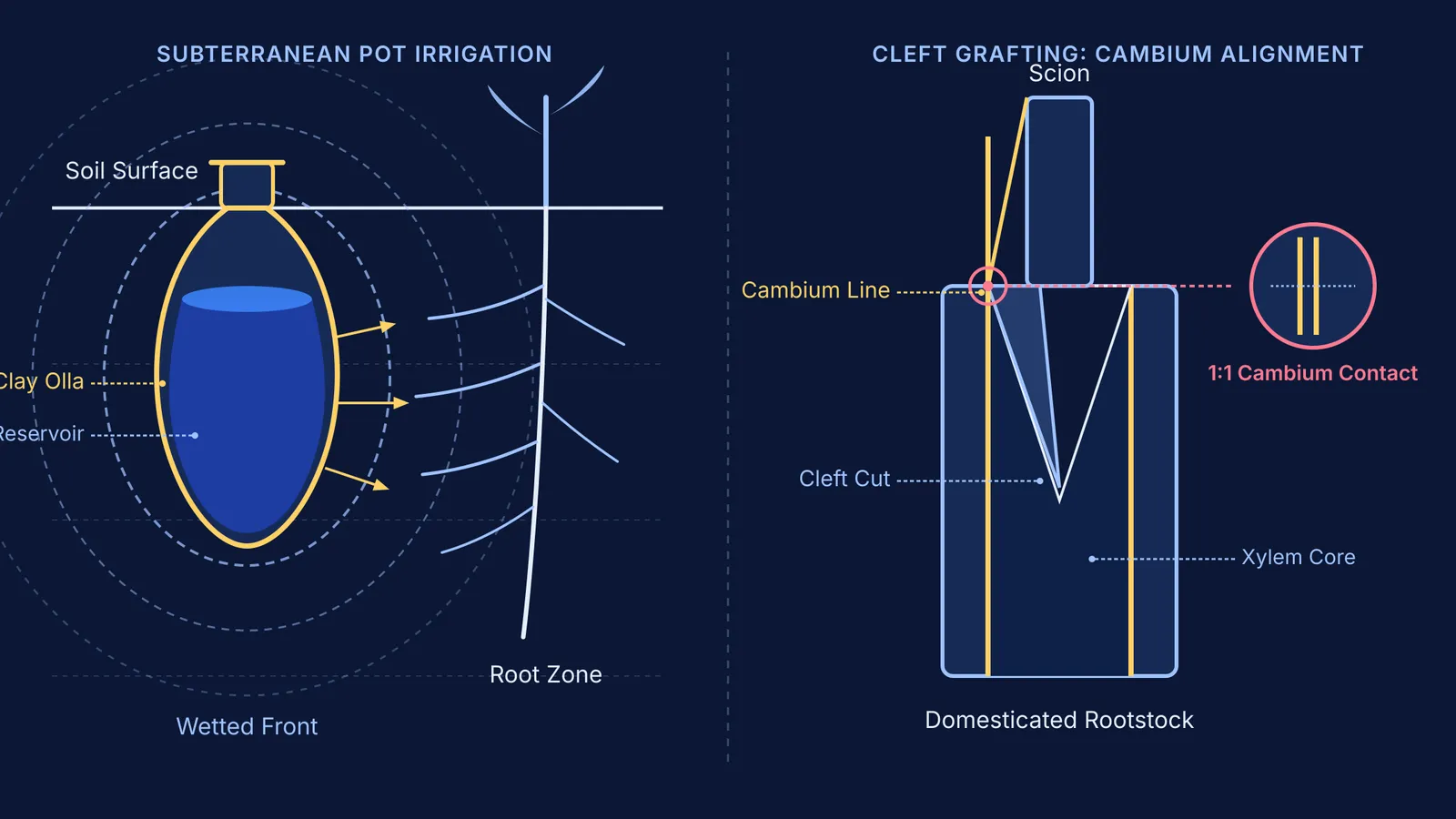
In propagation, Ibn al-Awwam detailed cleft, bark, shield, and pipe grafting, requiring exact alignment of vascular cambium layers. In his noted Aljarafe trial, he grafted wild mountain olives onto domesticated plains rootstocks to combine drought resilience with high yield. In Chapter 3, he introduced subterranean clay-pot irrigation, burying porous unglazed earthenware pots beside tree roots to deliver water directly to the rhizosphere without evaporative loss.
Practical framework: How can you diagnose soil using Ibn al-Awwam's checklist?
You can test garden or crop soil using Ibn al-Awwam's four-step diagnostic workflow:
Assess texture: Squeeze damp soil into a ribbon. Sticky, dense ribbons indicate heavy clay requiring coarse sand and leaf mold; crumbling soil indicates sand requiring compost and loam.
Check sensory cues: Fresh soil should smell earthy and sweet. Sour or putrid odors reveal anaerobic waterlogging, requiring drainage trenches or raised mounds.
Balance thermal amendments: Heavy clays benefit from warm horse or poultry manure, while dry sands need cool, well-aged cattle dung and vegetable compost.
Apply subterranean hydration: In hot climates, sink unglazed terracotta pots near deep root systems. Filling them allows moisture to seep steadily into the rhizosphere without crusting surface soil.
Why does medieval empirical agronomy matter for modern students?
Ibn al-Awwam shows that scientific progress stems from disciplined field trials and physical reasoning. For students studying biology and chemistry, agricultural science connects concepts like xylem water potential, soil ion exchange, and meristem regeneration to living systems.
When studying how mineral ions cross root membranes or how osmotic gradients maintain turgor, the Fermi Concept Library covers every concept in physics, chemistry, biology, mathematics and computing, each with its own lesson and its place in the map. For multi-step quantitative problems on transpiration flow or nutrient ratios, the Fermi Problem Library explains the underlying reasoning step by step rather than simply printing an answer. Testing hypotheses through structured problem-solving builds the same empirical rigor that defined 12th-century Seville.