

On this page
When Johannes Gutenberg completed his 42-line Bible around 1455, movable type transformed European scholarship. Yet four centuries earlier, an artisan in Northern Song China had already engineered and operated a complete, working movable-type printing press.
Between 1041 and 1048 CE, during the Qingli reign of Emperor Renzong, a craftsman named Bi Sheng created the world's first movable type from kiln-fired clay. Polymath Shen Kuo (1031–1095 CE) documented the workshop in his 1088 treatise *Dream Pool Essays* (*Mengxi Bitan*, Volume 18). Bi Sheng was an ordinary commoner without imperial rank (*buyi*, a man in plain hemp clothes), but his ceramic typography solved the bottleneck of mass book reproduction centuries before European metal casting.
Who was Bi Sheng and when did he invent movable type?
China had practiced woodblock printing (*xylography*) since the Tang dynasty, producing the *Diamond Sutra* in 868 CE. In the 10th century, Prime Minister Feng Dao directed the woodblock printing of the Confucian classics across 130 volumes, as communication historian Shelton A. Gunaratne documented in the *International Communication Gazette*.
Carving individual wooden blocks for each page was slow, and a slipped chisel could ruin weeks of labour. Bi Sheng recognized that written texts are recurring combinations of discrete symbols. Between 1041 and 1048 CE, he transformed bookmaking by decomposing pages into standardized, reusable pieces. When Bi Sheng died around 1051 CE, his original clay types passed to Shen Kuo's family, who preserved them.
How did Bi Sheng's clay movable type system work?
In his *Dream Pool Essays* (*Mengxi Bitan*, Volume 18), Shen Kuo recorded Bi Sheng's printing process in detail:
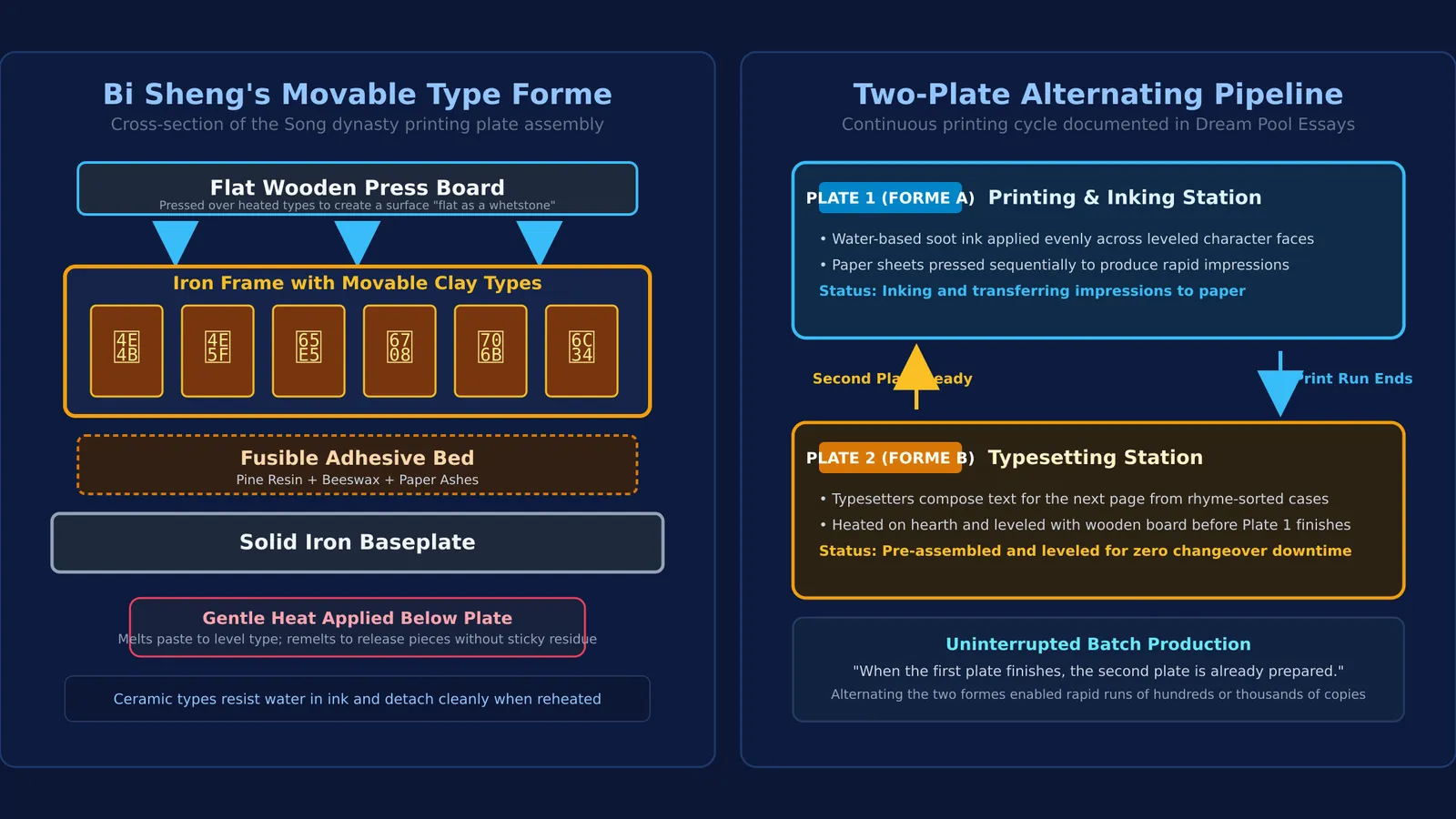
Carving and firing types: Bi Sheng carved sticky clay into character pieces "as thin as the edge of a coin" and baked them hard in a fire.
Adhesive baseplate: He coated an iron plate with a fusible mixture of pine resin, wax, and paper ashes.
Setting the forme: He placed an iron frame over the plate and packed the clay characters closely inside.
Thermal leveling: Heating softened the paste; workers pressed a wooden board over the characters until the surface was "as flat as a whetstone."
Alternating workflow: While one plate was being inked and pressed, workers set type on a second plate. Alternating the two formes made printing hundreds or thousands of copies rapid.
To handle repetition, common characters like *zhi* (之) and *ye* (也) had 20 or more pieces each per font set. Bi Sheng organized types in wooden cases by phonetic rhyme, while rare characters were carved and fired over straw fires within minutes.
Why did Bi Sheng choose baked clay over wood?
Bi Sheng originally tested wooden type, but abandoned it because of material flaws.
As Shen Kuo observed, wood grain absorbs moisture unevenly. Water-based ink made wooden characters swell and warp, causing uneven print heights. Heated wood also bonded tenaciously with the resin-wax paste, splintering when removed.
Fired clay overcame both flaws. Ceramic does not absorb ink water, and reheating the plate lets types drop out cleanly with a hand sweep. Modern replication experiments by researcher Sun Shouling, published in *Early Medieval China*, proved that properly fired clay types endure repeated mechanical pressing and survive drops onto stone floors.
Why did woodblock printing remain dominant in Song China?
Why did woodblocks dominate East Asia for centuries after Bi Sheng? Historian Tsien Tsuen-Hsuin resolved this puzzle in Joseph Needham's *Science and Civilisation in China*:
Character inventory: Alphabets require roughly 26 letters plus punctuation, totaling under 200 matrices. Written Chinese uses thousands of ideographs; printing an ordinary book required managing 3,000 to 5,000 active characters, making typesetting labor-intensive.
Reprint economics: Carved wooden blocks could be stored for decades to print 10 or 20 copies on demand without resetting type. Movable type tied up thousands of pieces in a single form, requiring printers to redistribute type between runs.
Ink chemistry: Chinese ink was water-based soot and glue, suited for absorbent paper and wood. When Johannes Gutenberg developed reusable metal type in the 1440s, he formulated oil-based ink tailored for metal alloy and an alphabet where movable type delivered overwhelming economic advantages.
Bi Sheng's modular breakthrough nonetheless spread. By the 12th century, Western Xia printers used clay and wooden movable types for Buddhist sutras, and Korean artisans cast the first surviving metal-type book, the *Jikji*, in 1377. Bi Sheng was part of the Northern Song scientific flowering that also produced Su Song's water-driven astronomical clock and Shen Kuo's discovery of magnetic declination.
What does Bi Sheng's modular breakthrough teach modern learners?
Bi Sheng's core insight was modularity: decomposing a monolithic task into standardized, interchangeable parts governed by a reusable interface.
When facing complex physics derivations or multi-step chemistry reactions, students often try to absorb problems as indivisible wholes, creating cognitive overload. Experienced problem solvers do what Bi Sheng did: decompose problems into modular primitives—conservation laws, force balances, or reaction steps.
When you need to deconstruct challenging science problems into their modular components, the Fermi Problem Library provides a step-by-step solver that explains the underlying reasoning rather than just printing an answer. If you want to visualize how modular forces or field lines interact dynamically, the Fermi Simulation Lab offers interactive simulations for ideas that are easier to see than read. And when you are planning your study sessions across a vast syllabus, Fermi's AI tutor can work out what you already know and build a focused plan for your session, helping you master complex subjects one reusable building block at a time.


