On this page
The Titanic took two hours and forty minutes to sink, from the collision at 11.40 p.m. to its disappearance at 2.20 a.m., according to the 1912 British Wreck Commissioner's inquiry (extent of the damage, final effect of the damage). Flooding sank it; rivets and cold steel played supporting roles.
Why did the Titanic sink?
Flooding. The iceberg damaged the starboard side about 10 feet above the keel, over a length of about 300 feet, the inquiry found (extent of the damage). That opened six compartments to the sea: the forepeak, holds 1, 2 and 3, and boiler rooms 6 and 5. Because the ship was moving at over 20 knots, the inquiry worked out that it passed along those 300 feet in less than 10 seconds (time in which the damage was done).
The court's finding was that the loss "was due to collision with an iceberg, brought about by the excessive speed at which the ship was being navigated" (inquiry report). It counted 1,490 lives lost; 711 of the 2,201 people on board were saved (numbers saved).
Watertight bulkheads divided the hull, but they were walls, not lids. The inquiry says water in boiler room 6 probably reached the top of its after bulkhead, at E deck, about an hour after the collision, and was coming into boiler room 4 after an hour and 40 minutes (gradual effect of the damage). It also concluded that the ship would have stayed afloat with the known damage if the bulkhead behind boiler room 5 had been carried up to C deck (effect of additional subdivision).
Were the rivets to blame?
NIST metallurgist Timothy Foecke analysed steel and rivet samples recovered from the wreck. In a 1998 report he found that the wrought iron in the rivets contained three times today's allowable amount of slag, making it less ductile and more brittle than it should have been (NIST, 1998). NIST called this strong evidence that the collision snapped rivet heads off and let water rush in between separated hull plates. Foecke called the hull's 3 million rivets "very possibly" the culprit, not certainly.
Sonar mapping of the starboard hull showed only six thin tears from the iceberg, with a total open area of about one square metre (12 square feet). Photographs of the Titanic's sister ship, the Olympic, taken after a 1911 collision, show dozens of empty holes where rivets popped (NIST feature).
Was the steel too brittle in cold water?
Steel can bend before breaking (ductile) or crack like glass (brittle), depending partly on temperature. H.P. Leighly and Katie Felkins at the University of Missouri-Rolla tested Titanic hull steel and found it about 10 times more brittle than modern steel at freezing temperature, the estimated water temperature that night (ScienceDaily, 1997). They also found high sulfur, oxygen and phosphorus and low manganese, published in JOM in January 1998 (JOM paper).
Brittle does not mean the hull shattered on impact. In a 1998 talk, Foecke said the evidence pointed away from that theory: the steel was adequate in strength but low in toughness at ice-water temperatures, and was much more likely a factor in the ship breaking apart at the surface (Philosophical Society of Washington).
How does flooding take away buoyancy?
A ship floats because the water it pushes aside weighs as much as the ship does. That is Archimedes' principle, the same idea behind how container ships float and stay stable. When a compartment floods, its space stops pushing water aside, so the rest of the hull must sink deeper to make up the difference.
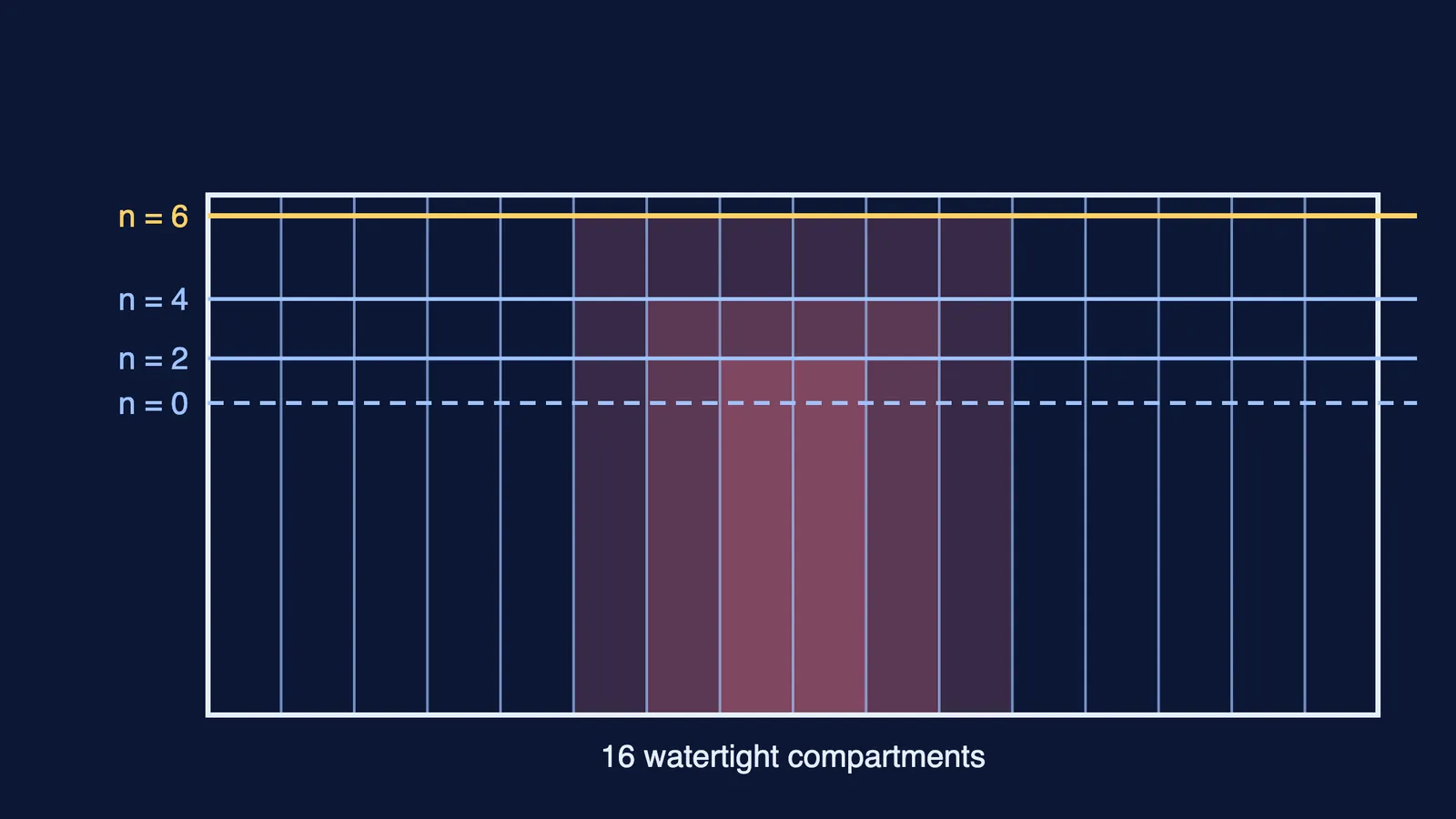
A worked example, with toy numbers rather than the Titanic's: take a box-shaped hull 10 m deep, floating 6 m deep, split into 16 equal compartments. Flood n compartments in the middle and the new draft is 6 × 16 ÷ (16 − n):
0 flooded: 6.0 m
2 flooded: 6.9 m
4 flooded: 8.0 m
6 flooded: 9.6 m
7 flooded: 10.7 m, deeper than the hull, so it sinks
The steps grow because each flooded compartment leaves fewer to share the load. Now put every flooded compartment at the front, as on the Titanic. The bow goes down further than the average, and once the tops of the bulkheads there sink below the sea outside, they no longer keep water in. Foecke added a caution: the six damaged compartments most likely flooded through their own plate separations, not by water spilling from one into the next (Philosophical Society of Washington).
To revise Archimedes' principle, the Fermi Concept Library covers every concept in physics, chemistry, biology, mathematics and computing. For an idea that is easier to see than read, the Fermi Simulation Lab has interactive simulations.
What does the Titanic teach a physics student?
Use this checklist on any "why did it fail" question:
Find the load: what weight had to be carried?
Find the margin, and how fast it shrinks.
Test materials at real conditions, not room temperature.
Look at the joints, not just the parts.
Ask what fails next.
The same chain of small causes runs through why the Hindenburg caught fire, and how icebreaker ships break ice shows hulls built for ice.