

On this page
A normal ship pushes water aside with a sharp bow. Try that against a frozen sea and the bow just grinds against a wall of ice. An icebreaker turns the problem around: it climbs on top of the ice and lets gravity do the breaking.
How do icebreaker ships break ice?
The Canadian Coast Guard explains it in two steps. The bow of an icebreaker is curved like the back of a spoon so that it can slide up onto the ice. The vessel's weight then crushes the ice from above.
That changes how the ice is loaded. Pushing a floating sheet from the side squeezes it; pressing down on its edge bends it, and a thin sheet cracks far more easily when bent.
The ship design guide at Cool Antarctica lists the features that make this work:
a gradual upward slope at the bow, especially at the waterline, so the bow rides up before its weight breaks through;
a hull that is heavy for its size, with extra-thick steel at the bow, the stern and the waterline;
the ability to move large amounts of water ballast quickly inside the ship, shifting its weight so the crew can rock it from side to side;
on some ships, air forced out under pressure about 2 m below the waterline, where the hull meets the ice.
Why is an icebreaker's bow sloped like a spoon?
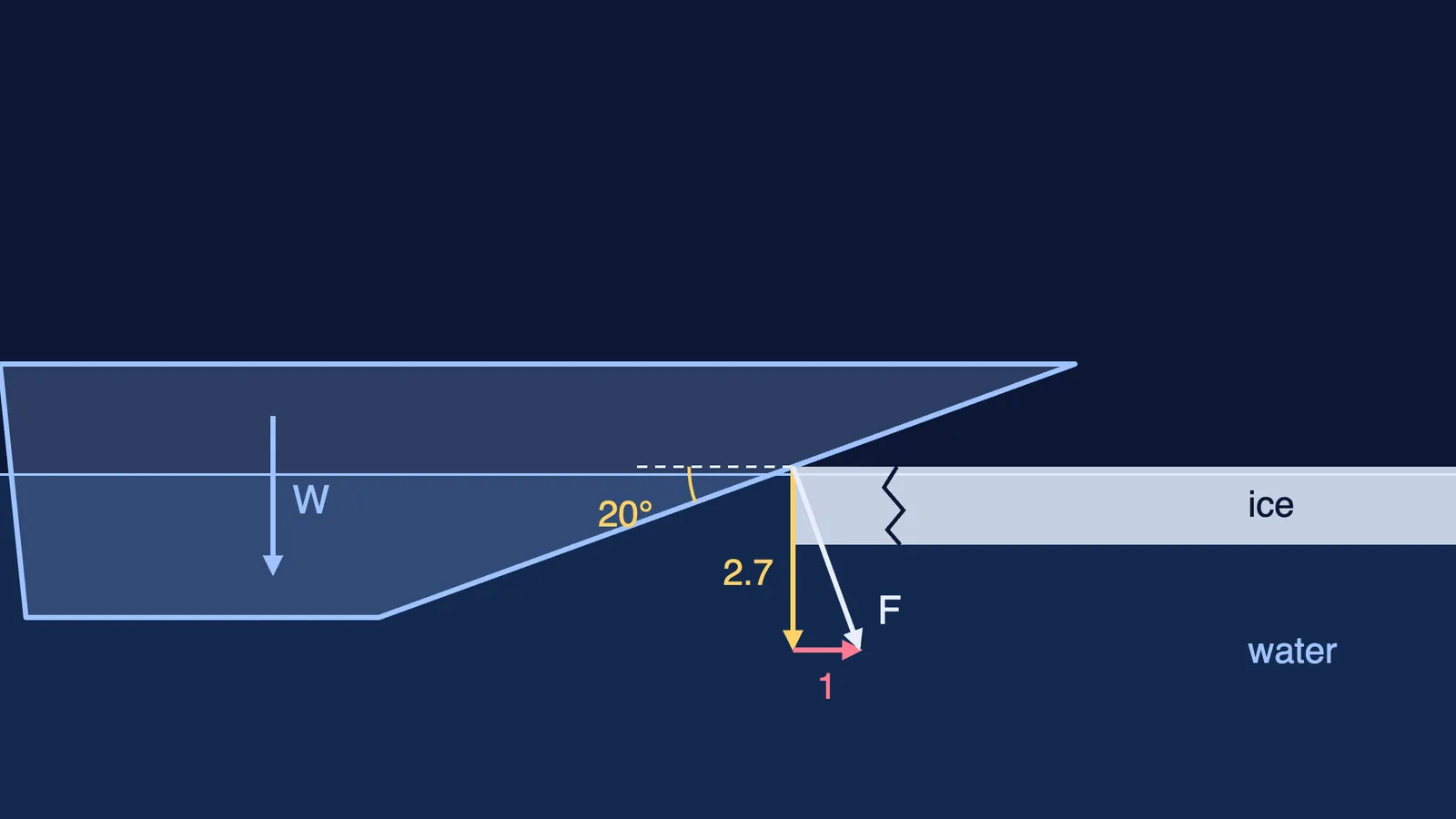
The slope is a force multiplier. Here is a worked example, assuming no friction.
Ice pushes on the hull at right angles to the hull's surface. Say the bow is sloped at 20° to the horizontal (an angle chosen for the example). The push between hull and ice is then tilted 20° from the vertical, so it splits into two parts:
Downward part = F cos 20° = 0.94 F
Forward part = F sin 20° = 0.34 F
Ratio, down to forward = 1 / tan 20° ≈ 2.7
So for every tonne-force of forward push the engines put into the ice, the sloped bow presses down with about 2.7 tonne-force. A vertical bow (90°) gives a ratio of zero: all push, no bending. Friction lowers the real ratio, but the idea holds: a shallow bow turns thrust into the bending load ice is weakest against.
Once the ice cracks, the hull must clear it. A US Coast Guard piece reprinted by The Maritime Executive says the Polar Star's rounded hull pushes broken ice to either side of the ship.
What happens when the ice is too thick?
The ship backs up and rams. The same Maritime Executive article describes the Polar Star as having 75,000 horsepower, a hull more than 2 inches thick and a weight of 13,500 tons. It breaks ice up to 6 feet (about 1.8 m) thick while moving steadily, and backs and rams ice up to 21 feet (about 6.4 m) thick. At an ice ridge, the cutter may have to back and ram several times to weaken the ice before it can open a path.
Why are some icebreakers nuclear powered?
The World Nuclear Association gives two reasons: the power needed to break ice up to 3 metres thick, and the difficulty of refuelling other ships far into the Arctic.
Russia's LK-60 class (Project 22220) runs on two RITM-200 reactors of 175 MW thermal each, which together deliver 60 MW to three propellers, the same source reports. Each ship displaces up to 33,540 t and is designed to break ice 2.8 m thick at up to 2 knots. The association credits the nuclear fleet with extending Arctic navigation from 2 to 10 months a year. If you want to know what goes on inside those reactors, read how a nuclear reactor works.
Try it: how much does the bow angle matter?
Do the worked example for other angles, with a calculator or by hand:
Bow at 10°: 1 / tan 10° ≈ 5.7
Bow at 20°: 1 / tan 20° ≈ 2.7
Bow at 30°: 1 / tan 30° ≈ 1.7
Bow at 45°: 1 / tan 45° = 1.0
A shallower bow presses down harder, but it is longer and must climb further, so real designs trade these off. Then ask why ice floats at all: our post on why most wood floats but some sinks walks through the density argument.
If resolving forces still feels slippery, the Fermi Simulation Lab has interactive simulations for ideas that are easier to see than to read. Fermi's AI tutor draws the figure and checks your understanding as it goes, so you can work out where your free-body diagram goes wrong.


