On this page
On 19 September 1979, Sylvia Earle rode to the seabed 381 metres down strapped to the front of a small research submersible, then unhooked herself and walked with no line to the surface. Guinness World Records lists it as the deepest untethered sea walk by a woman, and says she explored the seabed for over two hours. The dive took place off Oahu, Hawaii, according to an interview published by Mission Blue.
What kept her alive is an idea from your school pressure chapter: pressure in a liquid depends on depth.
What did Sylvia Earle do on her 1979 JIM suit dive?
She rode down in a JIM suit on the front of the submersible, then untethered herself and explored alone (Guinness World Records). In that Mission Blue interview she remembered bamboo coral that lit up when she touched it, sending "rings, like little glowing blue donuts of light" out from the touch (Mission Blue).
She was no beginner. In 1970 she was part of Tektite II, the first all-female underwater team, which spent 14 days underwater using a habitat 50 metres down in the US Virgin Islands. In the 1990s she became chief scientist of the US National Oceanic and Atmospheric Administration (NOAA), and in 2009 she founded Mission Blue, according to the Australian National Maritime Museum.
What is a JIM suit and how does it work?
A JIM suit is an atmospheric diving suit: a hard, person-shaped shell that keeps the air inside at one atmosphere, the same as at the surface (JIM suit, Wikipedia). The early suits were cast from magnesium, weighed about 500 kg in air with the diver inside, and were rated to about 460 metres. Oil-supported joints at the shoulders, arms, hips and knees let the diver move without letting water in.
A scuba diver breathes gas at the same pressure as the water around them, which brings risks such as decompression sickness and nitrogen narcosis. Someone inside a working atmospheric suit needs no decompression and no special gas mix (Atmospheric diving suit, Wikipedia). For the opposite approach, read how Cousteau and Gagnan's demand valve made scuba diving practical.
How much pressure was on Earle's suit at 381 metres?
The pressure at depth h in a liquid is P = P₀ + ρgh, where P₀ is the air pressure at the surface, ρ is the liquid's density and g is 9.81 m/s².
Density of seawater: about 1025 kg/m³ (The Physics Factbook).
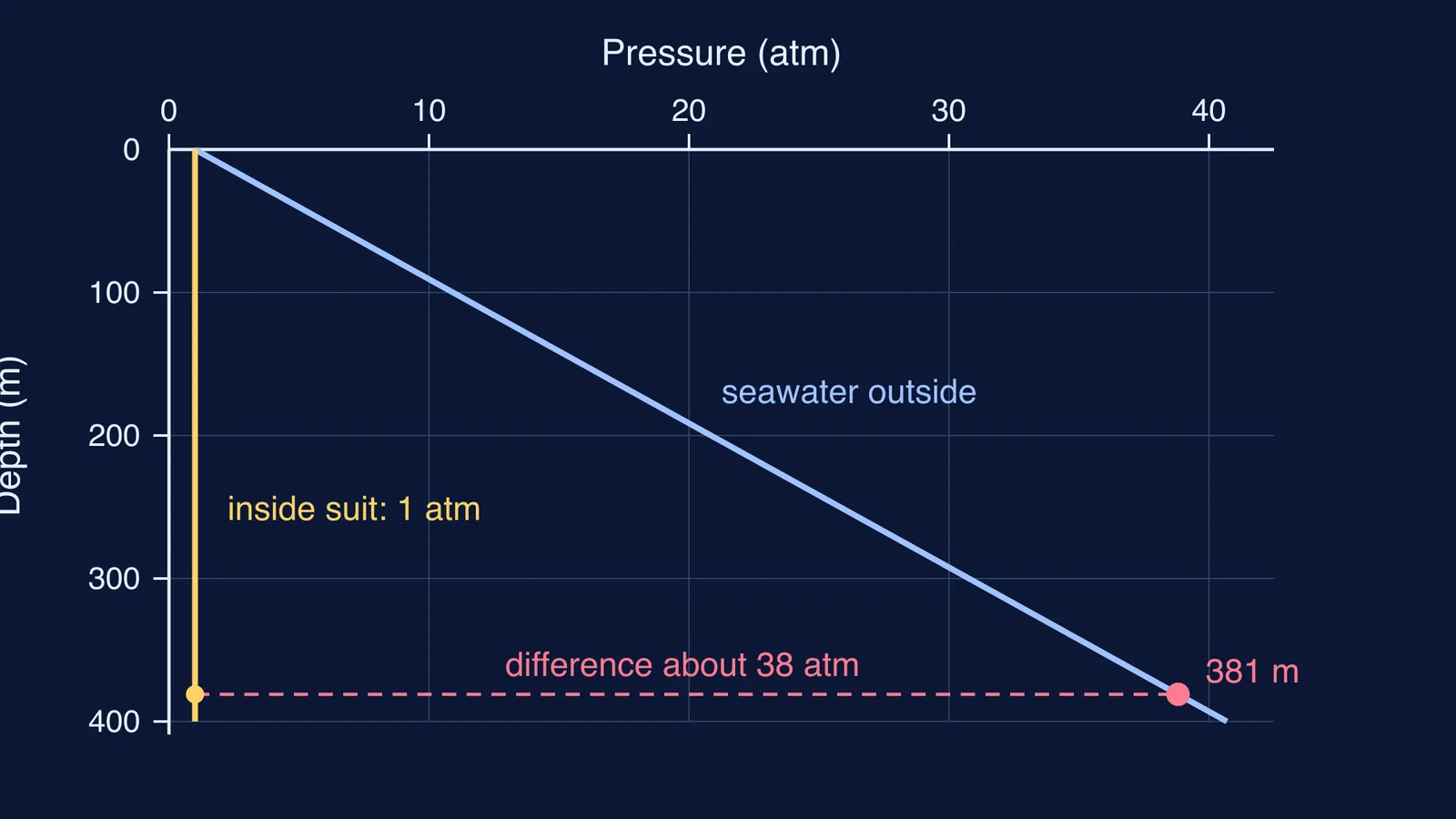
Pressure from the water above her: ρgh = 1025 × 9.81 × 381 ≈ 3,831,000 Pa, or about 3.83 MPa.
In atmospheres: 3,831,000 ÷ 101,325 ≈ 37.8 atm. This is the gauge pressure.
Add the 1 atm of air sitting on the sea: about 38.8 atm absolute.
Now check it with NOAA Ocean Service, which says pressure rises by one atmosphere for every 10.06 metres of seawater. 381 ÷ 10.06 ≈ 37.9 atm, which agrees with step 3. Our explainer on why every 10 metres of water adds one atmosphere shows where that rule comes from.
Inside, the suit stayed at 1 atm. So its shell carried a difference of about 37.8 atm: roughly 3.8 million newtons on every square metre. On a palm-sized patch of 10 cm by 10 cm (0.01 m²), that is about 38,000 N, the weight of nearly 4 tonnes.
If the two kinds of pressure still blur together, our post on gauge pressure vs absolute pressure untangles them.
How can you solve depth-pressure problems without slipping?
Run through this checklist before you write the answer.
Put depth in metres and density in kg/m³ before multiplying, so the answer comes out in pascals.
Decide whether the question wants gauge or absolute pressure, and say which one you gave.
Sanity-check with the rule of about 1 atm per 10 metres of seawater (NOAA Ocean Service).
Remember that pressure at a point acts in every direction, so the water pushes on the sides of the suit as well as its top.
To get a force, multiply the pressure difference by the area it acts on.
Try one yourself: what gauge pressure would a JIM suit face at its 460-metre rating (JIM suit, Wikipedia)? Using the same density, ρgh = 1025 × 9.81 × 460 ≈ 4,625,000 Pa, or about 45.6 atm.
If the step from ρgh to a force on a suit wall is where your working goes wrong, the Fermi Problem Library has worked problems with a step-by-step solver that explains the reasoning rather than printing an answer. And if depth and pressure are hard to picture, the Fermi Simulation Lab has interactive simulations for the ideas that are easier to see than to read.
Next time you see ρgh in a textbook, picture a biologist on the seabed, studying glowing coral while nearly 39 atmospheres pressed on her suit.