On this page
Search for "the first chemist" and one name comes up again and again: Tapputi, a perfume maker in ancient Assyria whose recipe was described as "fit for a king". Some versions of her story are true. Some are later additions. Here is what the clay tablet actually says, and how you can tell the difference.
Who was Tapputi, and what does the tablet say?
The tablet that names Tapputi is known as KAR 220 (museum number VAT 10165), and it is kept at the Vorderasiatisches Museum in Berlin, according to historian Eduardo A. Escobar's chapter in the UCL Press sourcebook Women in the History of Science. It was dug up in the city of Assur, in what is now northern Iraq, and dates to about 1230 BCE, in the Middle Assyrian period (Escobar 2023, PDF).
The tablet is a recipe for processing aromatic cane oil. The last lines, called the colophon, describe it as a recipe for about 20 litres (2 seahs) of cane oil "fit for a king, according to the mouth of Tapputi-belet-ekallim, the perfume-maker" (Escobar 2023). "According to the mouth" means the scribes credited the knowledge to her.
Escobar notes that women in Assyrian perfumery held the professional title muraqqītu, "experts in aromatics", and that six perfume recipes are known from Assur. She was a named expert in a skilled trade.
Was Tapputi really the first chemist?
Escobar opens his chapter by noting that she has been "hailed as history's first chemist" (Escobar 2023). The label sticks because her tablet records a careful method: measured ingredients, heating, overnight steeping and repeated filtering.
But Escobar's own study questions for students ask whether the recipe can be called "chemistry", and what the drawbacks are of calling her "history's first chemist". Chemistry as a science with atoms and equations came thousands of years later. "One of the earliest recorded chemists" is a fairer phrase if you mean someone whose careful, practical chemical work was written down under her name.
Why do many articles say Babylon? Early research on these texts was framed as Babylonian. Martin Levey's 1954 paper in the Journal of Chemical Education was titled "Perfumery in ancient Babylonia", and his 1956 paper in Osiris was "Babylonian Chemistry: A Study of Arabic and Second Millenium B.C. Perfumery". The tablet itself comes from Assur, the Assyrian capital.
Did Tapputi use a still or distillation?
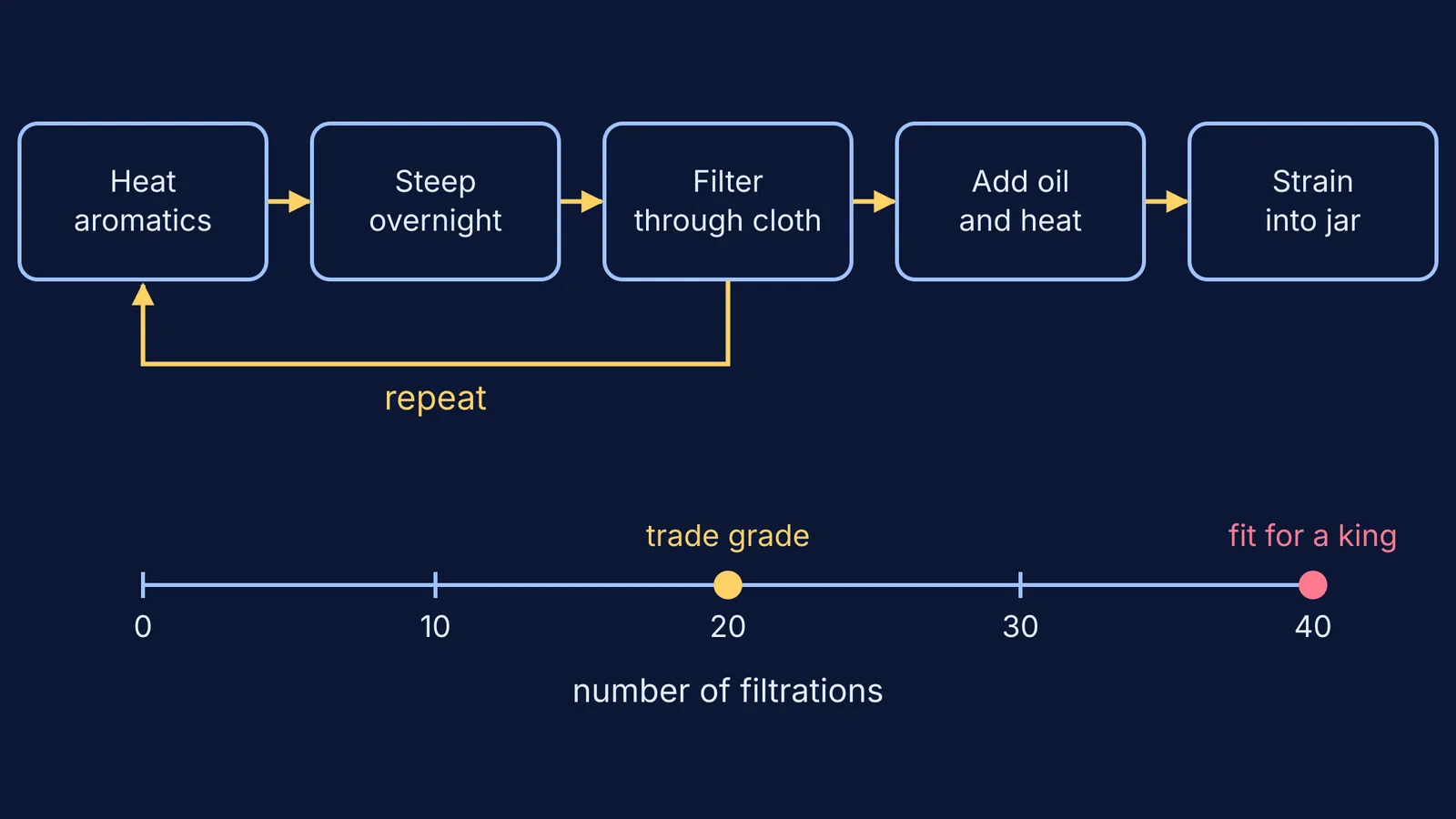
Many popular accounts, including Wikipedia's article on Tapputi, say her ingredients were distilled, and some even credit her with an early still. The translated recipe does not say that. In Escobar's translation, the steps are heating aromatics in water in a large vat, leaving the mixture to steep overnight, filtering it through a cloth at dawn, adding oil and heating again, and finally straining it into a jar (Escobar 2023).
Escobar sums up the Assur recipes as heat extraction, maceration (soaking plant material for a long time) and refinement by filtration. He adds that Assyrian perfumes were graded by refinement: after 20 filtrations you had a grade fit for trade, and the finest oil, "fit for a king", took weeks and 40 filtrations (Escobar 2023).
If you want to compare her methods with distillation, our posts on the principle of steam distillation and reflux versus distillation show what a still actually does.
How can you check a "first ever" claim yourself?
Here is a four-step check you can use for school projects or the next viral post.
Find the object. Is there a named tablet, manuscript or paper? For Tapputi: yes, KAR 220.
Find a translation by a specialist. Here, Escobar's chapter, published by a university press.
Compare the claim with the text. "She was a perfume maker credited with a royal recipe" matches. "She invented the still" does not appear.
Check the word "first". First known, or first ever? Records are lost all the time, so "one of the earliest recorded" is usually the honest phrase.
The same check works for other early figures. Our piece on what we really know about Jabir ibn Hayyan applies it to early alchemy.
What can a chemistry student take from Tapputi's recipe?
Read the recipe as a lab procedure and you will spot ideas from your own syllabus:
Solvent extraction: hot water and oil pull scent molecules out of plant material.
Time as a variable: steeping overnight gives the solvent time to work.
Filtration as purification: each pass through the cloth removes more solid particles.
Ratios: the recipe says its measurements are "to be apportioned according to the amount of water taken" (Escobar 2023).
If separation methods still feel like a list to memorise, the Fermi Concept Library gives each concept in chemistry its own lesson and its place in the map, so you can see how filtration, extraction and distillation connect.
Tapputi's tablet is a reminder that chemistry began as careful, repeated practice by skilled people, including women like her, long before it had equations.