On this page
Fermat's last theorem says that a^n + b^n = c^n has no solutions in positive whole numbers once n is bigger than 2. When it finally fell, the proof went through a guess made in Japan in the 1950s by Yutaka Taniyama and Goro Shimura, linking two parts of mathematics that seemed unrelated.
What is the Taniyama-Shimura conjecture?
According to the MacTutor biography of Yutaka Taniyama, Taniyama (1927-1958) posed a set of problems at the 1955 symposium on algebraic number theory in Tokyo and Nikko, and these became the basis of the conjecture. In MacTutor's words, it claims that "every elliptic curve defined over the rational field is a factor of the Jacobian of a modular function field."
Taniyama's first version was slightly incorrect, and he and Shimura worked to make it more rigorous until 1957, as the Wikipedia article on the modularity theorem records. André Weil later rediscovered it and in 1967 gave the first serious evidence that it might be true, which is why you will also see it called the Taniyama-Shimura-Weil conjecture. Taniyama died in 1958, aged 31; Shimura (1930-2019) later worked at Princeton University (MacTutor).
In plain words: for every elliptic curve there is a modular form whose coefficients record how many solutions the curve has modulo each prime.
What are elliptic curves and modular forms, with an example?
An elliptic curve here is an equation like y^2 + y = x^3 - x^2, with whole-number coefficients. A modular form is a highly symmetric function you can write as a power series in q.
The LMFDB page for the curve 11.a3 lists y^2 + y = x^3 - x^2 with conductor 11 and links it to the modular form q - 2q^2 - q^3 + 2q^4 + q^5 + 2q^6 - 2q^7 + ... + 4q^13 + ....
Here is the check you can do with a pencil:
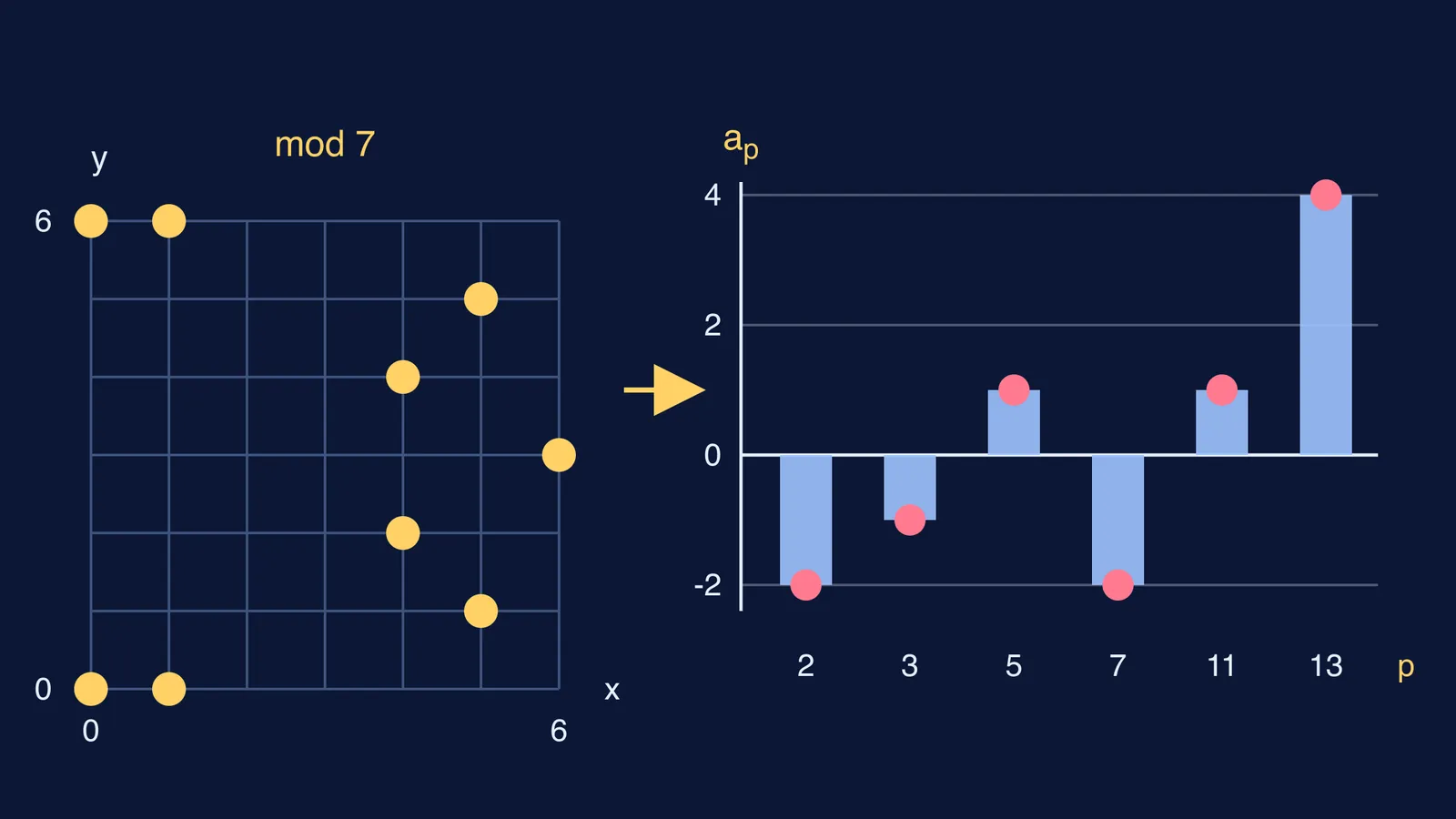
Pick a prime, say p = 7, and try every pair (x, y) from 0 to 6.
Keep pairs where y^2 + y and x^3 - x^2 leave the same remainder mod 7. There are 9: (0,0), (0,6), (1,0), (1,6), (4,2), (4,4), (5,1), (5,5) and (6,3).
Work out p minus the count: 7 - 9 = -2.
Look at the coefficient of q^7 in the modular form. It is -2.
The modularity theorem page uses the same rule in its example. We repeated it: mod 2 there are 4 solutions (2 - 4 = -2), mod 3 there are 4 (-1), mod 5 there are 4 (1), mod 11 there are 10 (1) and mod 13 there are 9 (4). Every value matches the q-expansion on LMFDB.
If remainders feel slippery, our post on finding remainders of large powers builds the skill, and the Fermi Concept Library gives each mathematics concept its own lesson and its place in the map.
How is the Taniyama-Shimura conjecture linked to Fermat's last theorem?
The link is a proof by contradiction, set out on the Wikipedia page on Wiles's proof:
Gerhard Frey suggested that a solution a^n + b^n = c^n would give an unusual elliptic curve, y^2 = x(x - a^n)(x + b^n).
Jean-Pierre Serre pinned down what was missing, and in 1986 Ken Ribet proved that this Frey curve could not be modular. Ribet's paper appeared in Inventiones Mathematicae in 1990.
So if every semistable curve, Frey's kind, is modular, no Fermat solution can exist.
Who proved the Taniyama-Shimura conjecture?
Andrew Wiles heard of Ribet's result in 1986 and began working on the conjecture in secret; the project took more than seven years of his research time. He announced a proof in Cambridge in June 1993. A gap was found, and after almost a year of work, partly with his former student Richard Taylor, Wiles found the fix in September 1994 (Wikipedia). The work was published in the Annals of Mathematics in 1995 as Wiles's Modular elliptic curves and Fermat's last theorem and Taylor and Wiles's Ring-theoretic properties of certain Hecke algebras.
Wiles proved only the semistable case, which was enough for Fermat. The full conjecture was proved by Christophe Breuil, Brian Conrad, Fred Diamond and Richard Taylor, whose 2001 paper in the Journal of the American Mathematical Society states: "We complete the proof that every elliptic curve over the rational numbers is modular." It is now called the modularity theorem, and Wiles received the 2016 Abel Prize for this proof.
For those years in detail, read Andrew Wiles and the proof, step by step; for where it began, see Pierre de Fermat and his last theorem.
What can a student take from this?
-Compute small cases by hand before you trust a pattern, as you did mod 7.
Write guesses down precisely. Taniyama's first version was slightly wrong and still changed mathematics.
When stuck, restate the problem in another language, as Fermat's equation became a question about curves.
When your own small-case checks go wrong, the Fermi Problem Library has a step-by-step solver that explains the reasoning rather than printing an answer.